Training for patients with alpha-1 antitrypsin deficiency
Author
Michaela Frisch, as published in Alpha1 Journal 2/2015
In addition to medication adjustment and substitution therapy, a regular training The most important component of therapy in the treatment of patients with alpha-1 antitrypsin deficiency. This is confirmed by current studies.
Many terms from training theory – reaction speed, anaerobic or aerobic endurance, strength endurance, coordination, explosive or speed strength, hyperflexibility, action speed, reactive strength, speed endurance, maximum strength – are merely theoretical concepts. These are not helpful in overcoming inertia and motivating exercise. The following reasons are far more relevant to everyday life and explain why patients with alpha-1 antitrypsin deficiency should exercise despite shortness of breath and lack of motivation:
- increases lung volume
- improves breathing
- improves oxygen uptake and transport
- slows down the brain aging process (dementia protection)
- Increases insulin sensitivity (reduces type 2 diabetes)
- trains coordination (fall prevention and prophylaxis)
- Increases bone density (osteoporosis prophylaxis)
- lowers blood pressure
- promotes physical well-being
- strengthens the immune system
- offers social contacts
- improves quality of life
- increases mobility
Don't forget performance-limiting factors.
However, factors that limit performance should not be overlooked. The Posturomed has long been established in proprioceptive (deep sensory) training for respiratory patients. Here, under the guidance of therapists, the strain is trained in combination with breathing using intrinsic vibrations and equipment. The "Galileo" device is being used more and more frequently for respiratory patients – and therefore also for those with alpha syndrome. Recent studies confirm this. With Galileo, the training frequency determines the number of stretch reflexes per second. This therapy offers increased muscle work with a reduced cardiovascular response. This stimulates metabolism and blood circulation. However, those suffering from diabetes should be aware of the risk of hypoglycemia. Depending on the training frequency setting, Galileo training serves to relax/detonize muscles, improve muscle function/coordination, or increase muscle performance and strength.
The training goal determines the frequency.
It's important to note that the frequency is selected based on the training goal. However, Galileo training is only effective and leads to targeted performance improvements if the exercises are performed consciously and, above all, actively. New scientific findings also recommend training the respiratory muscles. Due to the significant weakness of the respiratory muscles (detected by PImax measurement during lung function testing and a defined training zone established by a physician), it initially seems contradictory to further train an already overworked respiratory system.
To further stress the muscles through additional training. However, due to the training baseline, an effect will only become noticeable after approximately 14 days of consistent and regular training.
The threshold load method is well suited for patients with alpha-1 antitrypsin deficiency.
For patients with chronic respiratory disease – specifically, those with alpha-1 antitrypsin deficiency – the threshold load method has proven ideal. A predefined and set threshold (30 % of the PImax value) creates negative pressure. As soon as this threshold is exceeded during inhalation, the valve releases, allowing air to flow in. However, proper instruction by a therapist during supervised sessions and correct execution of the training are crucial. Each training session consists of seven 2-minute intervals (with a maximum of 20-30 breaths per interval).
An important component: Ergometer training
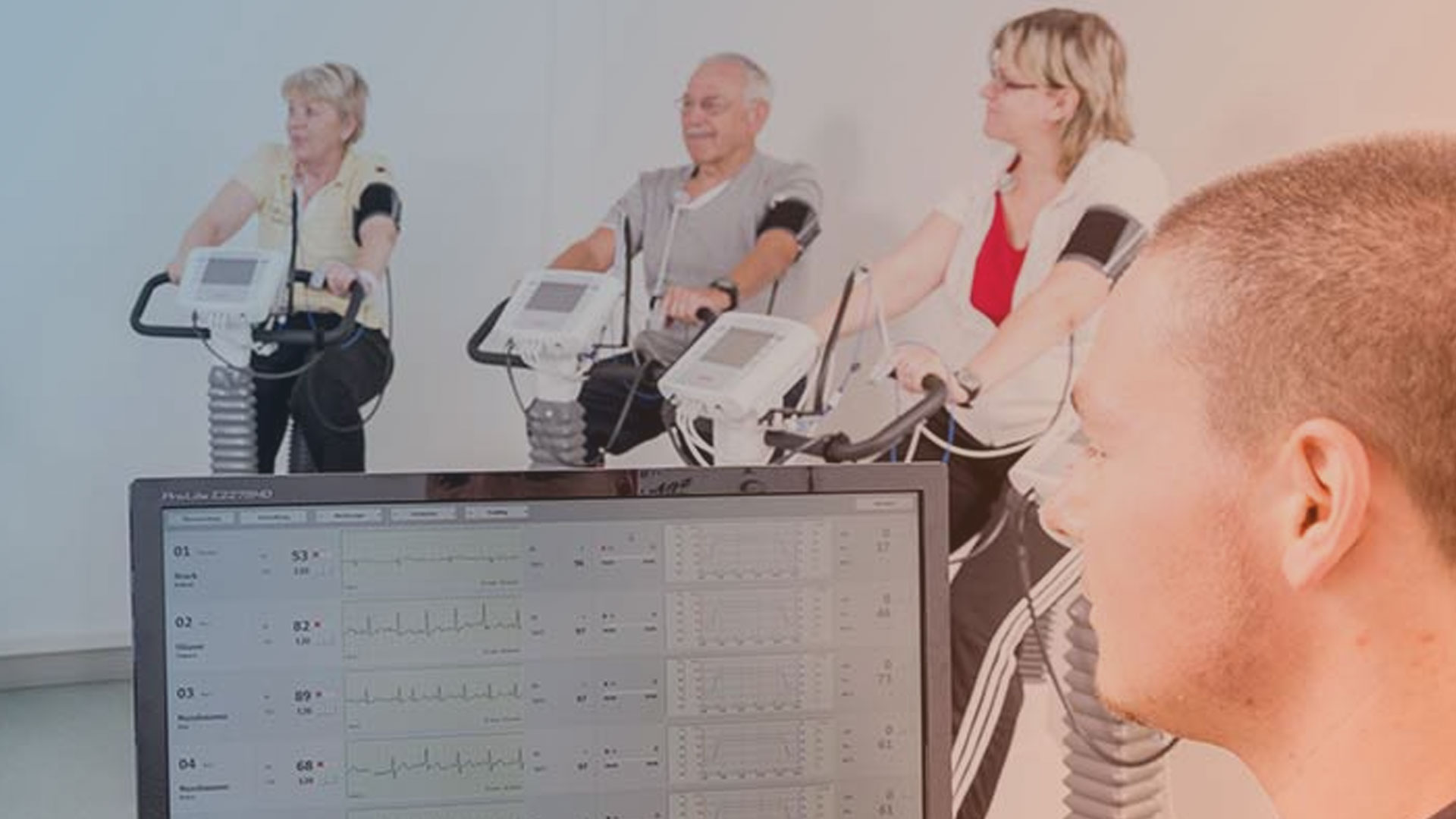
Ergometer training is also an important component of therapy – both as part of independent training on a home ergometer and as part of supervised and computer-controlled training during pulmonary rehabilitation. Here, the training can be used as
Interval training can be performed. This is particularly suitable for patients who need to be gradually reintroduced to physical exertion after a prolonged hospital stay. Constant training – in addition to heart rate-based or SO2-based training – is also possible with newer systems as part of rehabilitation. For medical training therapy (MTT) or as an extension of pulmonary rehabilitation, there are various prerequisites that are beneficial for an Alpha-1 patient:
- Individual settings for each patient
- (Mobile) control mirrors to prevent protective behavior or use of auxiliary respiratory muscles and to check upright posture
- Footrests to help maintain basic physical tension more easily
- Smaller weight increments are better for patients with severe respiratory illnesses.
- Additional weights allow for better adjustment to the actual performance level.
- Pre-tensioners eliminate the problem of a slack path.
- Training isolation: A one-sided isometric training program to reduce cardiovascular stress after a prolonged hospital stay and to gradually reintroduce physical exertion.
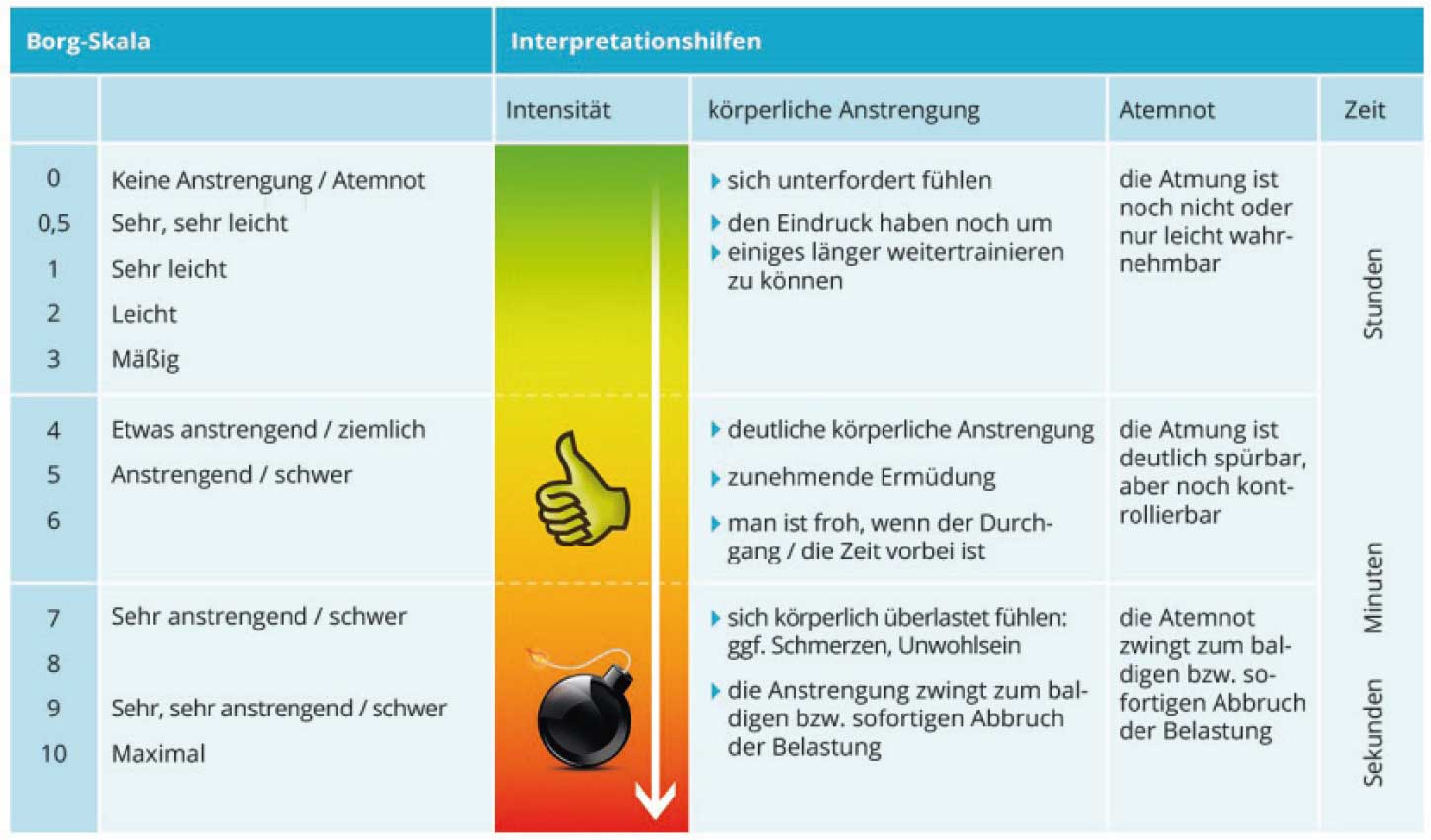
The Borg scale (see image) is always a suitable tool for training control across all types of training. The optimal training range is between 4 and 6. Training for everyday life is a primary therapeutic goal in the collaborative work between patients and therapists. This applies to both rehabilitation and pulmonary exercise programs. Training programs tailored to the individual's physical capacity are developed collaboratively, with the aim of improving daily life management. A realistic target is crucial and must be regularly adjusted. Integration and feasibility into daily life must also be considered to achieve consistent training.
Within the framework of training management, this means clarifying the patient's difficulties and problems in their daily life. The spatial conditions, personal preferences and expectations, as well as the patient's willingness to participate, must also be taken into account. This leads to the creation of an individually tailored training plan. This plan includes, among other things, practicing movement patterns that are difficult due to illness. Certain movements are adapted and broken down into individual movement components. The goal of the training is to gradually increase the initial speed of each exercise.
The Borg scale, ideally displayed at several points in the training room, allows for the assessment of training progress – starting with the warm-up phase and continuing through the subsequent build-up phase. This helps identify the optimal training zone for each individual. Performance is improved, and the intensity is gradually increased. The gradual increase in workload should be monitored by repeatedly recording the breathing rate (no more than 4 breaths in 10 seconds). This enables the correct selection of the exercise intensity. Prior to this, comprehensive instruction in the "pursed-lip" breathing technique and various breathing-facilitating body positions is essential.