




The liver – a true all-rounder

The liver is a true all-rounder and one of the most important organs in our body – it performs around 500 vital functions.
Particularly noteworthy: It possesses the ability to regenerate itself – for example, after consuming alcohol or certain medications.

The most important factor is how frequently we consume alcohol or medication, as both substances have a mildly toxic effect on the liver. While a single instance of excessive consumption isn't catastrophic – even though individual liver cells may die – these cells can usually regenerate.

Nevertheless, it's important to remember that alcohol is generally harmful to the liver. Women are also more sensitive to alcohol than men and should therefore pay particular attention to the amount they consume. In addition to alcohol, sugary drinks also put a strain on the liver. Sweetened beverages and fruit juices contain many calories, which the liver converts into fat – leading to fat deposits that can impair liver function.

The recommendation is therefore to avoid sugary drinks, fruit juices, and alcohol as much as possible. Water, unsweetened herbal tea, and coffee, on the other hand, are perfectly acceptable. Two to three cups of coffee a day can even have a positive effect, especially for patients with liver disease.

And what does a liver-friendly diet look like? Basically, you can eat anything – moderation is key. Highly processed foods like hamburgers or fries should be the exception. Vegetables, legumes, whole grains, and healthy fats are recommended. Olive oil and omega-3 fatty acids – such as those found in salmon – are particularly beneficial for the liver. And last but not least, regular exercise also contributes to keeping the liver healthy.

Alpha-1 antitrypsin deficiency and the liver:

Alpha-1 antitrypsin is primarily produced in the liver. Due to the genetic defect, misfolding can occur, preventing the altered protein from being completely eliminated from the liver and causing it to clump together.

But how can one detect liver remodeling in time?

It is difficult for patients to notice the onset of liver remodeling (liver fibrosis) because "by the time you feel your liver, it's often already too late." Therefore, it is important to have regular blood tests and to undergo a liver stiffness measurement (LSM) using a specialized ultrasound device (FibroScan®). Elevated levels of the enzymes transaminase GPT (ALT, ALAT) and GOT (AST, ASAT), gamma-GT, or alkaline phosphatase can indicate liver or biliary tract diseases.

A combination of GOT (AST, ASAT) and platelet count can also provide good indications of the presence of liver fibrosis by calculating a so-called APRI index.

Initial assessment: APRI index

The AST/platelet ratio index (APRI score) is particularly well-suited for an initial assessment of liver health, as both required values are easy to determine and anyone can perform the calculation themselves using an online calculator. Numerous studies have shown that approximately 20-251 TP3T individuals with Pi*ZZ genetic predisposition exhibit at least moderate liver fibrosis. The risk of advanced fibrosis is approximately 20 times higher compared to the general population, and about 2 times higher in Pi*MZ individuals. While the genetically determined risk is low in Pi*MZ individuals, it increases rapidly in the presence of additional liver stressors such as obesity, excessive alcohol consumption, or diabetes.

How do I calculate the APRI index?

The AST/platelet ratio index (APRI scores) is determined using routine blood tests.

You can find the Apri calculator here, for example:

APRI score (bioscientia.info))

What does my result mean?

Both the initial LSM and APRI values were very good at predicting the development of future problems:

a. If your liver stiffness is 7.1 kPa or higher

and/or

b. Your APRI score is at least 0.5,

You should discuss this with your doctor.

A notice: An APRI >0.5 is measured in PiZZ subjects with <20% and indicates the presence of liver scarring, which should be investigated further. Our goal is to detect the development of liver fibrosis early on, rather than waiting until cirrhosis develops.

As mentioned in the following letter, the University of Aachen also offers you immediate advice.

Current information on alpha-1 antitrypsin deficiency and the liver:

Referat Frau Dr. Malin Fromme,
Liver disease – thinking outside the box

Liver disease – thinking outside the box

September 18, 2025
Schematische Darstellung einer Leber und eines DNA-Strangs
New study on liver involvement in alpha1 antitrypsin deficiency published

New study on liver involvement in alpha1 antitrypsin deficiency published

November 9, 2024
Dr. Judith Smith beim Patiententag in Aachen.
Successful liver study: Insights from Aachen

Successful liver study: Insights from Aachen

July 18, 2024
EASL – Studio S6E6 – Alpha-1-antitrypsin deficiency (AATD): A poster child for genetic therapy

EASL – Studio S6E6 – Alpha-1-antitrypsin deficiency (AATD): A poster child for genetic therapy

June 3, 2024
Dr. Malin Fromme
Dr. Malin Fromme: Alpha-1 Antitrypsin Deficiency: Understanding Liver Stress and Pulmonary Emphysema

Dr. Malin Fromme: Alpha-1 Antitrypsin Deficiency: Understanding Liver Stress and Pulmonary Emphysema

June 2, 2024
Univ.-Prof. Pavel Strnad, Aachen: Alpha-1 Antitrypsin Deficiency: How the Liver Was Rediscovered

Univ.-Prof. Pavel Strnad, Aachen: Alpha-1 Antitrypsin Deficiency: How the Liver Was Rediscovered

July 9, 2023

Alpha-1 and the liver: Functions of the liver

The liver is the central hub of human metabolism. It processes nutrients from the intestines, namely proteins, fats, and carbohydrates. From these substances, new substances are produced for the body. The liver is also important for detoxifying medications and other foreign substances.

Alpha1 and the liver – I'm just a carrier, right?

A very important finding of research in recent years is that carriers of the gene defect (PiMZ) should also pay attention to their liver health. If the mutation is present on even one copy of the gene (heterozygous form, PiMZ genotype), a increased risk of liver disease, provided that other factors such as excessive alcohol consumption, obesity or diabetes are also present.

Symptoms of liver dysfunction

Unlike other organs whose dysfunction is easily noticeable, the liver is a "workhorse that doesn't complain." Symptoms originating from the liver are often nonspecific. Fatigue, malaise, or mild abdominal pressure may occur. In most cases, however, liver dysfunction remains completely undetected for a long time. Therefore, a doctor is rarely consulted, or only at a late stage, which often results in liver problems being diagnosed late. Furthermore, in the case of alpha-1 antitrypsin deficiency, there is often little awareness that liver damage can also frequently occur.

The liver is incredibly resilient to acute damage. However, if the liver is repeatedly subjected to damage, chronic remodeling of the liver tissue can develop over time. This involves the loss of liver cells and the formation of connective tissue with scarring in the liver. Over years and decades, this leads to scarring of the liver (liver fibrosis) and ultimately to cirrhosis, in which... Liver transplantation becomes necessary.
Our YouTube explainer video on Alpha-1 Antitrypsin Deficiency and the Liver

Play Video

Play explainer video

Our virtual self-help group 'Liver'‚

To the self-help group

Causes of liver cirrhosis

Numerous chronic liver stressors, such as the viral infections hepatitis B and C, excessive alcohol consumption, or the use of certain medications (e.g., the painkiller paracetamol), can lead to liver damage and even cirrhosis. Other triggers include obesity and/or poor diet, especially when combined with diabetes mellitus. Furthermore, various autoimmune diseases can lead to cirrhosis through a chronic inflammatory process.

In alpha-1 antitrypsin deficiency, the development of chronic liver damage, progressing to cirrhosis and liver cancer, is unfortunately a fairly common complication – up to 501 TP3T (!) of all adult alpha-1 patients develop relevant liver damage., regardless of their genotype! This means that even heterozygous individuals (carriers) carry this risk. That's why it's so important for us Alphas to have regular liver checkups.

Liver involvement in alpha-1 antitrypsin deficiency

In healthy individuals, the alpha-1 antitrypsin molecule is produced in liver cells and released into the bloodstream. In alpha-1 antitrypsin deficiency, an altered protein is produced. This protein essentially becomes trapped in the liver cells, accumulating and eventually damaging the tissue. This can therefore be described as a "protein blockage" in the liver. The situation in the liver is thus quite different from that in the lungs, which also suffer from a deficiency of alpha-1 antitrypsin. Liver damage is the second most common cause of reduced quality of life and life expectancy in alpha-1 antitrypsin deficiency.

Two age groups are particularly affected by liver disease in alpha-1 antitrypsin deficiency: infants and children, and adults over 40. Alpha-1 antitrypsin deficiency is the most common inherited disorder leading to liver disease in children. A very small percentage of children with homozygous AAT deficiency (2-3%) develop cirrhosis so early that they require a liver transplant in their first few years of life.

Liver problems are relatively rare in adolescents and young adults with alpha-1 antitrypsin deficiency. However, after the age of 40, up to 501 TP3T of patients with severe alpha-1 antitrypsin deficiency develop liver damage, with patients with a homozygous PiZZ genotype being particularly affected. This is also associated with an increased risk of liver cancer, even when liver function tests are still within the normal range. Due to the significantly increased risk of developing liver cancer, regular screening examinations should be performed, for example, using liver ultrasound or measuring liver stiffness (see below).

Specialized liver examinations in Germany

Questions about the Europe-wide initiative can be answered by the coordinating study center in Aachen (Priv.-Doz. Dr. Pavel Strnad).
– at 0241-8036606 or alpha1-leber@ukaachen.de.

Free liver examinations are offered throughout the year at several locations in Germany. These include patient days, support group meetings, and our annual information day. Further information can be found in our events calendar or by contacting our team in Aachen.

Further information

On the website of the German Liver Foundation (Deutsche Leberhilfe e.V.), you will also find an overview of clinics and specialized practices for liver diseases that are certified as specialized hepatology practices by the Federal Association of Practicing Gastroenterologists of Germany (Bundesverband Niedergelassener Gastroenterologen Deutschland e.V. - bng eV). It is possible to filter for the disease alpha-1 antitrypsin deficiency.


To the clinics

Symptoms of liver cirrhosis

Liver cirrhosis is the end stage of a chronic liver disease that usually develops gradually over years. In the early stages, the progression of cirrhosis can sometimes be reversed, but in the late stages, this is no longer possible, and complications increase. By the time signs of cirrhosis appear, large portions of the liver tissue have already been affected. These are therefore late signs of the disease. They include ascites (fluid accumulation in the abdomen) and jaundice (yellowing of the eyes and skin). Other serious complications include life-threatening bleeding or the development of liver cancer. In the final stage, multiple organ failure can occur, in which case only a liver transplant can help.

Since the presence of so-called "decompensated liver cirrhosis," meaning late-stage liver cirrhosis with corresponding complications, is associated with a very serious prognosis, it is crucial to detect the underlying liver disease early and thereby prevent the development of this condition. In cases of already decompensated liver cirrhosis, close medical monitoring helps to prevent further complications and thus improve quality of life and life expectancy. Blood tests help a specialist to detect liver cirrhosis and classify it into severity levels. However, these changes represent late signs of the disease and are therefore not suitable for the early diagnosis of a liver problem.

Early detection of liver disease

Early detection of liver disease is crucial. Only then can the development of the numerous complications of chronic liver disease be effectively prevented. As previously described, the insidious aspect is that liver disease usually causes no subjective symptoms. Even with standard methods, it is only possible to assess liver remodeling to a limited extent.

Standard liver diagnostic procedures include blood tests to measure liver enzymes and a liver ultrasound. Blood test results often rise if the liver has recently been stressed, for example, after heavy alcohol consumption or taking medications that can damage the liver. These values often return to normal just as quickly. Consequently, the long-term condition of the liver cannot be assessed, or can only be assessed to a limited extent, using these methods. A liver ultrasound can often only detect chronic damage that has led to changes in the liver or space-occupying lesions (e.g., liver cancer). Minor liver damage is often not visible on ultrasound.

Precise results could be obtained by examining liver tissue under a microscope. However, this requires a small tissue sample from the liver (a so-called liver biopsy). Therefore, this method is only of limited use for long-term monitoring.

For several years now, various new measuring devices have been available for determining liver stiffness. A special ultrasound is used to measure how stiff the liver is, which correlates with the degree of scarring. The examination is similar to a standard ultrasound scan and is virtually risk-free. The doctor takes the measurement on the right side between the lower ribs; the patient feels a slight throbbing at the tip of the probe.

For various diseases, intensive research has established threshold values for when liver fibrosis or cirrhosis is present. This allows some patients to avoid a liver biopsy. However, in the case of alpha-1 antitrypsin deficiency, liver stiffness has not yet been systematically investigated, which is why there are currently no established threshold values for this condition. The research group led by Aachen University Hospital is currently working to change this, enabling early diagnosis and monitoring of disease progression (see below).

Study on liver involvement in alpha-1 antitrypsin deficiency

Since 2015, a Europe-wide initiative has been underway to systematically investigate liver involvement in alpha-1 antitrypsin deficiency. This multicenter study group aims to systematically examine the neglected liver involvement in alpha-1 antitrypsin deficiency in order to develop clear recommendations for the early detection of liver involvement. The initiative also seeks to establish screening standards to minimize the number of complications experienced by patients with liver involvement.

This is an important initiative because liver involvement in alpha-1 antitrypsin deficiency is considered underestimated and undertreated. While lung involvement is relatively well understood and can be treated with alpha-1 antitrypsin, there is unfortunately little information to date on the extent of liver involvement. Only through intensified research efforts can diagnostic and therapeutic advances be made for the benefit of affected patients. Further information can be found in the study group's flyer. www.alpha1-leber.de

By participating in the study, every Alpha-1 antitrypsin patient can find out if and to what extent their liver is affected. Many patients can receive preliminary reassurance. Patients with liver disease will discuss which preventative measures are advisable. They will also be informed about factors that can burden the liver and ultimately lead to liver disease. A "liver-healthy lifestyle" aims to prevent the complications of liver disease associated with Alpha-1 antitrypsin deficiency.

Through a questionnaire and blood test, the researchers also want to investigate whether other liver diseases are present. The simultaneous presence of alpha-1 antitrypsin deficiency (any genotype) and another liver disease likely leads to more severe liver damage. Treating the other liver disease would therefore probably inhibit the progression of the liver damage.

In parallel with the studies on patients, the researchers are using an animal model of alpha-1 antitrypsin deficiency to search for specific stress factors. This should advance the development of a specific liver therapy in the future.

Video about Fibroscan

Play Video

Play explainer video

Alpha-1 and the liver – deeper insights and possible outlooks

A key objective of the speaker's research group is to support liver function through cell therapy. This involves a wide range of diseases. However, implementing these scientific ideas takes considerable time. Drug development typically takes 10-15 years, and cell therapy methods will certainly require even longer from the start of research to their introduction into clinical practice. The following discussion will illustrate what might be possible in the future.

Alpha-1 antitrypsin deficiency as a serpinopathy

A wide variety of proteins circulate in the blood. Around 10 % proteins belong to the serpins (serine protease inhibitors). One of the more than 40 members of this family is alpha-1-antitrypsin (AAT). It inhibits proteases, including the serine protease trypsin. When serpins have defects in their composition, they precipitate and accumulate in cells as inclusion bodies, which cannot be expelled from the cells and eventually destroy them. In nerve cells, for example, the deposition of neuroserpin leads to a form of dementia. Another problem with defective serpins is the loss of their normal function.

Genetic reading error

In alpha-1 antitrypsin deficiency (AAT deficiency), a genetic error in the DNA leads to incorrect protein folding and the resulting disease. The DNA consists of deoxyribonucleic acid (DNA), a helical molecule with two strands, the double helix. Pairs of bases are arranged like rungs on a ladder and hold the two parallel strands together. A single error in one of these bases causes the double helix to contain incorrect genetic information.

For the cell to produce proteins based on its genetic information, a messenger molecule (messenger RNA) transmits the information from the gene to the "protein factory." Here, in the endoplasmic reticulum, AAT is produced. It is then packaged and transported out of the cell. In the case of the Z allele, the underlying problem is that at position 342 of the chain, the amino acid lysine is incorporated instead of the usual glutamate. Due to this genetic error, the AAT molecule is assembled incorrectly; its folding and spatial arrangement are abnormal. Consequently, the packaging is also incorrect. The molecule cannot leave the cell normally and cannot enter the bloodstream.

Normal and pathological liver structure

As a representative example of the human liver, the microscopic structure of a mouse liver can be examined. Under the microscope, researchers observe that a specific type of contact point connects the liver cells around the tiny blood vessels belonging to the liver's portal vein system. This likely creates a barrier against unwanted substances transported to the liver via the portal vein, primarily from the intestines. This barrier of specialized cell contacts could keep toxins or pathogens away from the liver.

In AAT deficiency, this regular network of tissue surrounding the portal vein branches is not present to the normal extent. The protective function of the barrier is lacking. Instead, the cells are filled with deposits of defective AAT. This makes the liver more vulnerable to unwanted substances or bacteria from the intestines.

The liver actually has a very large functional reserve. It can compensate for up to 70% loss of its tissue if the remaining 30% of liver tissue is healthy. However, if more and more cells become overloaded with AAT, connective tissue that does not serve a normal function will increasingly form over time.

Liver transplantation in alpha-1 antitrypsin deficiency

When the liver of patients with AAT deficiency is so severely damaged that it can no longer maintain its normal function, a liver transplant is the only option. In the United Kingdom, 3.5% of all liver transplants in children and 1.1% in adults are performed on patients with AAT deficiency. In Germany, the number of annual liver transplants has been steadily declining since 2010. There is a shortage of donor organs. Only two-thirds of patients on the waiting list ultimately receive a transplant.

Cell therapy as a possible way out

Researchers have demonstrated in recent years that only 3-5 % cells of the actual liver cell mass are required for adequate function. If it were possible to introduce enough functional cells into the existing liver, it would not be necessary to replace the entire organ with a transplant.

Exciting new animal experiments show that liver function can be supported by transplanting liver cells. After researchers transplanted liver cells from a donor rat to a diseased recipient rat, the cells settled around the small blood vessels of the portal vein system and functioned normally. If enough cells could be transplanted, near-normal liver function could be achieved. Success in this regard was already achieved in 1998 in a patient with a very rare metabolic disorder, Crigler-Najjar syndrome.

Growing liver cells from stem cells

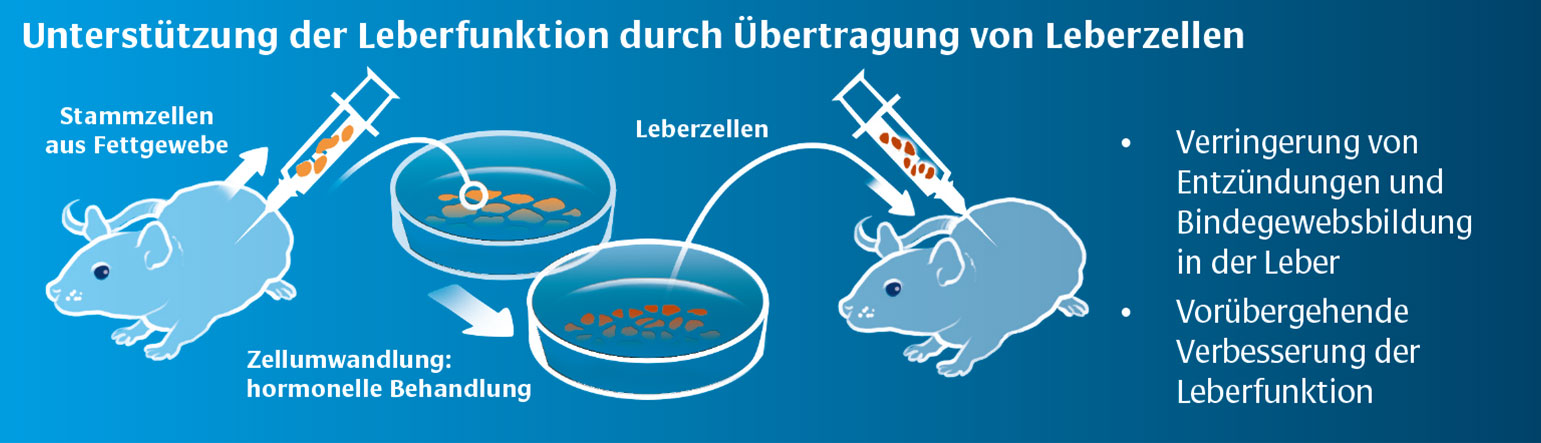
Scientists can grow liver cells in the laboratory. This involves extracting stem cells from the fatty tissue of adult mice, multiplying these stem cells in the lab, and inducing them to differentiate into liver cells. The entire process takes three to four weeks. The result is cells that can perform many of the functions of healthy, normal liver cells.

When cultured liver cells are transferred to diseased animals, a small proportion of these transplanted cells settle in the liver of the recipient mouse. Liver function improves as early as one week after transplantation. However, the effect is not permanent, so the procedure would need to be repeated after 7-8 weeks.

In mice exhibiting liver damage similar to the PiZZ defect, stem cell transplantation successfully reduced inflammation and connective tissue formation in the liver and temporarily improved liver function. Fewer cells died, and a greater proportion of cells, including transplanted ones, regenerated.

Researchers are also testing this type of stem cell therapy for other liver diseases, such as fatty liver. The transplantation of cultured liver cells could also be suitable for people with liver cancer who have to have large portions of their own liver removed.

YouTube Download list Newsletter contact