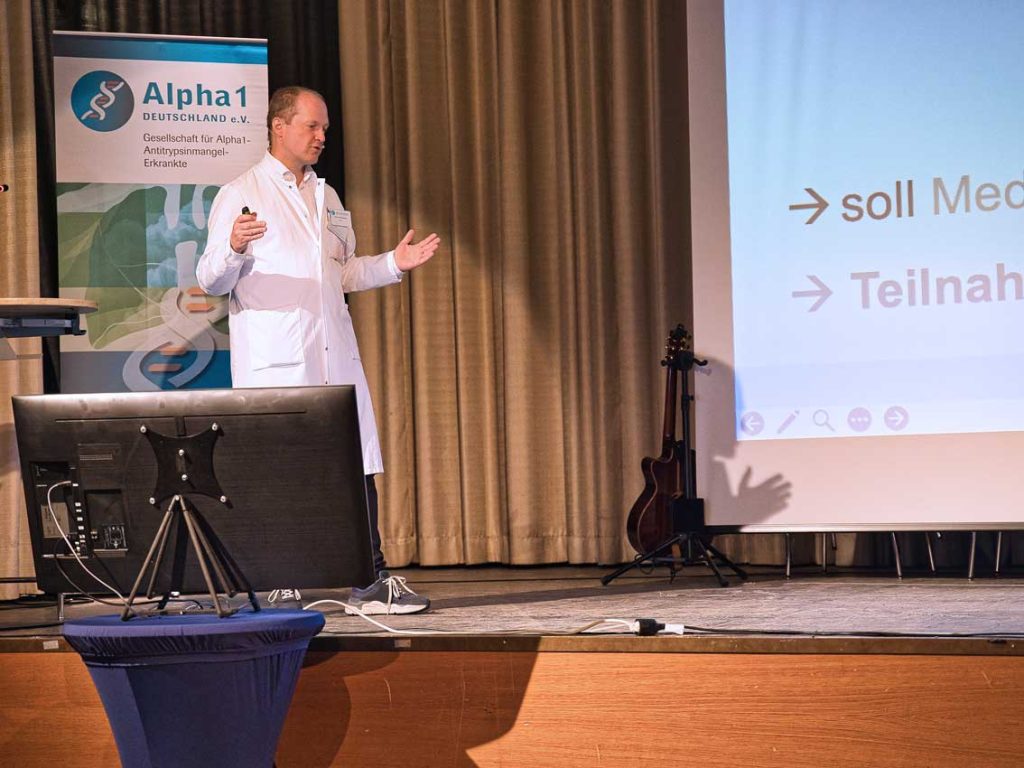
Author
Sabine Habicht, as appeared in Alpha1 Journal 1/2026.
Two diseases, one cause
Alpha-1 antitrypsin (AAT) is a protein primarily produced in the liver and released into the bloodstream. Among other things, alpha-1 antitrypsin protects elastic lung tissue from damage caused by the body's own enzymes, which are released during the body's defense against inflammation or by harmful substances such as cigarette smoke.
Alpha-1 antitrypsin deficiency is caused by a genetic defect. This often leads to a so-called protein folding disorder. Due to this misfolding, the defective AAT proteins largely remain "stuck" in the liver and accumulate. These deposits can damage liver tissue and lead to chronic inflammation. As a consequence, liver fibrosis (scarring) develops, and later, potentially, cirrhosis (liver shrinkage, the end stage of fibrosis).
In the lungs, the lack of the protective protein AAT can lead to pulmonary emphysema. Liver and lung diseases are two separate conditions that require individual treatment. It is important to understand that an alpha-1 antitrypsin deficiency does not necessarily always result in liver and/or lung disease.
Risk profile
The risk of liver disease in AATD depends primarily on the specific genotype. The most important genotypes are listed below:
Pi*ZZ: The most clinically relevant form. Affected individuals have a high risk of liver damage, regardless of additional risk factors. Approximately 10% of affected children and 20–33% of affected adults develop relevant liver changes.
Pi*SZ: This genotype has a significantly lower risk of liver fibrosis than Pi*ZZ, but probably somewhat higher than other heterozygous forms.
Pi:MZ (heterozygous carrier): For a long time, this genotype was considered harmless to the liver, but more recent studies show a moderately increased risk of liver fibrosis or cirrhosis.
The liver suffers silently
Most chronic liver diseases develop over many years, sometimes even decades, without being noticed. This is because liver diseases rarely cause specific symptoms. Symptoms such as fatigue and reduced performance can have many causes besides liver problems and are therefore usually not attributed to a possible liver disease.
Typical signs such as jaundice, ascites, itching, or vascular changes only appear when the liver disease is in its final stage, cirrhosis.
Therefore, regular liver testing is crucial for detecting fibrotic changes at an early stage – especially for Alpha-1 patients with a high risk profile.
Several options are available for this:
- Serum markers in the blood ALT (also known as GPT) and AST (also known as GOT) are the most important liver enzymes in the blood. Elevated levels indicate damaged liver cells; however, they only provide snapshots of liver function over a short period. ALT is concentrated almost exclusively in the liver and is therefore a highly liver-specific marker. AST is also found in the heart and skeletal muscle and is less specific. Combining ALT with other parameters, particularly platelet count, can provide clues to liver fibrosis. For this purpose, the FIB-4 or APRI scores are used.
- Fibroscan/ultrasound elastography These are imaging techniques that measure tissue elasticity and stiffness. In many cases, this procedure replaces an unpleasant liver biopsy. It should be noted, however, that values measured with different ultrasound-based devices are not directly comparable.
- MR elastography, An imaging technique that combines magnetic resonance imaging (MRI) with mechanical vibrations. It is used to precisely measure the stiffness or elasticity of tissue, but is not yet widely used in Germany.
- Liver biopsy – a tissue sample is taken of the liver, in order to examine it histologically. The procedure is usually performed under local anesthesia and ultrasound guidance.
Snapshots – Tears of the Liver
Serum markers in the blood are primarily determined by the general practitioner. Liver function tests can be a sensitive early indicator and are therefore sometimes referred to as the "tears of the liver." However, they only provide a snapshot in time, as liver function tests are influenced by a variety of factors, such as stress, medications, alcohol, and viral infections. Liver function tests should be performed on individuals with a Pi*ZZ type of liver disease at least every six months, and more frequently if abnormalities are detected.
Slightly elevated levels are not a cause for concern, but they do require monitoring. If liver enzyme levels remain elevated in repeated measurements and a significant increase is detectable, action is necessary.
The opportunity to undergo a Fibroscan, as offered at the annual Alpha1 information day, represents an optimal complement and also the best possible medical care within a study – especially since Fibroscans are not available nationwide and are not paid for by statutory health insurance companies.
Liver biopsies are only performed in specific cases, for example to rule out additional diseases.
Additional stress factors
Additional factors can place a heavy burden on the liver, even in genotypes like Pi*MZ, and significantly increase the risk of disease. These include:
- Excessive alcohol consumption
- Overweight (obesity)
- Diabetes mellitus
- Male and over 50 years old
Exercise, on the other hand, has a relieving effect. The liver particularly benefits slim people who exercise a lot.
Drug perspectives
The folded alpha-1 antitrypsin proteins that remain in the liver cause stress and chronic inflammation. A new, innovative drug, fazirsiran, is currently being investigated in a clinical trial.® Fazirsiran is an RNA interference (RNAi) therapeutic that specifically stops the production of the defective protein in the liver to prevent liver damage and fibrosis. The drug works at the RNA level, thus not affecting DNA, our genetic material. The approval study is already in the final phase of clinical trials. Initial results show that protein production was reduced by more than 80% of %. Liver enzyme and inflammation markers were also reduced. Side effects were similar to those experienced with a placebo, although the number of participants is currently still very small.® is currently the greatest hope for the treatment of liver disease in AATD.
Internationally, gene therapies at the DNA and RNA levels are also under development and could enable entirely new therapeutic approaches in the future. These approaches aim to reverse the genetic mutation. Although achieving 100 % corrections will likely not be possible, initial studies have already achieved 50 % corrections.