
Smoking cessation in alpha-1 antitrypsin deficiency
Below you will find the latest articles on the topic of 'smoking cessation':
Below you will find the latest articles on the topic of 'smoking cessation':
Quitting smoking is extremely important for all smokers, but it is particularly crucial for patients with smoking-related diseases such as coronary artery disease (CAD), peripheral artery disease (PAD), stroke, respiratory illnesses, or cancer, as it is often the most important and effective therapeutic measure to halt or significantly slow the progression of the disease. In theory, quitting smoking requires only the decision to stop and a change in behavior in previous smoking situations. In theory, however, in reality, it proves considerably more difficult for many smokers.
In Germany, inhaling tobacco smoke is the most significant preventable risk factor for numerous diseases and premature death. The over 8,000 chemical substances in tobacco smoke ultimately affect all organs of the body and lead to illnesses such as...
e.g. coronary heart disease (CHD), heart attacks, strokes, peripheral arterial disease (PAD), numerous cancers and especially respiratory diseases such as chronic obstructive pulmonary disease (COPD) or pulmonary emphysema.
Half of all smokers die from tobacco-related illnesses, and half of all smokers die before the age of 70. According to data from the German Federal Government, at least 127,000 people die annually in Germany from the effects of tobacco smoking, which equates to roughly 350 people every day. The three main causes of death are cardiovascular disease, lung disease, and cancer – suffering and death that could be avoided if people didn't start smoking in the first place, or at least quit very early.
In Germany, however, around 25% of adults still smoke, and in the 20-60 age group, the figure is even higher at around 33%. Smoking in Germany incurs considerable costs for the state and thus for every individual citizen each year: according to scientific calculations, direct healthcare expenditures amount to around €30 billion, and indirect costs, for example, due to lost productivity and work incapacity, amount to around €67 billion. These costs are offset by tax revenues of just under €15 billion.
Given all these facts and figures, it is certainly fair to ask why such a product is not much more strictly regulated, instead of being sold at supermarket checkouts or 24/7 at petrol stations?
Most smokers are dissatisfied with their own behavior; the majority actually want to quit or at least significantly reduce their intake. Nevertheless, only a few successfully quit each year (i.e., in the long term).
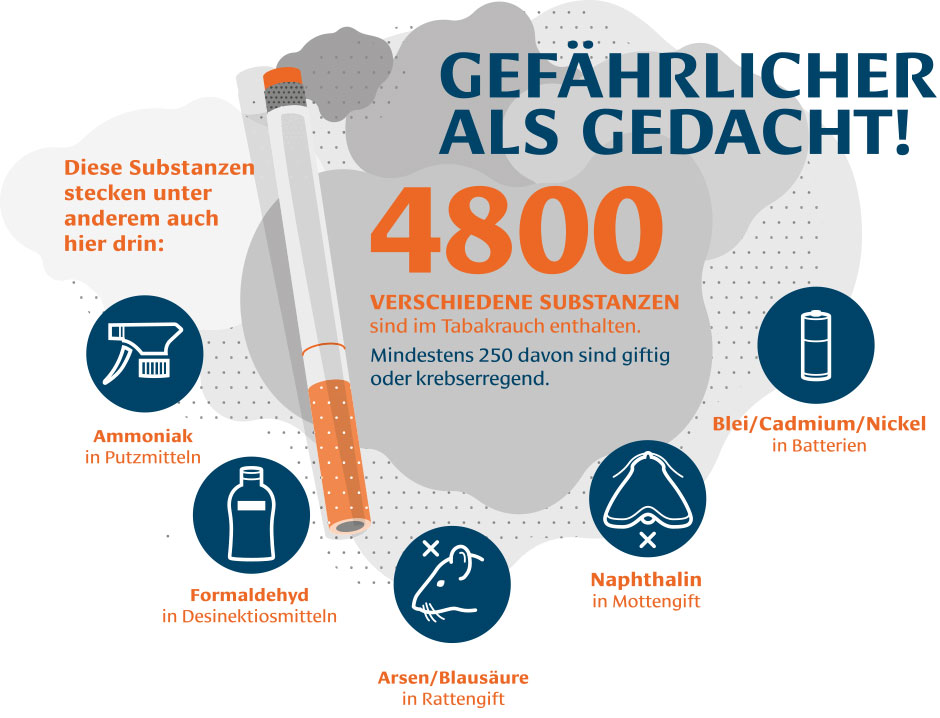
The reasons for this are manifold. Firstly, there is a firmly established habit that has been ingrained for years, often decades – and habits generally cannot simply be changed overnight. They have to be "unlearned," and "training" always involves more effort than "not training.".
On the other hand, cigarettes serve certain functions for smokers, such as stress reduction, increased concentration, structuring the day, structuring breaks, maintaining social contacts, overcoming boredom, and – paradoxically, although hardly any smoker has ever enjoyed their first cigarette – also "pleasure." Therefore, smokers are torn (ambivalent) when it comes to quitting: on the one hand, they know that smoking is bad for their health, but on the other hand, they have been accustomed to it for a long time, and smoking fulfills certain functions for them.
A third important point is that many smokers are addicted to tobacco smoke, especially to its main active ingredient, nicotine. Smokers constantly need to replenish their supply of this addictive substance, otherwise they experience withdrawal symptoms such as nervousness, difficulty concentrating, irritability, aggression, sleep disturbances, and above all, intense cravings. They are essentially using smoking to alleviate a negative state they wouldn't experience without it.
Spontaneous attempts to quit using the so-called New Year's Eve method ("I'll just quit then") without preparation or support therefore have a low long-term success rate of 3-7%. This means that the spontaneous decision to quit alone has a success rate of 93-97%.
In most cases, the relapse into previous smoking behavior occurs within a short time, usually only a few days or weeks.
Smoking in Germany continues to be viewed as a "lifestyle"—a behavior for or against which one can consciously choose—and is not recognized as an (addictive) illness. Consequently, therapeutic cessation measures for smokers are not financed by health insurance companies, unlike, for example, alcohol or prescription drug addiction, or addiction to illegal substances, even in cases of relapse.
Smokers participating in certified smoking cessation programs can only receive a "subsidy" from their health insurance under the so-called primary prevention clause (§ 20 SGB V). They must initially pay for the cessation program themselves and bear the majority of the costs. Costs for cessation medications, although highly effective and often necessary for many addicted smokers to begin quitting, are not covered by health insurance under current regulations (§ 34 SGB V). This clearly demonstrates unequal treatment of addictions; imagine if an alcoholic had to pay for their own withdrawal medication! While the German Bundestag passed an amendment in the summer of 2021 to address the issue of dependent or ill smokers, its implementation by the Federal Joint Committee (GBA) is expected to take several more years. During this time, smokers will continue to receive no financial support to quit.
Furthermore, Germany lags behind the rest of Europe in political tobacco control measures. Reasons for this include not only the aforementioned legal regulations, but also the free sale of tobacco products, the inconsistent enforcement of the advertising ban, the comparatively low taxation of tobacco products, the highly heterogeneous and, in many federal states, lax non-smoking laws, and so on.
Based on the facts and figures presented at the beginning, one would actually expect that all those involved – smokers, non-smokers, doctors, politicians and those responsible at health insurance companies – would do everything in their power to a) prevent people from starting to smoke (which usually happens in adolescence or young adulthood) and b) offer as many smokers as possible evidence- and guideline-based support for quitting smoking.
The BZgA website also offers the opportunity to register for the BZgA's free smoking cessation program. Participants receive support during their 21-day cessation process. About the starter package.
Apart from the decision to quit in the first place, we know of two core elements that smokers need when quitting: 1. behavioral therapy support and 2. if an addiction is present, also medication support.
Behavioral therapy aims for lasting behavioral change. Smokers need to learn to do something different in situations where they previously smoked. For example, instead of lighting up a cigarette 15 minutes after waking up, they could do squats, push-ups, a workout, a relaxation exercise, or yoga. Or they need to learn how to take non-smoking breaks, structuring their time without cigarettes, for example, by eating healthily, doing a breathing exercise, going for a walk, or sunbathing briefly on a park bench. The possibilities for new behaviors are virtually limitless, and everyone needs to find practical alternatives for each individual smoking situation.
The goal of medication-assisted quitting is to enable smokers to take the first step towards a smoke-free life by alleviating withdrawal symptoms in the initial weeks. These symptoms are primarily responsible for the high number of relapses within the first three months after quitting smoking. Three classes of medication are currently approved in Germany:
Nicotine replacement products are available without a prescription in pharmacies, while other medications require one. The best support for smokers is offered by cessation programs, which typically last several weeks, or individual therapy sessions over multiple appointments, usually combined with medication for smokers with addiction. Such programs show long-term success rates of 35–45%. However, the problem is that courses for smokers willing to quit are not readily available everywhere or at all times. Currently, due to the coronavirus pandemic, the number of in-person courses has practically dropped to zero.
In recent years, online smoking cessation programs and apps have increasingly offered an excellent alternative. It is important that the content of such digital programs is based on guideline recommendations; ideally, there are even studies that demonstrate the effectiveness of the respective program. One of the smoking cessation apps, the "Non-Smoking Heroes App," meets these criteria and has been available as a prescription-only app since July 2021. The costs for this app are fully covered by health insurance (https://diga.bfarm.de/de/verzeichnis).
Quitting smoking is possible for virtually every smoker with appropriate (guideline-based) support. Some need less support, while others need a great deal.
Germany is more of a developing country than an emerging country in terms of supporting smokers, but also in the area of tobacco control policy, and many framework conditions need to improve in the coming years in order to reduce the smoking rate and then, with a time lag, also the rates of illness and death.
About the author:
Dr. Alexander Rupp is a specialist in internal medicine and pulmonology, allergology, addiction medicine, and emergency medicine. He supports Alpha1 Deutschland e.V. as a scientific advisory board member for the area of 'lungs and smoking cessation'.


