Alpha-1 antitrypsin deficiency – what is it?

In the hereditary metabolic disorder alpha-1 antitrypsin deficiency (alpha-1 for short), affected individuals lack a protective protein in the lungs, the so-called alpha-1 antitrypsin. Due to this lack of protection, lung tissue deteriorates over the years. The metabolic disorder can manifest itself primarily through

  • Atemnot, initially only under stress – later also at rest
  • Husten, often initially in the early morning hours
  • AEjection, in many variations

Symptoms can become noticeable. Elevated liver enzyme levels can also be a sign of alpha-1 antitrypsin deficiency. It is not uncommon for affected individuals to first notice these symptoms as early as age 35. Although alpha-1 is considered a rare disease, experts estimate that there are up to 20,000* people in Germany alone who are homozygous for alpha-1 antitrypsin deficiency.

Because the main symptoms of alpha-1 antitrypsin deficiency also apply to other diseases such as COPD or asthma, the condition often goes undetected for a long time. However, the disease can be diagnosed or ruled out using simple testing methods. As a genetic defect, the disease is not curable, but various treatment options are available to slow its progression. In addition to bronchodilators, replacement therapy can also be helpful, in which the patient receives the missing alpha-1 antitrypsin via infusion.

*Taken from: International Journal of COPD 2017:12 561ff

Key symptoms: Alpha-1 antitrypsin deficiency is primarily noticeable through shortness of breath, persistent cough and expectoration.

Husten bei Alpha-1-Antitrypsin-Mangel

Our explanatory video on YouTube: What is an Alpha-1 Antitrypsin Deficiency?

The protective protein alpha-1-antitrypsin:

  • The protein alpha-1-antitrypsin is produced in liver cells. You can learn how the protein alpha-1-antitrypsin is normally produced in the body in [link to relevant section].
    the article  by Dipl. Biol. Martina Veith and Prof. Dr. Timm Greulich
  • From there it enters the bloodstream.
  • Although this protective protein can be found in all body tissues, it plays a particularly crucial role in the lungs.

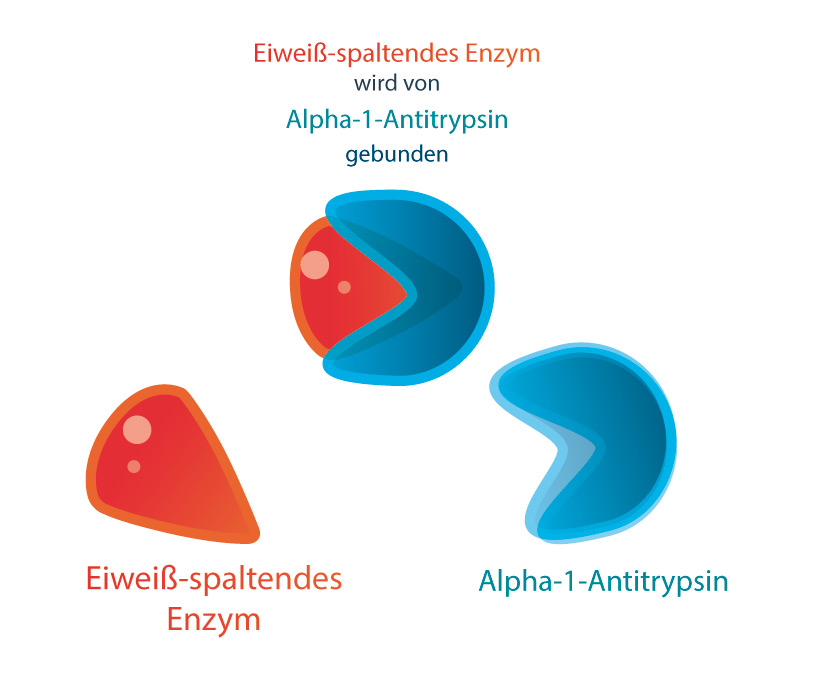
Because the lungs are frequently exposed to pathogens, tobacco smoke, and general air pollutants through the air we breathe, the body has special substances that can destroy such pathogens. These substances are protein-splitting enzymes (proteases). However, these enzymes cannot distinguish between foreign substances and the body's own tissue. Therefore, the body needs molecular "shields" that protect its own tissue from being broken down by these protein-splitting enzymes. Alpha-1 antitrypsin acts as such a shield for lung tissue, preventing damage to this vital respiratory organ. However, patients with alpha-1 antitrypsin deficiency lack this important protein. Over time, the lungs become increasingly damaged, leading to the development of pulmonary emphysema. In extreme cases, a lung transplant is considered the last resort.

As previously described, alpha-1 antitrypsin is produced in the liver. In AAT deficiency, the problem arises that the alpha-1 polymerizes (clumps together) in the liver and can no longer be, or only partially, eliminated. Thus, what is deficient in the lungs is simultaneously excessive in the liver. This is often particularly noticeable in infants and young children, manifesting as elevated liver enzymes and enlarged organs. There is a risk of liver cirrhosis for both children and adults with alpha-1 antitrypsin deficiency, and for both affected individuals (mostly PiZZ, PiSZ) and carriers (PiMZ)! Read more here.

Small protein, big effect: Alpha-1-antitrypsin in a model

Alpha-1-Antitrypsin

Causes of Alpha-1 Antitrypsin Deficiency

AATD is caused by mutations in the codominantly inherited SERPINA1 gene. Mutations in this gene can lead to abnormal deposition of the protein in the liver, ultimately resulting in low serum A1AT levels. It can also accumulate in the liver, leading to liver scarring. To date, more than 150 mutations in the SERPINA1 gene have been identified, with S and Z being the most common.

Origin and spread of the Z mutation

Due to the high prevalence of the Z mutation in parts of Scandinavia and on the opposite side of the Baltic Sea, in the Baltic states, the origin of the Z mutation is suspected to be in this region, having first appeared 2000–3000 years ago (see also hereIt was then spread in Europe by the Vikings during their raids and conquests along the coasts of the Baltic and North Seas, across the Atlantic to the Mediterranean, and also upstream of the rivers flowing into them, roughly between 800 and 1050 AD, which is why alpha-1 antitrypsin deficiency is also called Viking disease. A plausible hypothesis for its spread is that the resulting imbalance between alpha-1 antitrypsin and neutrophil elastase leads to better protection against bacterial infections in early childhood, and its disadvantage only becomes apparent at an age that very few people reached during the Viking Age.

Prevalence of alpha-1 antitrypsin deficiency

According to the latest research, even the Number of affected individuals The figures have been revised upwards. While it was assumed until 2016 that 8,000-12,000 people were affected by PiZZ, the numbers were increased to 19,000-20,000 at the beginning of 2017. Read more here.


Life expectancy with alpha-1 antitrypsin deficiency

There are figures circulating on the internet (e.g., an average life expectancy of 60-68 years) that we do not endorse. These figures originated at a time when Alpha-1 testing was only performed on severely affected individuals. Today, we know many people (including those severely affected by the deficiency) who live well into their 80s. We rarely see people who live healthy lives despite the deficiency, as they do not exhibit any noticeable symptoms, thus providing no reason for testing. It is important to understand that the disease has highly individual courses, making predictions neither possible nor advisable.

YouTube Download list Newsletter contact