For the lungs to absorb enough oxygen into the body, you need to breathe deeply enough. About three-quarters of this breathing work is normally done by the diaphragm. In emphysema, the problem is that the lungs are overinflated.
It can easily contain 1-2 liters of trapped air. During physical exertion, the situation worsens: breathing becomes increasingly shorter and incomplete; the chest cavity becomes increasingly inflated. In addition to the emphysema at rest, another 1-1.5 liters of air accumulate in the chest cavity – doctors call this dynamic hyperinflation. This pushes the diaphragm further and further downwards, impairing its function. Instead, the respiratory muscles, which are less effective and require a lot of energy, have to be used more extensively.
Furthermore, the narrowed bronchi themselves ("obstruction") and the increased pressure in the chest cavity caused by hyperinflation restrict the patency of the bronchi (triggering "shortness of breath"). Compared to healthy individuals, the work of breathing is significantly increased, and a COPD patient expends up to 10-12 times more energy with each breath during exertion.
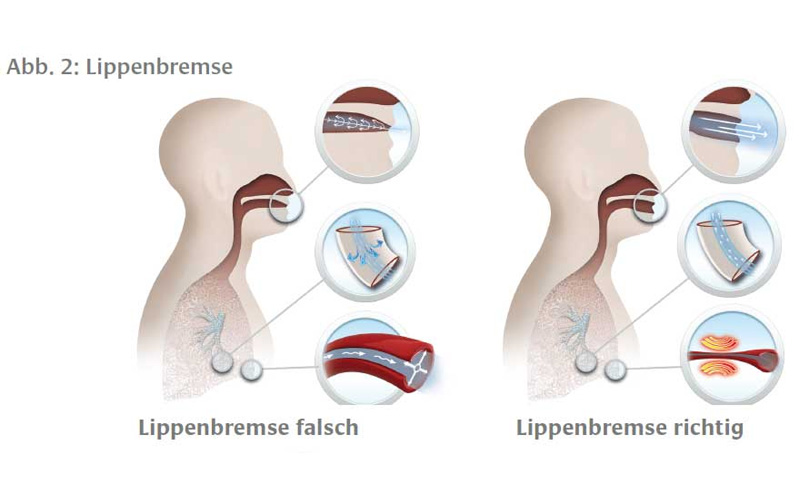
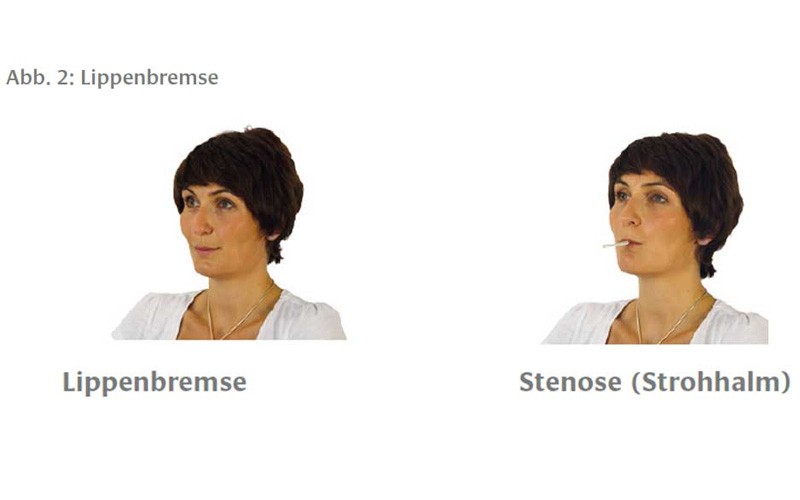
Therefore, under exertion, pursed-lip breathing or the use of a "stenosis" (e.g., a straw) is essential: you form only a small opening with your lips, which creates a backup of air during exhalation, keeping the bronchi more stable and thus open: you can exhale better and more completely (see Fig. 2).