
Author
Presentation by Thomas Hillmann, summary by Gabi Niethammer | As published in Alpha1 Journal 2/2022.
If I, as a respiratory therapist, had to summarize the desired goal of treating a patient in one sentence, mine would be: movement is the best physiotherapy and the best respiratory therapy you can do. And if you can manage to laugh while doing it, then that's the ultimate achievement in secretion mobilization.
Even with inhalation, it's unclear who should actually teach the patient how to do it. This could be doctors, physiotherapists, or medical technical assistants – or no one at all, because each professional group relies on the other.
During the initial consultation, I observe the patient's breathing pattern objectively. They sit on the edge of the bed or chair and breathe naturally. There's no right or wrong way to breathe, as everyone has their own unique way of breathing. My main concern is identifying whether this natural breathing pattern might be causing problems with secretion clearance. Based on posture and breathing pattern, I can often already see where a potential secretion issue might be.
For example: Imagine someone sitting in front of me whose breathing is clearly concentrated on the left side, resulting in significantly less ventilation on the right side and causing mucus to become trapped. My task then is to improve ventilation on the right side to prevent overinflation. Through targeted pressure exercises with my hands, I support exhalation in the chest using what's called contact breathing, thereby improving ventilation on the right side. This allows the next breath to be deeper, and the secretions can begin to loosen. Another important indicator for me is how the patient uses pursed-lip breathing, as this is the tool needed to ensure sufficient airflow. Pursed-lip breathing simply means loosely closing the lips and exhaling slowly. The key is not to use more force, but to exhale slowly so that the airways remain open for a little longer. If the patient exhales too forcefully, the positive effect of pursed-lip breathing is negated by the use of accessory respiratory muscles.
Deep breathing, also known as abdominal breathing, is not easy for Alphas with already low-lying diaphragms due to enlarged lungs. In these cases, it can be beneficial to relearn it.
Your coughing technique plays a crucial role. The pressure created by coughing is transferred directly to the pelvic floor, and it's actually worthwhile for both women and men to train their pelvic floor muscles to prevent urine leakage when coughing or laughing. Making a slight twisting motion while coughing can be helpful, as this engages the abdominal muscles and prevents the pressure from being transferred unfiltered directly to the pelvic floor and bladder.
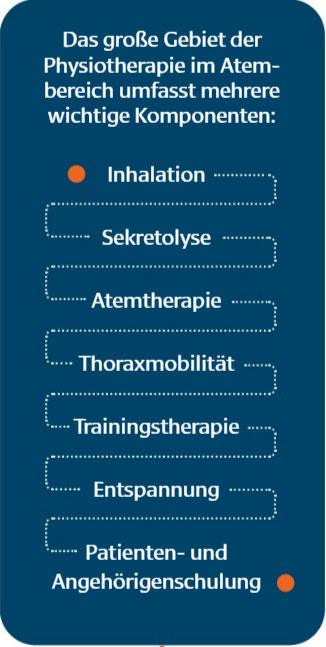
Unfortunately, in respiratory therapy, a patient's cough reflex is far too rarely checked using a peak flow meter, even though a certain cough velocity is necessary to expel mucus. If various mucus clearance techniques are applied to a patient with severe lung disease, and the patient's weak cough prevents them from clearing the mucus from the lungs, the problem is exacerbated. Therefore, if necessary, the cough reflex should be addressed first.
An ineffective cough poses not only reduced secretion removal from the airways but also other health risks: among other things, it increases the risk of infection and leads to a deterioration in blood oxygen saturation.
The amount of mucus produced is crucial for assessment – not only for healthcare professionals, but also for each individual patient. Therefore, it is so important to regularly check your mucus, as its consistency can indicate, for example, whether it is advisable to continue inhaling high-dose saline solution. If the mucus is already quite thin and frothy, further inhalation is not recommended, because maintaining a certain viscosity is important for the mucus to be cleared.
The main goal of physiotherapy is to get the air behind the mucus so that it can then be exhaled and transported upwards. An important aid in this process is to hold your breath briefly before exhaling. This is another technique that patients learn during respiratory therapy. In this situation, hypertonic saline solution with 3.6 or 7 % is also more helpful than isotonic saline solution with 0.9 %. Patients should gradually get used to the higher percentages when inhaling, as the biggest problem is usually the inhalation technique, not the medication itself. Unfortunately, we repeatedly observe that a large proportion of inhalation patients use their devices incorrectly, resulting in only a fraction of the medication reaching the lungs.
There are different inhalation techniques:
- Humidity humidifier (the Pariboy® is particularly well-known here)
- Metered-dose inhalers (emergency spray)
- Powder inhalers
The main goal is to always get as much of the inhalant into the lungs as possible.
With a nebulizer, a considerable amount of medication tends to get trapped in the nebulizer. Furthermore, the medication has to be forced through an almost right-angled bend between the mouth and esophagus. To prevent the medication from getting stuck in the throat, it's important to tilt your head back slightly while inhaling to straighten this bend. Under no circumstances should you look down while inhaling, not even to look at an inhalation technique on your phone, for example.
The faster the patient inhales the medication, the less effectively it reaches the lungs. Therefore, the goal is always to inhale as slowly as possible.
The ultimate in inhalation technique is indeed the metered-dose inhaler! For example: A typical patient in the clinic, using a walker, arrives at one of my exercise classes and immediately uses his emergency inhaler upon arrival.
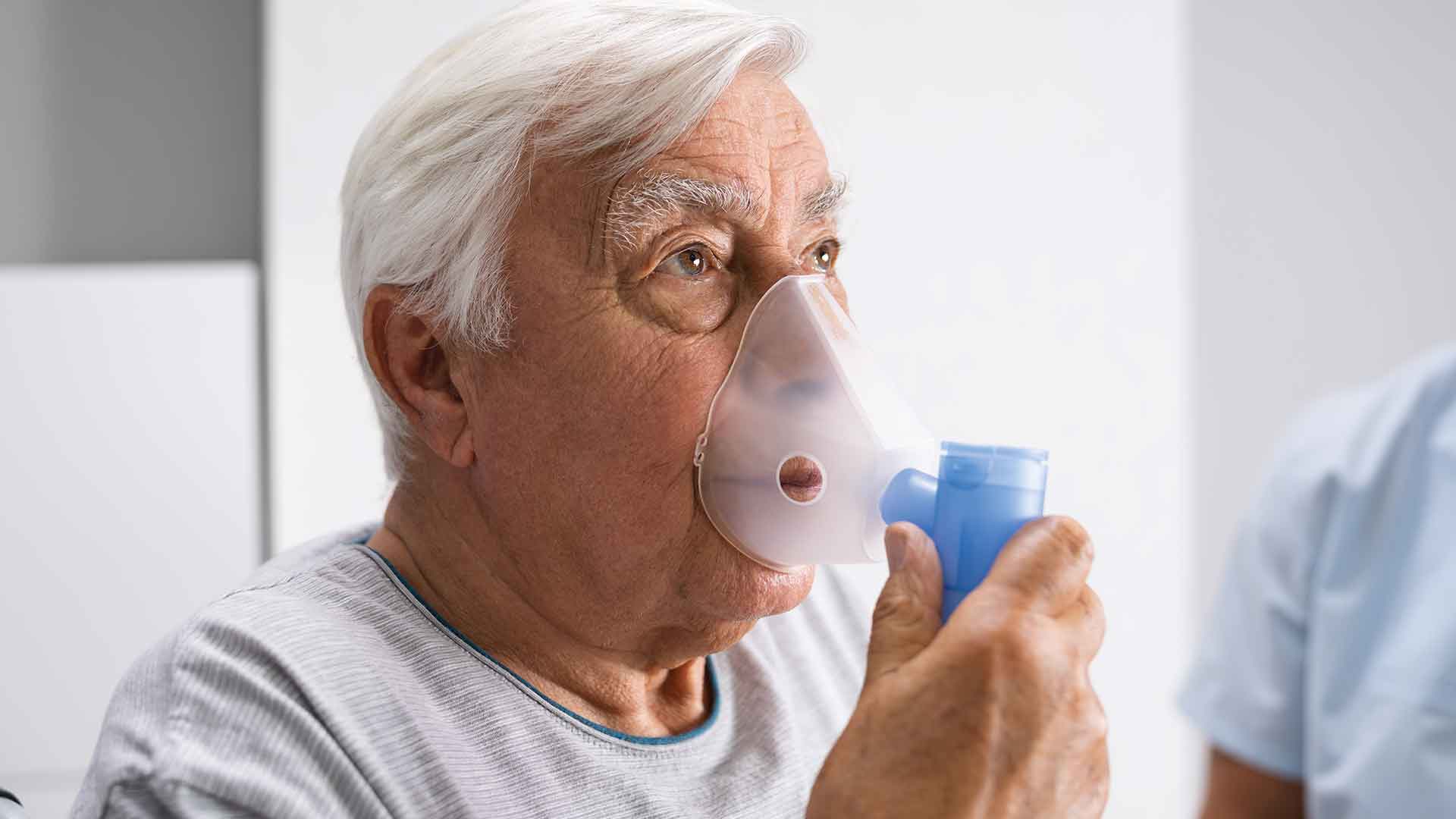
Because he is completely dynamically overinflated from running (visible in his raised shoulders), not much medication can reach his lungs. Ideally, the patient should first exhale air for the medication to be effective. Then it's crucial to inhale the rescue inhaler as slowly as possible. This is difficult because it shoots out of the metered-dose inhaler at 100 km/h, and the goal is to get it around the back of the throat at approximately 20 km/h. To achieve this, the patient must first inhale two or three times without pursed lips and exhale slowly. With his head tilted slightly back, the task is then to force the medication into the exhaled breath and subsequently hold it so that the active ingredient can be released into the lungs. It's actually as complicated as it sounds, and it's very helpful to practice the correct technique with a respiratory therapist.
There are also other things to consider when using wet and dry powder inhalers: Often, far too much medication gets stuck to the teeth, for example, because the patient wants to keep their hands free and therefore holds the inhaler with their teeth. If the pressure from the teeth is too high, the tongue automatically moves upwards and the medication ends up under the teeth instead of in the lungs.
Today we know that between 30 and 100 liters of air are needed for dry powder inhalers. The medication is bound to lactose and separates from it. If you inhale too forcefully, the lactose is forced into the throat, which can lead to voice changes and restricted breathing. Newer devices have a trigger that controls the inhalation rate and only require 30–40 liters. Due to the patient's own need for air, it is difficult to inhale slowly. Therefore, the patient should be trained by a physiotherapist to select the most suitable device for them.
A major problem is dynamic hyperinflation. The patient repeatedly inhales more than they exhale. This causes the shoulders to rise, creating the typical "belt effect," as if someone had fastened a belt around the chest. The result is that the patient tries to inhale against this feeling, only to feel even more constricted, leading them to believe the medication isn't working. However, the problem here isn't the inhalant, but the hyperinflation itself, which must first be addressed.
For secretion management, I, as a therapist, prefer to use my hands. For home use, there are helpful aids, such as oscillating PEP systems, which provide positive expiratory resistance, ensuring that the airways remain open and stale air can be expelled. Some systems are amplified by tones, giving the patient even better control. The most affordable PEP system is pursed-lip breathing, followed by a straw, the casing of a small disposable syringe, and systems like the Pari-PEP® or BA-Tube®. It's essential to start with the lowest possible resistance and determine which resistance allows the airways to remain open for the longest possible time.
For secretion mobilization, there are other aids available, some of which are only used in other countries. For example, a very expensive American vest, while it does create significant lung movement, does not replace the patient's own need to perform secretion-loosening breathing exercises. Various other devices, such as autogenic drainage, the Active Cycle of Breathing Technique, or the Simeox® Physioassistant, complete the range of options. They all have advantages and disadvantages that the patient should discuss with their therapist.
As a physiotherapist, my focus is on truly working with the patient, feeling where the problem lies, and then treating it. It's important to emphasize that I can only provide support, and the primary responsibility for breathing lies with the patient. Therefore, their willingness to cooperate is essential.
No aid can replace individual and active work on and with the patient!
Once the mucus has cleared, the crucial thing for the patient is to get moving. The vicious cycle of "I can't breathe properly, and when I can't breathe properly, I do less, and then I can't breathe properly even more, and I can do even less" must be broken, otherwise social contact will decrease and avoidance strategies will increase. It is essential to break this downward spiral of inactivity. Controlled physical activity, regardless of severity or age, can have positive effects on various organs and improve quality of life. It is important to note that movement should be adapted to breathing, not the other way around.
For those not affected, it's important to know that the work of breathing in a COPD patient is already twelve times (!) higher at rest. Furthermore, a finger pulse oximeter, with its saturation measurement, provides no information about how well the patient is actually breathing. For example, a patient with a saturation of 75 might be able to complete a 380-meter walk test, while another with a saturation of 98 might only manage about 100 meters.
To begin to understand the limitations experienced by a family member, a person with healthy lungs can sit down and breathe through a straw. If they then try to do exercises, they will likely be unable to continue after 40 seconds because of the extreme lack of air.
Working with the physiotherapist also serves to teach economical techniques:
- Reducing anxiety
- Energy saving
- Building muscle
- Independence / Self-esteem
- Maintaining livelihoods (e.g., for single people)
In my clinical practice, I frequently observe that patients undergoing stress tests assume the settings on their portable oxygen concentrators correspond to the number of liters of oxygen delivered. A portable concentrator at setting 5 does not equate to 5 liters of oxygen. During exertion, our breathing becomes faster, and the device is then continuously activated. However, if the patient is already exhaling, they are no longer adequately supplied with oxygen, and a demand-based system might not be the right choice during exertion. Therefore, it is always necessary to assess each individual case to determine whether a continuous flow system might be a better option for training.
When choosing a rollator, it is essential to ensure that it fits the user's body type so that they can stand upright with it, thus improving their breathing. Therefore, it is important to pay attention to this and provide guidance, as posture can affect vital capacity by up to 30 percent.
Strength, endurance, flexibility, and coordination should all be trained. As a therapist, it's important for me to create an individualized training plan that's accessible to patients and makes them feel confident in their ability to manage the workload. The most important thing at the beginning is for the patient to get moving and stay motivated by small successes. We often use interval training of 30 to 60 seconds followed by a 30-second break. This allows the lungs time to deflate before the next interval. The individualized training plan also includes a detailed assessment of the patient's living situation, such as whether they have to climb stairs at home, whether they enjoy cycling, whether they frequently have to carry heavy shopping bags, and so on.
To achieve a training effect, you should train two to three times a week, allowing sufficient recovery time. More frequent training leads to little or no performance improvement; in fact, it increases the risk of injury while simultaneously reducing fitness. To maintain performance, one session per week at a consistent intensity is recommended.
Exercise with care: When respiratory physiotherapy should be paused
1. Blood pressure > 220/120 mmHg (systolic/diastolic blood pressure)
2. Circulatory disturbance (signs of ischemia) or life-threatening arrhythmias in the exercise ECG (electrocardiogram).
3. Coronary artery disease with symptoms (Symptomatic coronary artery disease)
4. Heart muscle weakness with fluid accumulation in the heart (decompensated heart failure)
5. Cardiac arrhythmias affecting blood flow (hemodynamically significant cardiac arrhythmias)
6. Heart defects affecting blood flow (hemodynamically significant defects)
7. Inadequately controlled high blood pressure in the systemic circulation (arterial hypertension)
8. Overload of the right side of the heart caused by increased pressure in the lungs, which can no longer be compensated for (decompensated cor pulmonale)
9. Right heart strain due to high blood pressure in the lungs (pulmonary hypertension: PAP > 40 mmHg)
10. Acute worsening caused by viruses and bacteria (exacerbated COPD / infection)
11. Other individual reasons; advice from the treating physician
The goal is to train precisely the skills the individual needs in their life. And to ensure they maintain these skills long-term, even after their time in the clinic, it's important that the exercise is enjoyable. Today, there are many excellent fitness apps with interesting training approaches (e.g.,...). the PROMISE sports program by Dr. Inga Jarosch and Dr. Tessa Schneeberger and sports that can be played on a Wii or with virtual reality. In our daily clinical practice, we frequently observe that patients with a heart rate of 120 on a stationary bike describe their perceived exertion as an 8. However, if they wear virtual reality glasses at the same heart rate, the perceived exertion is reduced by half, precisely because they are distracted. Alongside all the training, the subsequent relaxation should not be neglected, as it is essential for the recovery of both body and mind. Whether the individual chooses one of the various relaxation techniques or, for example, regenerates by listening to music, is irrelevant and individual. What is important is to regularly take this time for oneself.
My goal is for the patient and me to work together so well that one day he'll be able to train me effectively, gently pushing me aside because he knows how to best care for himself. Then, as a physiotherapist, I'll have done everything right and will be satisfied.


