„"I'm just a carrier" – PiMZ and Alpha-1 Antitrypsin Deficiency

Alpha-1 antitrypsin deficiency is caused by a defect in a gene on chromosome 14. The gene can be either normal (M) or contain mutations (the most common being S or Z). The alteration involves the substitution of an amino acid building block with an incorrect one. The vast majority of individuals with alpha-1 antitrypsin deficiency inherit the Z mutation from both their father and mother; this is known as the PiZZ type. In these cases, the alpha-1 antitrypsin activity is reduced to only about 10<sup>1</sup>T<sup>1</sup> of normal function, and blood levels of alpha-1 antitrypsin are severely decreased. This significantly increases the risk of developing pulmonary emphysema.

Individuals with PiMZ inherit the healthy M gene from one parent and the Z mutation from the other. In these individuals, the activity of alpha-1-antitrypsin is reduced to approximately 60 % of the normal range, and blood levels lie between those of healthy individuals (PiMM) and patients with the PiZZ type.
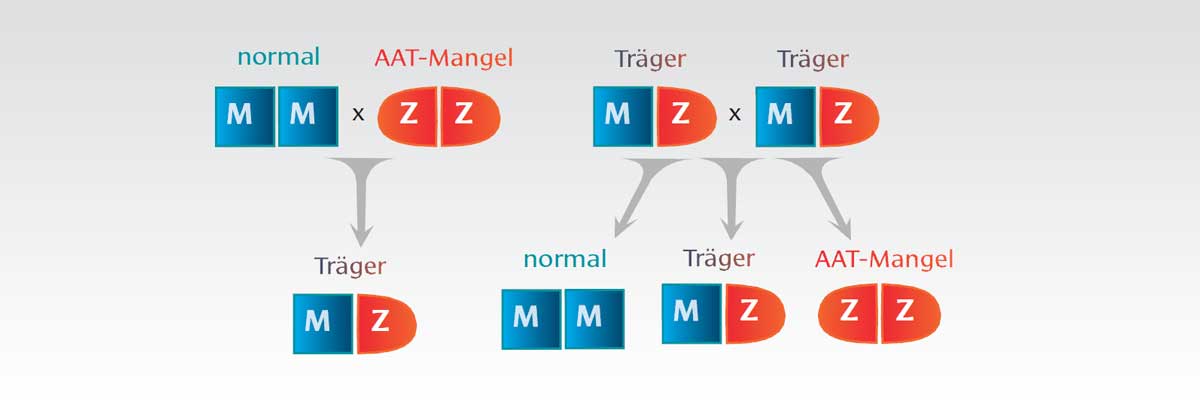

Alpha-1 antitrypsin deficiency inheritance pattern

PiMZ
M = healthy gene
Z = altered gene
1M+1Z = heterozygous, two different variants of the AAT gene
2Z = homozygous, two identical AAT genes
2M = homozygous, two identical AAT genes

Diagnosis of the PiMZ type

In every person with chronic obstructive pulmonary disease (COPDEveryone should have their alpha-1 antitrypsin blood level measured once in their lifetime to rule out alpha-1 antitrypsin deficiency. In fact, doctors find reduced levels in the range of 50-90 mg/dL (normal: 90-200 mg/dL) in 5% of all COPD patients. The next step is to determine the genotype using the AlphaID® test via a cheek swab. The doctor can retrieve the results one to two weeks later. Other individuals with the PiMZ type are identified because relatives have alpha-1 antitrypsin deficiency. It is generally recommended that all individuals with PiZZ genotypes have their children tested. Siblings of individuals with the PiZZ type should also be tested. If the father has the PiZZ type and the mother is healthy with PiMM, every child will have the PiMZ type and none will have the PiZZ type. The situation is slightly different if one parent has the PiMZ type and the other parent has the PiZZ type. Then the children are either PiMZ carriers or affected as PiZZ type. However, there is no correlation between the statistically possible genetic changes and reality, because if you're unlucky, all children in such a family could inherit the PiZZ type.

Health significance of the PiMZ type

Unlike the PiZZ type, individuals with PiMZ do not typically experience a severe alpha-1 antitrypsin deficiency. Nevertheless, their risk of developing pulmonary emphysema is somewhat higher than that of healthy individuals. This applies primarily to smokers. Therefore, someone with the PiMZ type who never smokes is likely at very low risk. For this reason, it is important to detect the PiMZ type in infants and children. Parents can then take steps to prevent their child from starting to smoke. In a study of smokers in Ireland, it was found that individuals with the PiMZ type had narrower bronchi and, over time, lost more alveoli than healthy PiMM carriers. People with the PiMZ type often suffer from hypersensitive airways, characterized by "non-specific bronchial hyperreactivity." They experience respiratory distress in response to odors, fumes, or cold temperatures. Those affected report that they cannot tolerate the smoke after blowing out candles, or that they cannot stand the smell in the kitchen when searing meat. These complaints should not be confused with respiratory allergies.

Non-specific airway hypersensitivity is best diagnosed using a specialized pulmonary function test. In the "Body" whole-body plethysmograph, airway resistance indicates that the bronchi are narrower than normal during resting breathing, and lung hyperinflation can also be measured. If the patient inhales a bronchodilator and the measurement is repeated afterward, the treatment effect becomes apparent. For a more precise diagnosis, a provocation test can document the hypersensitivity.

Quit smoking

The first and most important step for any smoker with the PiMZ type is to quit smoking. Unfortunately, this is rarely successful in practice. In one study, smokers who had received the results of their genetic test three months prior were interviewed. While 59 of the PiZZ carriers (%) had attempted to quit smoking, and 12 had actually succeeded, the results were significantly worse for the PiMZ carriers, with only 37 attempts and 6 successes. This makes it all the more important for doctors to repeatedly address the problem with their smoking patients and convince them of the importance of quitting. Children whose PiMZ type is known should never start smoking. For teenagers, campaigns in schools can help prevent them from smoking altogether or from starting in the first place. Young people are impressed when patients with advanced COPD talk about their illness and express what a huge mistake their former smoking was.

Other measures for hypersensitive airways

Respiratory problems can also occur at work or during leisure activities, for example, due to dust, gas, or fumes. Examples include bakers, farmers, painters, or welders. In these cases, a doctor should provide preventative advice.

It is also advisable to prevent respiratory infections through vaccination. This includes, among other things, vaccinations against influenza and pneumococcal disease. A vaccine against Haemophilus influenzae bacteria is available for children.

Medications

Hypersensitive airways can be effectively treated with medication. Inhaled corticosteroids, administered as a metered-dose inhaler or powder, are very important. Many patients manage with low doses of a basic medication and only one inhalation per day. Their symptoms subside, and their lung function improves. Other patients require slightly higher doses of medication.

Comorbidities

Unlike individuals with PiZZ, those with the PiMZ type are not at risk of other organs being affected. However, the risk of developing gallstones is increased in individuals with the PiMZ type.. You can find studies on this topic here.
Panniculitis or inflammatory bowel diseases do not occur more frequently in people with PiMM than in healthy individuals. This also applies to rheumatic conditions or granulomatosis with polyangiitis (GPA). .

Caution: PiMZ and the liver

Recent research has shown that carriers of the gene defect also have a higher risk of developing liver damage. This is especially true if there is already liver damage, which can be exacerbated by the alpha-1 deficiency. Regular liver checkups are therefore strongly recommended!

Family planning

When planning a family, individuals with PiMZ must consider that they have a (statistically) 50% chance of passing the defective Z gene on to their offspring. Whether the child is affected can be tested immediately after birth. In Germany, all newborns undergo screening tests for various metabolic disorders. While alpha-1 antitrypsin deficiency is not among these, parents with a Z mutation can ensure that their newborn child is tested for it.

Summary

  • While carriers of the PiMZ gene were previously considered to be at low risk, it has been shown that smokers, in particular, are more likely to develop pulmonary emphysema than healthy individuals. Therefore, all individuals who know they have the PiMZ gene type should quit or remain non-smokers.
  • It is not uncommon for individuals with PiMZ syndrome to have nonspecifically hypersensitive airways. This condition responds well to medication. Annual check-ups with a pulmonologist are advisable for monitoring its progression.
  • Those with PiMZ should pay particular attention to their liver, as they have an increased predisposition to liver diseases.
  • People with the PiMZ type should also receive genetic counseling so that they are aware of possible consequences for their children.

Assessment of the risk of chronic obstructive pulmonary disease in alpha-1 antitrypsin deficiency PiMZ heterozygotes

Original in English (Clarification of the Risk of Chronic Obstructive Pulmonary Disease in α1-Antitrypsin Deficiency PiMZ Heterozygotes; Am J Respir Crit Care Med. 2014 Feb 15; 189(4): 419–427.
Published online 2014 Feb 15. doi: 10.1164/rccm.201311-1984OC, PMCID: PMC5955067, PMID: 24428606

Conclusions of the study: The results indicate that PiMZ heterozygotes exhibit significantly more airflow obstruction and COPD than PiMM individuals, and that cigarette smoke exposure has a significant modifying effect.

Titelbild zeigt DNA-Strang
Heterozygous carrier of trait PiMZ

Heterozygous carrier of trait PiMZ

YouTube Download list Newsletter contact