
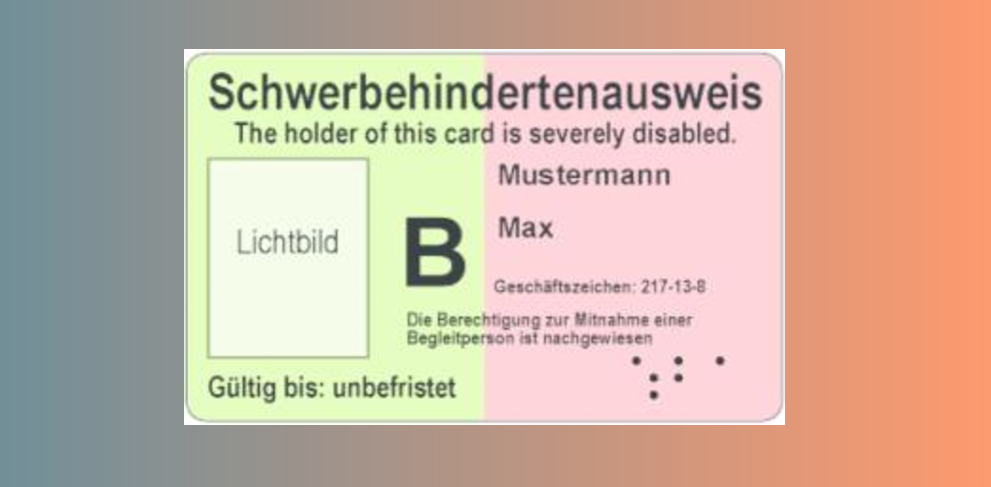
Disability ID card with alpha-1 antitrypsin deficiency
Below, we would like to inform you about the topic of severe disability and provide you with as much information as possible. Please feel free to contact us if you have any further questions.
What is a severely disabled person's ID card?
The severely disabled person's ID card is a credit card-sized document that provides information about the holder's degree of disability. This is referred to as the degree of disability (GdB). In everyday language, it is usually expressed as a percentage (for example, "I have a 70% severe disability").
A severely disabled person's ID card is issued for a disability rating (GdB) of 50 or higher. For ratings below 50, only a notification is issued.
In addition, the disability card may contain certain symbols indicating specific limitations. For individuals with alpha-1 antitrypsin deficiency, the symbol "G" is often relevant. This symbol indicates that mobility in road traffic is significantly restricted – whether due to shortness of breath or limited walking ability that makes movement difficult. The symbol "G" is noted on the back of the card along with the degree of disability (GdB).
There are other distinguishing features; here are the most important ones:
| Distinguishing mark | Meaning |
| G | Severely mobility impaired |
| aG | Exceptional walking disability |
| B | Entitlement to bring along an accompanying person |
| H | helplessness |
| Bl | Blind |
| Gl | Deafness |
| RF | Exemption or reduction of broadcasting fees |
| TBl | Deafblind |
The validity period is also noted on the ID card, which is located below the holder's photo.
How do you obtain a severely disabled person's ID card?
To have the degree of disability assessed, an application must be submitted. This application is filed with the responsible authority. Which authority is responsible depends on the federal state. It is usually the district office or the social welfare office.
You can find out which office is responsible at your local citizens' registration office or online. The addresses of the relevant authorities are listed there. Application forms are also available online. For example, you can find them using a search engine by entering "application for severe disability + Rhineland-Palatinate".
Alternatively, application forms can be obtained directly from the responsible authority or, in many places, from the citizens' office.
You also need a passport photo.
Let's go!
It is recommended that you first carefully read the instructions and information sheet included with the application. It is also helpful to gather any existing medical documents, such as reports, doctor's letters, hospital reports, rehabilitation assessments, laboratory results, or X-ray reports. Other documents, such as medical bills from private patients, may also be useful.
If possible, it is advisable to attach copies of relevant documents – especially from the last two years – to the application. However, if no documents are available, a complete list of all health limitations or illnesses is sufficient. In this case, the processing time may be longer, as the necessary medical records must first be requested from the treating physicians listed.
The application must list all physical, mental, and psychological health impairments that have existed (or will exist) for at least six months and that are to be considered for determining the degree of disability (GdB). This includes not only alpha-1 antitrypsin deficiency or impaired lung function, but also all other existing illnesses and resulting functional limitations. Complete information is essential for an accurate assessment of the GdB.
Furthermore, it can be helpful to include a supplementary description of the individual's health situation with the application. In particular, describing limitations on especially stressful days and providing concrete, vivid examples can help to convey the most realistic picture possible of the actual impairments. The determination of the degree of disability (GdB) is not about diagnoses, but about the impact of the illnesses on the affected person's daily life. These should be presented clearly and comprehensibly on a separate sheet.
Furthermore, all treating physicians and hospitals must be named and released from their duty of confidentiality so that the responsible authority can obtain the necessary medical information. It is advisable to inform the respective treating physicians in advance that an inquiry from the authority may be made in order to expedite the processing as much as possible.
If the space provided in the application form for listing the treating institutions is insufficient, the relevant information can be added on a separate sheet and attached to the application. Care should be taken to ensure that no one is overlooked.
Once fully completed, the application, including the required passport photo, must be sent to the relevant authority; registered mail is recommended. Processing may then take up to six months. If no confirmation of receipt or processing is received within approximately four weeks, it is advisable to contact the relevant authority in writing.
If you have any uncertainties or questions about completing the application, you can seek additional professional support. This is offered, for example, by the social welfare association VdK or the social welfare association of Germany (SoVD). Membership in the respective association is usually required for this. Alternatively, the free consultation service of the Supplementary Independent Participation Advisory Service (Supplementary Independent Participation Advisory Service) is available.EUTB) available.
How is the degree of disability (GdB) determined?
The responsible authority generally does not conduct a personal examination of the applicant, but rather makes its decision based on the available files. The decisive factor here is the German Ordinance on Medical Assessment for Disability Benefits (VersMedV) and the principles of medical assessment contained therein. These establish corresponding assessment criteria for a wide range of possible health impairments in the form of degrees of disability (GdB) or degrees of impairment.
If several health impairments are present simultaneously (e.g., a lung dysfunction, a depressive disorder, and an orthopedic impairment), the individual disability ratings are not added together. Instead, an overall assessment is conducted, examining the extent to which the individual functional impairments influence each other and their combined effect. The starting point for the assessment is always the most severe impairment with the highest individual disability rating; the other limitations are then considered in relation to this primary impairment.
In practice, the determined results may not always be readily comprehensible. If the degree of disability (GdB) is perceived as too low, an appeal should be filed within the prescribed time limit.
Support can be obtained from the aforementioned advice centers.
For individuals with alpha-1 antitrypsin deficiency, the regulations in Chapter 8 (Chest, lower airways and lungs) of the German Social Code, Book V (SGB V) are particularly important. Furthermore, depending on the individual's health situation, other chapters, such as Chapter 9 (Heart and circulatory system), may also be relevant.
The German Social Code, Book IX (SGB IX), assigns specific assessment frameworks in the form of disability ratings (GdB values) to various health impairments. In this context, the term "degree of impairment" (GdS) is also frequently used, which describes the severity of the respective health impairment. GdS and GdB are assessed according to the same principles.
The following differentiation is provided in the principles of social medicine under chapter 8.3 „Diseases of the respiratory organs with permanent impairment of lung function“:
Easy degree
There is excessive shortness of breath during moderate exertion (e.g., brisk walking at 5–6 km/h or moderate physical work). Static and dynamic lung function test results are up to one-third below predicted values; blood gas values are within the normal range.
→ GdS: 20–40
Intermediate level
Shortness of breath occurs even during light everyday exertion (e.g., walking at 3–4 km/h, climbing stairs to one floor, or light physical work). Static and dynamic lung function test results are up to two-thirds below predicted values; partial respiratory insufficiency is present.
→ GdS: 50–70
Severe degree
Shortness of breath occurs even with minimal exertion or at rest. Static and dynamic lung function test results are more than two-thirds below predicted values; this indicates global respiratory failure.
→ GdS: 80–100
Following a lung transplant, the healing process must first be monitored. For a period of two years, the degree of disability is generally assessed at 100. Even in cases of favorable recovery, a degree of disability of at least 70 must subsequently be assigned. This regulation can be found in Chapter 8.4 of the Principles of Disability Assessment.
Furthermore, other conditions, such as sleep apnea syndrome, can be included in the overall assessment of the degree of disability (see Chapter 8.7).
What advantages do I have with a severely disabled person's ID card?
The benefits of the severely disabled person's ID card are referred to as compensation for disadvantages, as they are intended to offset existing limitations.
Here you will find two very clear overviews, one showing the compensation for disadvantages according to the degree of disability and the other showing the compensation for disadvantages for the respective disability markers.
Disability-dependent compensation measures
Disability-related compensation measures
My application for disability status was rejected, or in my opinion the degree of disability is too low – what now?
You now have one month to file an objection. An objection will prompt the responsible authority to review the decision. To meet the deadline, the objection must be received by the issuing authority within one month.
The contradiction could be phrased as follows:
„"I hereby object to the decision dated… with file number… within the prescribed time limit. Please send me all information that led to your decision so that I can base my justification on it. A detailed justification will follow."“
Don't forget the date and signature!
This saves time and provides the opportunity to develop one's own argument in a targeted manner, to explain which aspects were not taken into account or how they should have been evaluated.
Should the application be rejected again, it is possible to file a lawsuit with the Social Court if you wish to pursue the matter further. The one-month deadline must also be observed in this case. Support can again be sought from a social welfare organization or the EUTB (Independent Participation Advisory Service).
In a nutshell: Tips for submitting an application
- Give all diseases and impairments. Also describe the burdensome aspects. Effects of the necessary treatments. Use an additional sheet and describe in detail the impact of the illness and treatment on your entire life (e.g., family life, social life, mobility, partnership, sexuality, eating, sleeping, managing the household, etc.).
- List the doctors and clinics who are currently best informed about your illness(es) and release them from their duty of confidentiality (this is already included in the application).
- Discuss the application with your treating physician so that, in addition to the diagnoses, the effects of the illness and/or the therapy are also described in detail.
- Please attach all relevant medical documents you have to your application.
- Please include a passport photo (name and date of birth on the back) for identification purposes.
Authors: Heike Isensee and Nicole Scherhag
Note:
At Alpha1 Germany, we have Nicole Scherhag as an advisor who is knowledgeable about social law and its intricacies. Please feel free to contact her with any questions. Her contact details can be found on our website in the relevant section. „"About Us"“ to find.


