
Author
Heinz Stutzenberger, as appeared in Alpha1 Journal 2/2025.
Alpha-1 antitrypsin deficiency (AATD) of the Pi*Z genotype is well on its way to becoming a prototype for new genetic engineering treatments based on manipulating DNA (deoxyribonucleic acid) or RNA (ribonucleic acid). This is because this form of AATD is caused by a single incorrect (mutated) base pair at a precisely defined location in the genetic material, and will therefore be easier to treat than other inherited predispositions or diseases caused by multiple mutations.
Given this starting point, it is natural that Alphas would gain a deeper understanding of the connections, and a webinar organized by the Alpha-1 Europe Alliance, the umbrella organization of national European Alpha-1 associations, served this purpose for its member representatives. The presentation was given by Marion Bouchekareilh, who conducts research on AATM at the Bordeaux Research Institute for Translational Oncology and who participates as a guest for France in the monthly general meetings of the Alpha-1 Europe Alliance. Her remarks are summarized below:
Human genetic information, which controls the structure, function, and repair of the body, is stored in DNA. This is located in the cell nucleus and consists of approximately six billion base pairs arranged in a double helix. Only four different bases are used, designated by the letters A, T, C, and G. Among other information, DNA also encodes the instructions for protein production in liver cells (hepatocytes), including alpha-1 antitrypsin. In alpha-1 antitrypsin deficiency (AATD) with the genotype PI*ZZ, two specific base pairs are incorrectly inserted. DNA and RNA interventions are used to treat this deficiency. As a result, the protein produced is shaped somewhat differently than the normal AAT molecule, or rather, misfolded. Due to this misfolding, it tends to clump together and can no longer leave the liver cells: Alpha-1 antitrypsin deficiency develops.
When producing proteins, cells cannot directly access the DNA contained within the cell nucleus as a template. Instead, a kind of copy of the DNA, called RNA, is created. This RNA is then secreted from the nucleus and directs protein production. Errors in the DNA are naturally also found in the RNA. However, the production of a specific protein only requires a copy of a particular section of DNA. This copy, which exists for every protein produced in the body, is called mRNA, or messenger RNA.
The novel drugs now target different points in protein synthesis:
• either by altering/correcting the DNA
• or by altering/correcting the mRNA
• or by switching off the mRNA (and thus preventing specific protein production)
Different techniques are used depending on the goal of the procedure.
The CRISPR-Cas9 method, also known as gene editing, is used to modify the DNA. A larger section of DNA in the liver cells, containing the faulty information, is cut out and replaced with a corrected section, so that after treatment, normal AAT is produced in the affected cells. The resulting DNA modification in the liver cells is passed on during continuous cell renewal, so that ideally, this treatment involves a single dose of the drug, the effect of which then lasts a lifetime. However, this advantage also comes with one of the risks of this treatment: When using gene editing, neighboring base pairs can be unintentionally altered, which could lead to unwanted side effects that would then also be lifelong. The company Beam Therapeutics is working on developing such a therapy; Intellia discontinued development of AAT at the end of 2024 (and the clinical trial for a drug for another disease had to be interrupted due to an unexplained death (as of November 2025)).
mRNA is constantly being produced and broken down. Interventions at the RNA level therefore only have a temporary effect; a drug that modifies mRNA must be administered regularly. The so-called ADAR technique allows for the targeted repair of a single base pair on the mRNA, significantly reducing the risk of unwanted side effects. Should these side effects nevertheless occur, they are expected to decrease as the modified mRNA is broken down in the body, and side effects typically subside after a few weeks. Such drugs are currently being developed by the companies WAVE, KORRO, PrimeMedicine, ADARx, and AIRNA.
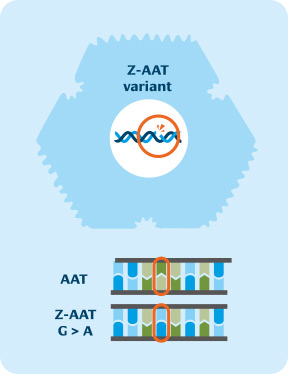
The Z variant of alpha-1 antitrypsin
The Z mutation is a small „change“ in the DNA – a bit like a typo in a text.
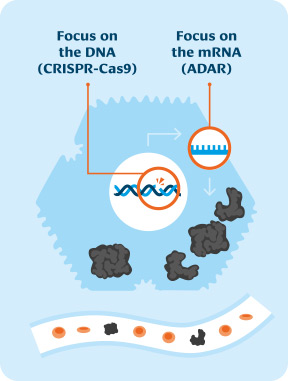
Therapeutic strategy
How can we prevent damage caused by the Z variant? We repair the Z variant.
Even though the two novel treatment methods described above cannot cure existing lung damage, their aim is to influence the liver in such a way that a sufficient amount of functional AATs is produced and at least the protective concentration of M-AAT is reached (the so-called protective threshold), as is the case, for example, in a typical PI*MZ carrier. This should protect the lungs from further damage and allow the liver to recover from deposits of polymerized Z-AATs. A prerequisite for this is that the drug reaches a sufficiently high proportion of liver cells, and the approaches of the various developers will differ in this respect.
The third intervention option is siRNA, or small interfering RNA. These are short strands of RNA that are administered to the body, bind to the target mRNA, and disrupt it before it can produce its corresponding protein. This treatment thus prevents the formation of any AATs, allowing a liver damaged by clumped Z-AAT to recover. A corresponding drug is being developed by Takeda, building on preliminary work by Arrowhead.
All these active ingredients have in common that they consist of very large molecules produced biotechnologically. These cannot simply be pressed into tablets or filled into capsules like chemically manufactured drugs. Oral administration would also be ineffective, as the active ingredients would be broken down in the digestive tract and would not reach their target, namely the liver cells. Instead, the active ingredients are packaged in complex "vehicles" designed so that, after administration under the skin (subcutaneously) or into the bloodstream (intravenously), they are absorbed directly by the liver cells and can exert their effects there.
The speaker also offered a very vivid illustration of these rather complex relationships, which might make understanding easier: DNA can be thought of as a kind of cookbook containing the recipes for the structure and function of the body. RNA can then be understood as a copy of this cookbook. Both the original and the copy contain chapters for the production of proteins. mRNA is then a copy of a page containing the recipe for the production of a specific protein. In this analogy, a mutation is an error in the recipe book or its copy, and in the case of AAT, a single letter is incorrect in a precisely known location. When DNA is edited, the entire chapter containing the error is cut out of the recipe book and replaced with a new one, which, of course, should not contain any new errors. In the case of RNA editing, only a single letter is erased and rewritten on the copy of a page of the recipe book, but the copy as a whole fades rapidly. siRNA causes the copied page to fade before it can be read.
Fortunately, a wealth of DNA- and RNA-based medications are currently in development or in various phases of clinical trials. This is where we, the people with AATD, come in, as clinical trials require participants. However, some programs do not recruit participants in Germany because substitution therapy is widespread here, and its use may preclude participation in some programs. Often, though, the inclusion criteria for these studies are broader, allowing programs to be conducted in Germany as well.
Interested in participating in a drug trial?
If you are interested in participating in a drug trial, please visit our website under the heading "Useful Information" and go to the "Research and Studies" page, or click here.
Images were provided courtesy of Marion Bouchekareilh.


