
Author
Marion Wilkens, as appeared in Alpha1 Journal 1/2026.
From June 24 to 27, 2026, the World Bronchiectasis Conference (WBC) returned to its birthplace: Exactly ten years earlier, the first international bronchiectasis conference, under the leadership of Prof. Tobias Welte (deceased 2025), also took place in Hanover. What began as a visionary platform for scientific exchange has since developed into one of the world's most important congresses for bronchiectasis. Several thousand experts from medicine, science, and patient advocacy groups came together to discuss the latest findings on diagnostics, therapy, and research, and to jointly advance the future care of people with bronchiectasis.
A key driver of this success story is the European bronchiectasis registry EMBARC (European Multicentre Bronchiectasis Audit and Research Collaboration). For many years, EMBARC has provided valuable data from clinical care, enabled high-quality research projects, and played a crucial role in bringing bronchiectasis significantly more into focus in research and healthcare. This development is particularly important for us to observe: With EARCO (European Alpha-1 Research Collaboration), the Alpha-1 community also now has an international registry and research network. EARCO pursues similar goals but is still in an earlier stage of development. EMBARC can therefore be seen as its "big sister"—an impressive example of what can be achieved through long-term international collaboration. This is precisely why it is so encouraging that another important milestone will be reached this year with the first international Alpha-1 conference in Barcelona.
The exchange with bronchiectasis experts and international patient organizations has once again shown us how diverse bronchiectasis is and how varied its causes can be. These include genetic disorders such as alpha-1 antitrypsin deficiency, cystic fibrosis, or primary ciliary dyskinesia, but also past infections, immunological diseases, or comorbidities such as COPD and asthma. Nevertheless, the cause remains unclear in about 20 to 40 percent of those affected despite comprehensive diagnostics – these cases are then referred to as idiopathic bronchiectasis.
For people with alpha-1 antitrypsin deficiency, bronchiectasis is one of the most common comorbidities and was therefore addressed in several scientific sessions. At the same time, it became strikingly clear how important the patient perspective now is.
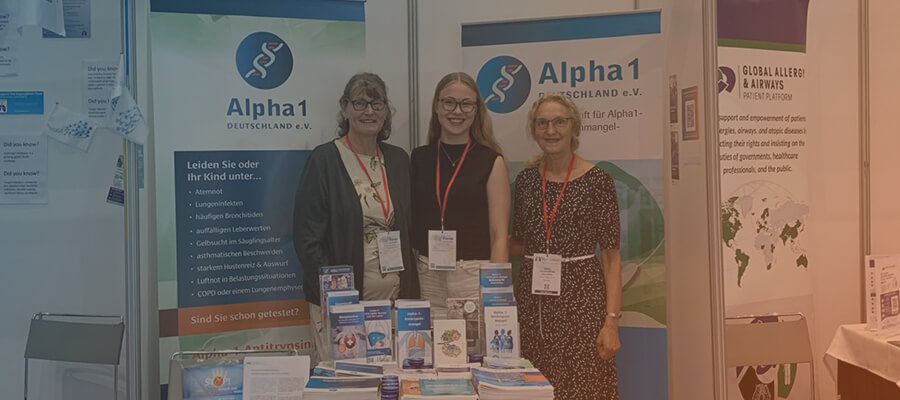
Alpha1 Germany e. V. was represented with its own booth and contributed the experiences of those affected to the international discussion in the accompanying patient forum. We had the opportunity to present our association and its diverse activities, as well as to explain to the bronchiectasis associations why every patient with bronchiectasis should be considered for and tested for alpha-1 antitrypsin deficiency. I was particularly pleased by the support at the booth from my daughter, Frieda Wilkens. We were also delighted to welcome, among others, Professor Sabina Janciauskiene, a member of our scientific advisory board, as a visitor.


