The electronic patient record (ePA) is coming
Author
Thomas Heimann, board member
We Alphas, due to our illness, frequently visit doctors. This often generates a lot of data and information, which the family doctor typically stores in their practice management system. If I then go to another doctor, for example, my pulmonologist, data entries about my health are also created in their system. If a follow-up CT scan, an echocardiogram, or participation in a study is added to the mix, it's easy to imagine that there's a wealth of data about my health, especially regarding long-term developments and trends, stored in various locations.
Up until now, I've always tried to get copies of my medical records and doctor's letters, which I've scanned and digitally stored at home over the years. This way, I at least have the opportunity to document my medical history over a longer period and across all the institutions involved. With this in mind, I've followed the discussions about introducing an electronic patient record (ePA) with great interest in recent years and hoped that it would become my central repository for my health data. However, it won't quite be like a "USB stick on the electronic health card.".
On November 7, 2019, the German legislature passed the "Act for Better Healthcare through Digitalization and Innovation" (Digital Healthcare Act – DVG). A key component of this act is the expansion of the telematics infrastructure. This infrastructure essentially forms the technical basis for electronic patient records (ePA) and electronic prescriptions (ePrescriptions), and serves as a communication platform for healthcare providers such as doctors, pharmacies, hospitals, etc.
Pharmacies and hospitals are given deadlines to connect to the telematics infrastructure.
Doctors who do not wish to participate will face a reduction in their fees.
The ePA should be able to do that.
„"The ePA can contain various data and documents such as:
- Findings (including allergology and laboratory findings)
- Diagnoses
- Patient information
- Nursing documentation
- Therapy documentation
- Dental bonus booklet
The file also supports the transfer of information from a digital health application (app on prescription). This includes, in particular, therapy histories, therapy plans and therapy results, as well as previously conducted data analyses.“ (Information from the gematik website)
The patient grants access permissions.
„"If an insured person opts for an electronic patient record, uploaded health-related documents are available at any time to those whom the insured person has authorized to access them. Access authorization is granted either via the insured person's ePA application or in the doctor's office by inserting the electronic health card (eGK) and entering the PIN (ad-hoc authorization)."“ (from gematik fact sheet)
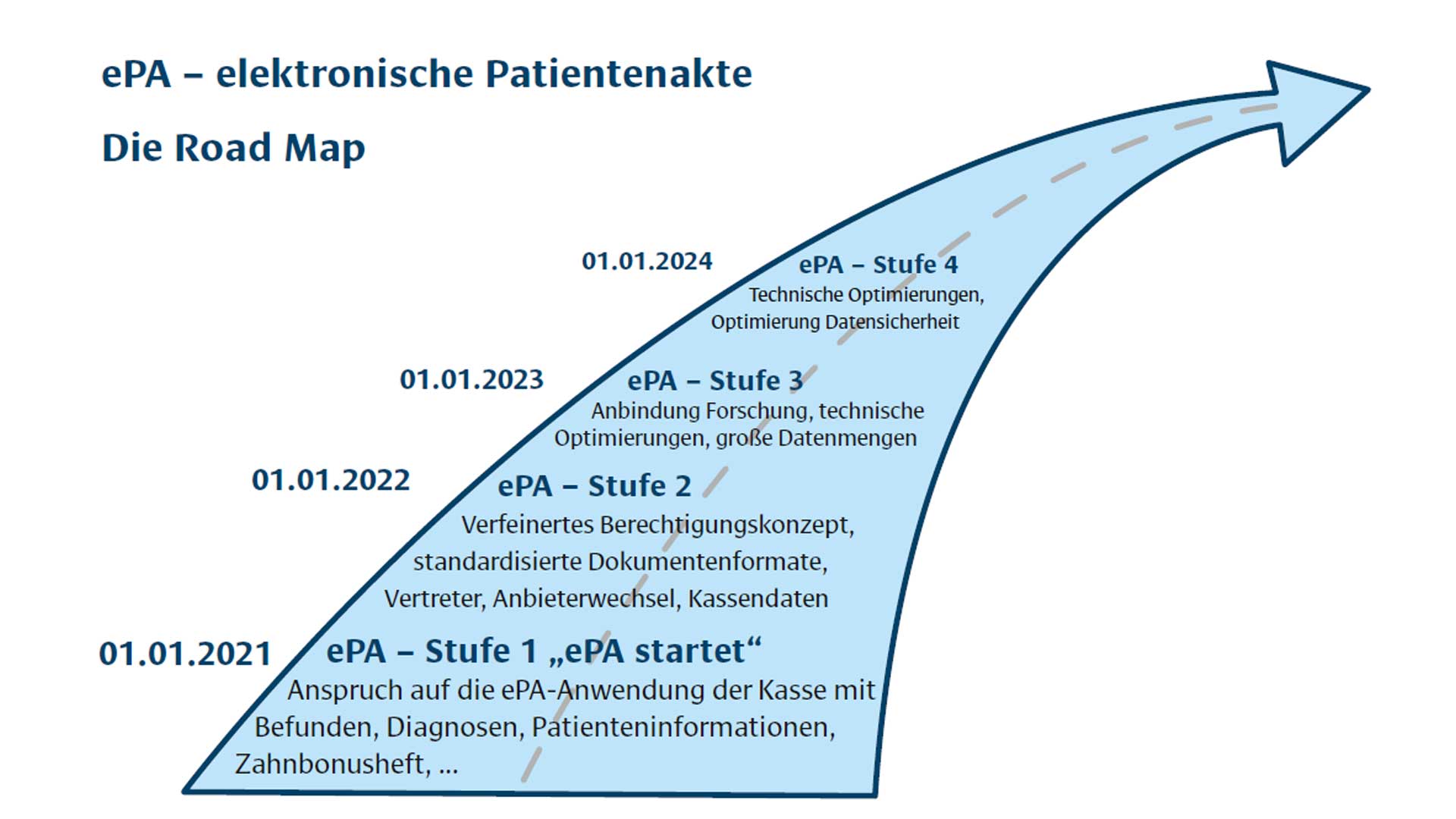
Introduction in four stages
The first phase will be introduced on January 1, 2021. This essentially includes patient-doctor communication, meaning my doctor can save measurement data and diagnoses from their practice management system to my electronic patient record (ePA). However, it appears that access rights will be limited in this initial version. If I grant my primary care physician permission, anyone in the practice will be able to read the information on my record.
Only with the second phase, on January 1, 2022, will an authorization concept be introduced that allows me to configure much more precisely who can view which of my documents and for how long. This phase will also include additional healthcare professionals, such as midwives, physiotherapists, nurses, and public health officials. Furthermore, access to passport-related documents, such as vaccination records, child health records, maternity records, and dental bonus booklets, will be included. It will also be possible to designate a representative for emergencies and to import additional data, for example, from health insurance companies (write access only, not read access!).
In the third stage (01.01.2023), data exchange with research will be linked and technical improvements in data exchange with large data sets will be implemented.
The final stage (January 1, 2024) – from today's perspective – will then include further technical optimizations, improvements to access rights control, and further enhancements to information security.
My conclusion as an Alpha-1 patient:
The first phase, starting January 1st, 2021, is really just a first step into this new technology. As someone interested in such systems, I will certainly get the electronic patient record (ePA) from my health insurance company and "try it out" with my family doctor and my pulmonologist. However, I will definitely only start using it properly when, in the second phase, I can more clearly define the access rights to my data.
What I'm still missing in the whole discussion about the electronic patient record (ePA) is the part where I can upload my "stored" data, which I've collected at home over many years, to the ePA so that I can make it available to my doctors. And this, in turn, raises the question for me whether a doctor even wants to see another doctor's diagnosis, or whether they always "measure and diagnose themselves" first anyway. It certainly makes sense to have medication and therapy plans and medical records in one place.
This remains exciting.
Information compiled from publications by gematik, BMG, KBV and the Ärzteblatt.