
Author
Dr. Heinz Stutzenberger, revised by Prof. Rembert Koczulla
Most people associate the term "sleep lab" with complaints such as snoring, sleep apnea, or significant daytime fatigue. These three types of complaints are the most common, but not the only reasons why patients visit a sleep lab. There are up to approximately 80 different forms of sleep disorders.
Overview: Sleep disorders1
Difficulty falling asleep and/or staying asleep (so-called insomnia)
Typical complaints include difficulty falling asleep, frequent awakenings during the night, difficulty falling back asleep, waking up too early in the morning, the feeling of "not sleeping deeply enough", and complaints of unrefreshing and insufficient sleep.
Disorders with increased daytime sleepiness (so-called hypersomnias)
Typical symptoms include difficulty staying awake during the day, involuntarily falling asleep or dozing off during the day, and feeling constantly drowsy despite sufficient sleep duration. Often, but not always, this is accompanied by snoring at night. Concentration and memory problems may also occur.
Sleep-wake rhythm disorders
A typical symptom is difficulty falling asleep at a "normal" time. Instead, those affected go to bed much earlier or much later, but then usually have no sleep problems. In other cases, no predictable sleep-wake rhythm can be identified at all. This is often a temporary problem after long-distance travel.
Sleep disturbances/abnormalities (so-called parasomnias)
This includes abnormalities in sleep such as sleepwalking, sleep talking, teeth grinding, and other things.
Morning headache, fatigue
Increase in blood carbon dioxide due to exhausted respiratory/accessory respiratory muscles.
Given the complexity of potential sleep disorders, it seems impractical to address the entire topic within the scope of this essay. Instead, a focus on the aforementioned widespread symptoms, such as daytime sleepiness, snoring, and pauses in breathing during sleep, appears more appropriate. The effects of these symptoms are usually daytime fatigue, lack of concentration, impaired memory, headaches, high blood pressure, and also the risk of microsleep episodes, which can occasionally have fatal consequences. These consequences include, on the one hand, sleep-related breathing disorders (SRBD) with disrupted sleep phases, and on the other hand, reduced blood oxygen saturation. It should also be noted that some sleep disorders, due to the associated noise, often negatively impact the sleep quality of the bed partner as well.
For a definitive diagnosis of these disorders and to determine appropriate treatment measures, those affected often consult a sleep laboratory. In Germany, there are several hundred sleep laboratories, more than 300 of which are certified by the German Society for Sleep Research and Sleep Medicine (DGSM).2, certified. Certification ensures that the laboratories in question have both appropriate equipment and adequately trained personnel.
The following measurements, bodily functions, and activities are recorded in the sleep lab.3:
- Brainwaves (they provide information about light/deep and dream sleep phases (REM*), measured with electrodes attached to the head (EEG**))
- Eye movements (also provide information about light/deep and dream sleep phases (REM*)), measured with attached electrodes (EEG**)
- Heart rate and heart rhythm, measured with electrodes attached to the chest (ECG***)
- Blood oxygen level, measured with a finger clip (oximeter)
- Airflow at the mouth and nose, measured using a stalemate device in the nose.
- Snoring sounds recorded with a microphone attached to the neck
- Breathing movements of the chest and abdomen, measured with strain gauges
- Muscle tension of the chin, measured with attached electrodes (EMG****)
- Leg movements, measured with attached electrodes (EMG****)
- Body position, measured with sensors in a chest strap
- Blood carbon dioxide (paCO2*****) measured with an ear clip (Transcutaneous CO2 measurement)
- Blood pressure (blood pressure cuff)
*) REM = Rapid Eye Movement; describes a sleep phase characterized by this eye movement with closed eyelids and accompanied by vivid dreams.
**) EEG = Electroencephalography = Measurement and recording of brain waves
***) ECG = Electrocardiography = Measurement and recording of the heart's electrical activity
****) EMG = Electromyography = Measurement and recording of electrical muscle activity
*****) paCO2 = Partial pressure (corresponds to the amount) of carbon dioxide in the blood
******) transcutaneous = through the skin without damaging it
To diagnose abnormal sleep patterns, patients are monitored in a sleep lab using an infrared video camera. Depending on the specific question being addressed, further diagnostic tests include esophageal manometry (pressure in the esophagus) and/or acid reflux (reflux) using a pH probe. These examinations are painless. Patients typically spend one to two nights in the sleep lab. The monitoring night begins around 7:30 p.m. with the wiring, and the measurement starts around 9:00 p.m. At that point, further important questions arise:
- Is it possible to sleep soundly with all those cables? Does the data collected under such unusual conditions even provide usable information? The cables might feel a bit strange and unfamiliar, but they don't affect sleep. Any blinking or buzzing measuring devices are not in the bedroom, but in an adjacent room. If necessary, a sleeping pill (zopiclone) can also be administered. This will not disrupt the sleep stages.
- Can one use the toilet if needed? The night staff can be summoned via a call button, and the measuring cables can be removed and just as quickly reconnected to the data acquisition system; a commode is also available if necessary.
If snoring can be confirmed as the primary cause of the sleep disturbance and a sleep-related breathing disorder can be ruled out, then there is a wealth of possible treatment options. These range from behavioral changes to the use of simple aids (such as a sleep shirt).+, mandibular advancement splint++, …) up to various types of surgical interventions and, in exceptional cases, also to hyperbaric oxygen therapy.4.
+) Shirt with the option of inserting a bulbous air cushion in the back, which prevents the wearer from lying on their back, thus reducing the risk of the tongue falling back and preventing snoring.
++) Two-part splint system for the lower and upper jaw, which slightly advances the lower jaw, thereby preventing narrowing or blockage of the airway.
Sleep-related breathing disorders are associated with significantly higher risks of developing secondary diseases or are themselves a comorbidity of other underlying conditions. Most patients suffer from cardiovascular diseases.
For the treatment of sleep-related breathing disorders, continuous positive airway pressure (CPAP) therapy is the treatment of choice. With this therapy, patients wear a breathing mask connected to a breathing machine while sleeping. They breathe in and out against a slight positive pressure (room air), thus keeping the airway open.
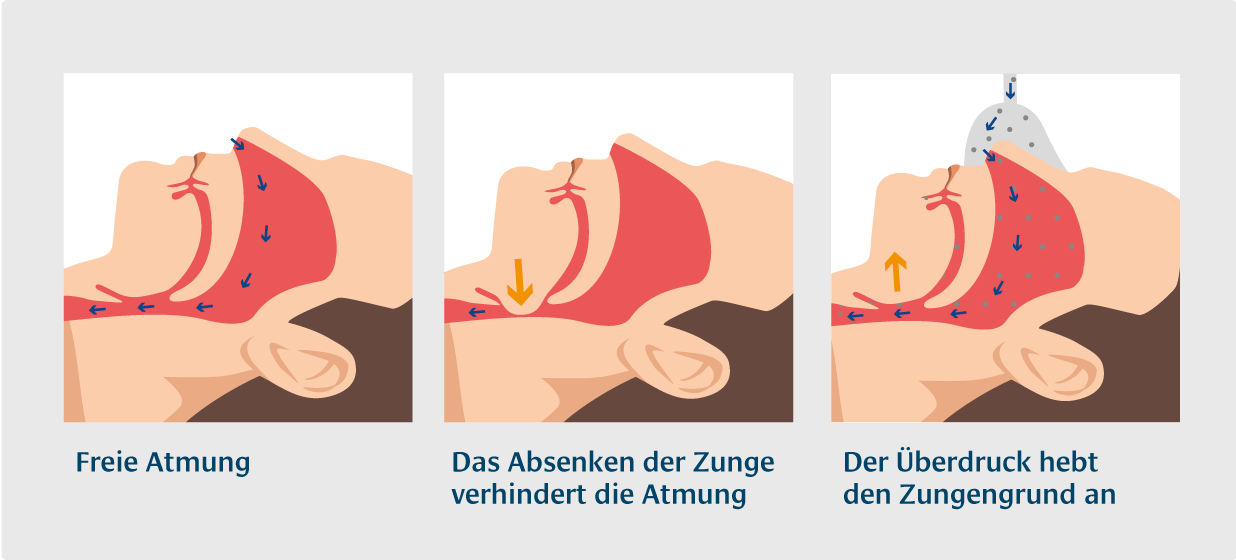
CPAP
CPAP stands for Continuous Positive Airway Pressure, in which a small compressor builds up a slight positive pressure and keeps the airways open via a nasal or mouth/nasal mask.
APAP
An advanced form of CPAP therapy is called APAP therapy (Automatic Positive Airway Pressure). Here, the device automatically determines the necessary therapeutic pressure with each breath. Instead of a fixed, constant pressure, the device only generates as much positive pressure as the patient currently needs.
BiPAP
„BiPAP“" stands for "„bilevel positive airway pressure“ (bilevel = two levels, PAP = Positive Airway Pressure) is a form of therapy that is mainly suitable for patients for whom the pressure of standard CPAP or APAP therapy is insufficient during inhalation.
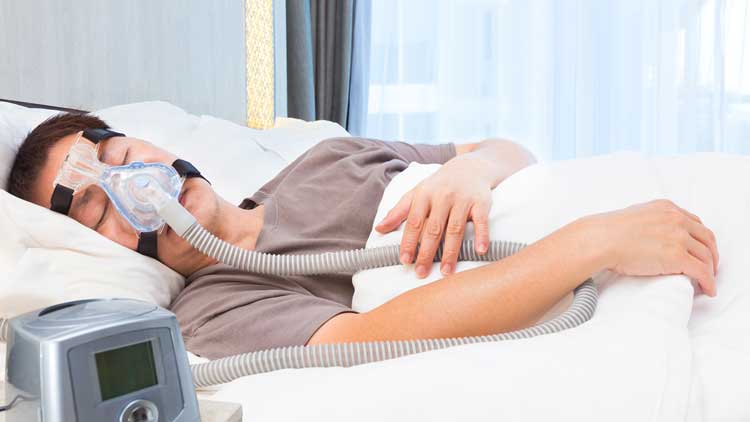
Sleeping with a mask over the nose or mouth/nose, and the noise of the therapy device, usually takes some getting used to, and sometimes a little patience is needed to find the individually optimal mask. In most cases, however, CPAP or another form of therapy can significantly improve the sleep quality and thus also the quality of life of sleep apnea patients.
The initial setup of the CPAP device and the optimization of the setting parameters are carried out in the sleep lab, although in individual cases a longer stay may be necessary before home use can begin.
All the explanations given so far refer to individuals without other respiratory illnesses. The situation becomes somewhat more complicated when people with already impaired lung function also suffer from the problems described above, such as COPD patients, but also those with A1ATM. Such cases are referred to as "overlap."6. In more severe cases, it is necessary to determine in a sleep lab which of the two underlying conditions (e.g., sleep-related breathing disorder or lung function impaired by A1ATM) contributes more to the reduction in blood oxygen saturation, as this finding significantly influences the choice of therapy. Since the accuracy of this diagnosis also depends on the experience of the sleep lab staff, it is advisable to obtain a recommendation for a suitable laboratory from your referring physician at the Alpha1 Center if you are referred.
For patients with statutory health insurance, a referral from a specialist is the necessary and sufficient condition for the health insurance company to cover the costs of the sleep study. Privately insured patients should clarify coverage with their insurance company in advance.
Depending on the disease to which the greater proportion of reduced blood oxygen is attributed during the examination in the sleep laboratory, the further procedure then looks like this.6:
- If sleep apnea is the predominant cause, then standard CPAP therapy is usually used.
- If impaired lung function with failure of the muscle pump and elevated CO2 levels is the predominant cause, then BiLevel PAP therapy is usually the treatment of choice.
Therefore, in summary, the following can be stated for those affected by A1ATM:
- A visit to a sleep lab may be advisable if, in addition to the problems caused by A1ATM, there are indications of an additional sleep disorder – see symptoms above.
- If the identified sleep disorder affects blood oxygen saturation during sleep, then a sleep lab can determine which of the two underlying conditions has the greater impact on reducing oxygen levels.
- If non-invasive pressure ventilation is to be performed to improve oxygen saturation during sleep, then another stay in a sleep laboratory is recommended to adjust the necessary device parameters.
Sources (accessed in July 2022):
- https://www.schlafgestoert.de/site-6.html
- https://www.dgsm.de/
- https://www.apotheken-umschau.de/diagnose/diagnoseverfahren/die-untersuchung-im-schlaflabor-744157.html#was-wird-im-schlaflabor-gemessen
- https://www.apotheken-umschau.de/krankheiten-symptome/symptome/strategien-gegen-das-schnarchen-716629.html
- https://www.jedermann-gruppe.de/cpap-beatmung/#:~:text=CPAP%20und%20das%20Obstruktive%20Schlafapnoe%2DSyndrom&text=Die%20Atemaussetzer%20entstehen%20durch%20die,Zunge%20sich%20nicht%20absenken%20kann
- https://www.copd-aktuell.de/copd-und-schlafapnoe#:~:text=Diagnose%20im%20Schlaflabor,erholsamem%20Schlaf%20und%20h%C3%A4ufiger%20Tagesschl%C3%A4frigkeit
Experiences of our members
Our members' experiences vary widely. From conversations, we gather that sleep labs can be helpful and have a legitimate place in the healthcare system. However, as is so often the case, the knowledge and empathy of the treating physicians also play a crucial role. These factors seem to determine whether the therapy is successful and whether the patient adapts to wearing a sleep apnea mask.
Here are some user reviews:
Petra: A sleep lab visit isn't scary at all! You'll be scheduled for an appointment in the evening or late afternoon (bring your pajamas). The doctor will then have a personal consultation and explain everything. This may have already been done beforehand at the doctor's office. At bedtime, measuring devices will be attached. Electrodes will be placed on your head, abdomen, chest, etc., wherever needed. There are quite a few. It doesn't hurt! You'll eventually fall asleep, and your sleep will be monitored – for example, oxygen saturation, heart rate, and more. There will be video recordings, and then the analysis will be done. This might happen immediately, or you could schedule an appointment. It helped me a lot.
Barbara: I've been to the sleep lab three times and have noticed that the main goal seems to be pushing sleep apnea devices on people. I think a lot depends on who's doing the testing and what the prescription says. The first time, several years ago, I was told: "You can decide for yourself whether you want the machine or not. It's not absolutely necessary." That's odd. The second time, I got the continuous positive airway pressure (CPAP) mask, even though they only detected a drop in my oxygen saturation. I'm still waiting for the results from the third time; it's about the oxygen deprivation during the night again. I hope I haven't scared anyone off. Best of luck!.
Lothar: My experience was very negative. The diagnosis: multiple sleep apnea episodes during the night. So I went to a sleep lab, was hooked up to monitors, and couldn't fall asleep for a very long time. I stayed another night, during which I still couldn't fall asleep until they gave me a pill to help. Naturally, I then slept wonderfully. I was given a CPAP mask, which a technician from the company explained to me very thoroughly and clearly. My first attempt failed miserably; I couldn't fall asleep, only lasted an hour, and then threw the mask in the corner. My pulse increased with the mask on, and I felt bloated. I tried many more times and also adjusted the airflow, but nothing helped. After an hour at the most, the mask ended up back in the corner. Unfortunately, no doctor understood this when I had my follow-up appointment a year later. So I'm no wiser than before.
Heike: I've already had several visits to the sleep lab. Especially with the problem that many people with apnea are probably familiar with—that oxygen saturation fluctuates significantly and can drop, particularly at night—it's difficult to get a reliable diagnosis from the sleep lab. Here, I see the main problem as the short study time, and the oxygen saturation might not be typical during the day. On the other hand, I can easily imagine that it can be very helpful for some, especially apnea patients with daytime sleepiness, in finding the right therapy/mask. As is so often the case, it comes down to knowledge, practice, and perseverance until the problem is resolved satisfactorily.
Uwe: It wasn't easy in the sleep lab. I had a very hard time falling asleep the first night, so it was good to have a second night to get used to the sounds and the environment. Later, when choosing the mask, my respiratory therapist and oxygen supplier provided excellent support. In fact, it wasn't until the fourth mask that I found one that fit properly. If the mask isn't fitted correctly, the machine whistles very loudly, and you have to learn how to use it. A sleep aid helped me during the first few days. My muscles were able to relax at night, and in the end, I was significantly more energetic during the day—a noticeable improvement in my quality of life. But it wasn't just difficult for me to get used to the nighttime mask—my wife found it just as hard. My advice: you have to be willing to commit to it!


