„"If someone has no fear, he has no imagination."“
This quote from Erich Kästner opens an introduction to illness-related anxieties. Anxiety has many faces – including in patients with alpha-1 antitrypsin deficiency. Often, anxieties remain unspoken in routine treatment. But it is precisely repressed anxieties that unleash their destructive power. Confronting them courageously is all the more worthwhile.
Common anxieties in patients with chronic lung diseases
Alpha-1-antitrypsin deficiency (AATM) shows similar lung changes to a „classic“ COPD. For COPD patients, there are now not only studies on typical anxieties, but also a valid (reliable) assessment tool – the COPD Anxiety Questionnaire (CAF). It lists the most common disease-related anxieties:
- Fear of dyspnea (shortness of breath)
- Fear of physical activity
- Fear of social exclusion
- Progression anxiety (fear of the disease progressing) and end-of-life anxiety (fear of dying and death)
- Fear regarding partnership
- Anxiety regarding LTOT (long-term oxygen therapy)
These disease-related anxieties are interconnected and affect the psychological well-being, quality of life, and disease progression of COPD patients. It is reasonable to assume that the similar lung symptoms lead to comparable anxieties in AATD patients. A vast field for research! However, this and the following articles will focus on the significance of these anxieties for daily life with AATD. The commonalities as well as the specific characteristics of each anxieties will be examined in turn.
First section: Anxiety about shortness of breath
For example, one patient describes their fear of shortness of breath like this: "When I can't breathe anymore. Pure panic – that's something that sticks in your memory. It's difficult to manage on your own." Those who have experienced fear during shortness of breath often subsequently develop a fear of shortness of breath and, as a result, fears related to shortness of breath triggered by situations such as physical or emotional stress. Psychopneumology uses established psychological concepts to address shortness of breath anxiety and adapts them to the specific situation of patients with chronic lung diseases.
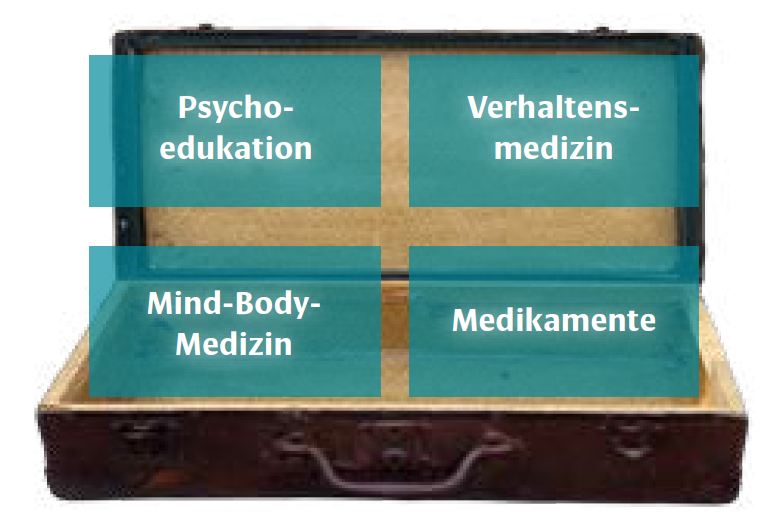
What helps with anxiety related to shortness of breath?
The following resources comprise the "solution kit" for patients with anxiety related to shortness of breath. Patients should be familiar with all the resources and use their personal "favorites" as needed. Let's look at the individual elements of the "solution kit" one by one.
Psychoeducation
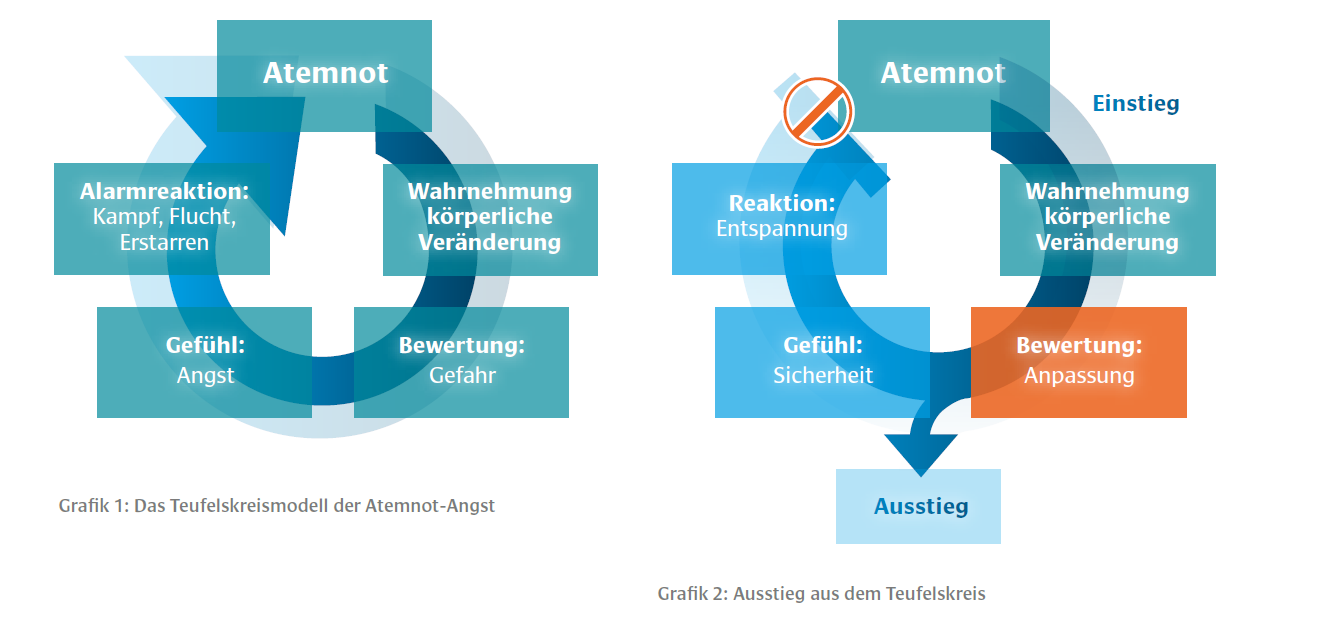
Behind this unwieldy term lies the communication of a disorder concept, e.g., the vicious cycle model of shortness of breath-related anxiety (see Figure 1). This model can also be used to explain how to break out of the vicious cycle – see Figure 2.
Behavioral medicine
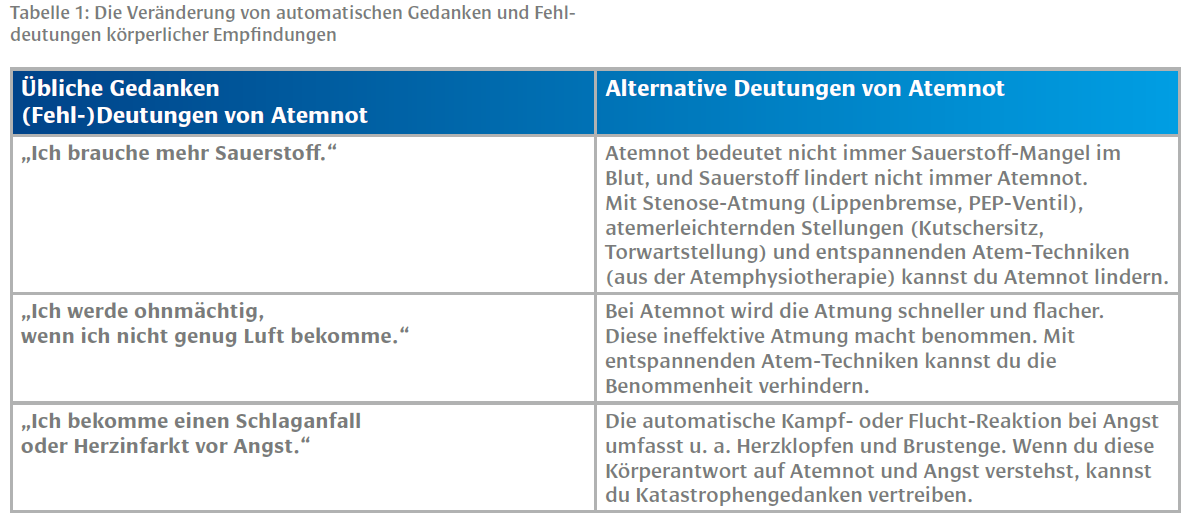
This includes, for example, behavioral therapy methods such as changing automatic thoughts and misinterpretations of bodily sensations (see Table 1).
Behavioral medicine takes the most effective approach to treating anxiety through exposure therapy. This involves diminishing the power of anxiety by redirecting attention. Interventions from mindfulness-based therapy, such as the following, have proven effective:
- observe one's own thinking
- Develop composure
- consciously perceive the present moment
- know what is truly important to me
Short-term distraction strategies are also helpful, e.g. the 5-4-3-2-1 method:
- Carefully observe and name 5 objects in the surroundings.
- 5. Attentively perceive and name sounds/noises
- Discover and name 5 colors in the surroundings
then:
- Observe and name 4 objects (they can be the same as above or different ones)
- 4 noises/sounds …
- 4 colors…
thereafter:
- 3 items…
- 3 noises/sounds
- 3 colors…
etc… You've already understood the principle, haven't you?!
Mind-body medicine
This area encompasses all methods for strengthening self-efficacy, where patients learn to influence their physical symptoms through regular practice, such as breathing techniques, relaxation methods (progressive muscle relaxation), biofeedback, functional relaxation, yoga, Tai Chi, Qi Gong, etc. Unfortunately, when I suggest these methods to patients, I repeatedly encounter skepticism and rejection. However, studies have shown that mind-body medicine approaches, in particular, have positive effects on self-efficacy beliefs. This increased competence is, in turn, crucial for coping with anxiety related to shortness of breath.
Medications
Despite skepticism towards "psychotropic drugs," anxiety-relieving medications can sometimes be helpful after careful consideration. Sometimes they even pave the way for psychological treatment.
Offers. You can learn more about the individual elements in the "solution kit" for patients with shortness of breath anxiety in The brochure „Anxiety during shortness of breath – ways out of the vicious cycle“ is available for free download..
outlook
Closely related to the fear of shortness of breath is the fear of physical activity. This "exercise anxiety" leads to withdrawal and, in turn, intensifies the fear of relationship problems and social isolation. Finally, the fears of worsening symptoms and life-threatening situations cannot be separated from the other experiences of the illness. The various fears are closely intertwined – yet they manifest in different forms. The following articles will examine other fears associated with AATD, including fears of the social consequences and the progression of the disease. Not easy reading! But engaging with these topics is worthwhile – true to the saying...