New figures for PiZZ victims
Author
Alpha1 Germany eV, as published in Alpha1 Journal 2/2017
In February 2017, a new worldwide study was published in the International Journal of COPD, addressing current figures on the prevalence of alpha-1 antitrypsin deficiency: „Alpha-1 antitrypsin Pi*Z gene frequency and Pi*ZZ genotype numbers worldwide: an update.“ The study was led by Dr. Ignacio Blanco, coordinator of the Spanish Alpha-1 Registry (REDAAT) and a reviewer for research projects for the Spanish National Agency for Assessment and Prognosis (ANEP).
Blanco focused exclusively on the Z allele and analyzed a total of 224 cohorts from 65 countries worldwide, comprising 253,404 individuals. For Europe, he collected data from 25 countries with 90 cohorts and a total of 75,603 participants.
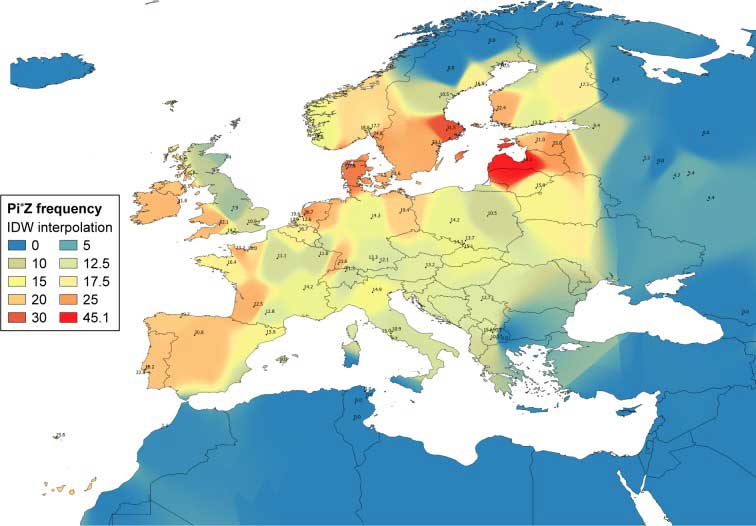
The graphic (see below) shows that Latvia is by far the most affected country by PiZZ, with a rate of 1:491, followed by Estonia (1:663) and Denmark (1:1,368). Germany, with 1:3,916 PiZZ cases, is in the lower middle range.
For his assessment of Germany, Blanco used a population of nearly 81 million and determined a frequency of 0.026% for the Z allele, which corresponds to almost 21,000 PiZZ. In 2007, Blanco had already compiled similar worldwide study data, from which he had calculated a frequency of 0.01% for Germany (PiZZ). According to Blanco, the frequency of people affected by alpha-1 antitrypsin deficiency with PiZZ has doubled in Germany within ten years! The only question is whether this assessment is due to improved data or whether there are actually more people with Alpha-1 disease.
Dr. Timm Greulich from UKGM Giessen/Marburg arrived at similar current figures for affected individuals in his study from March 2017: „The prevalence of diagnosed Alpha-1-antitrypsin deficiency and its comorbidities: results from a large population-based database.“ His result: 19,162 cases of PiZZ in Germany, which corresponds to a prevalence of approximately 0.024%.
Is alpha-1 antitrypsin deficiency still considered a rare disease?
In the European Union, a disease is defined as "rare" if it affects a maximum of 5 out of 10,000 people. Based on Germany's current population of 82.8 million, this means that a rare disease must not affect more than 41,400 people. Alpha-1 antitrypsin deficiency is considered the most common genetic cause of pulmonary emphysema in adults and liver disease in children. Using the latest figures of approximately 19,000-20,000 people affected by PiZZ (a specific genetic disorder), the genetic defect remains a rare disease, even though rarer mutations with severe manifestations must be added to these numbers. We are not aware of any new studies on the figures for rare mutations.
Alpha1 Germany has been pointing out for years that the deficiency remains underdiagnosed and the number of undiagnosed cases is high. These studies show that we are correct in our assessment that there are significantly more people with Alpha1 than currently assumed.
We corrected the reported number of affected individuals at the beginning of the year and have discussed the implications extensively internally and with experts. Not all of our questions have been answered yet, but the studies are a first step in the right direction.
For further reading:
Blanco's Overview of Alpha-1 Antitrypsin Deficiency: History, Biology, Pathophysiology, Related Diseases, Diagnosis and Treatment
Author: Ignacio Blanco / eBook ISBN: 9780128095416 / Hardcover ISBN: 9780128095300 Imprint: Academic Press / Published Date: 3rd May 2017
The prevalence of diagnosed Alpha-1-antitrypsin deficiency and its comorbidities: results from a large population-based database
Timm Greulich, Christoph Nell, David Hohmann, Marco Grebe, Sabina Janciauskiene, Andreas Rembert Koczulla, Claus Franz Vogelmeier European Respiratory Journal 2017 49: 1600154; DOI: 10.1183/13993003.00154-2016
Thus appeared in Alpha1 Journal 2/2017.