
Author
Marion Wilkens | As published in Alpha1 Journal 1/2025.
Resilience in focus: How we as a society and in the healthcare system can become stronger
Under the motto "Resilience – Strengthening Oneself and Others," the 131st Congress of Internal Medicine of the German Society for Internal Medicine (DGIM) took place in Wiesbaden from May 3 to 6, 2025. With approximately 9,000 participants, Congress President and DGIM Chairman Professor Dr. Jan Galle sent a clear message: Resilience – the ability to cope with stress and grow from challenges – is of central importance, especially for chronically ill people, their families, and medical staff.
In times of skilled labor shortages, structural reforms, and global crises, the question increasingly arises: How can medical care remain humane, sustainable, and of high quality even under difficult conditions – and how can medical staff themselves stay healthy? These challenges affect not only professionals but also patients directly. Resilience is no longer a "nice-to-have" but a fundamental requirement – because only those who maintain a clear head under stress can provide empathetic and competent treatment and avoid errors at the end of a long workday.
What is resilience?
Resilience describes mental and physical resilience – and it can be trained. This was also emphasized by Professor Dr. Imad Maatouk, Head of the Department of Psychosomatic Medicine at the University Hospital of Würzburg. Professor Galle, Director of the Department of Nephrology at the Lüdenscheid Hospital, underlined: „The development of resilience is a lifelong process. Our task in internal medicine is to accompany and support patients and medical staff on this path.“
The congress not only brought together experts from clinics, practices, and research, but also addressed societal issues surrounding the topic of resilience. With the participation of the international aid organization Doctors Without Borders, a prominent partner was secured for the first time, one that impressively demonstrates how resilience is practiced under extreme conditions. Dr. Tankred Stöbe, internist and author, emphasized: "Sometimes it helps more to take action than to stand by helplessly – that, too, is resilience."„
A previously often-overlooked topic also came into focus: climate change. Dr. Martin Herrmann, co-founder and chairman of KLUG e. V. (German Alliance for Climate Change and Health), emphatically drew attention to the health consequences of increasing heat stress. The Robert Koch Institute (RKI) estimates around 3,200 heat-related deaths in the summer of 2023 and approximately 3,000 in 2024 – primarily affecting vulnerable patient groups. Their protection requires adapted structures in hospitals, medical practices, and public life. Relevant expert presentations at the congress provided important insights.
Impressions
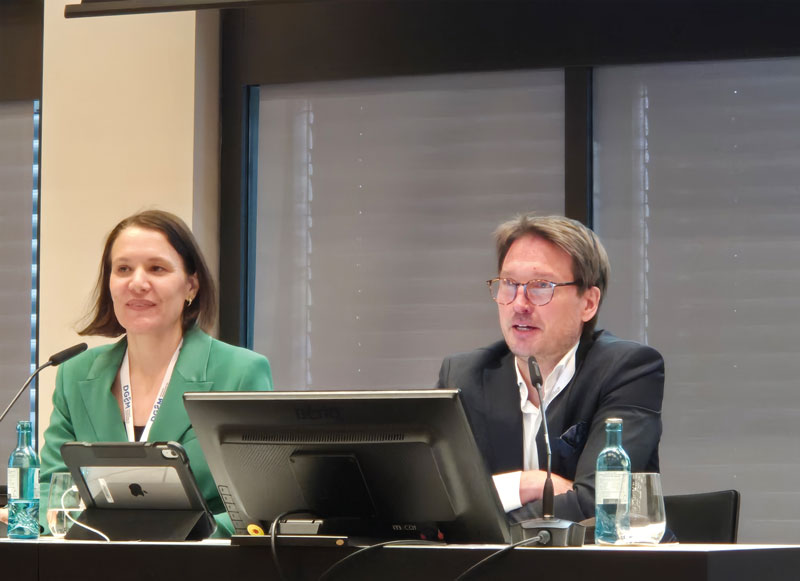
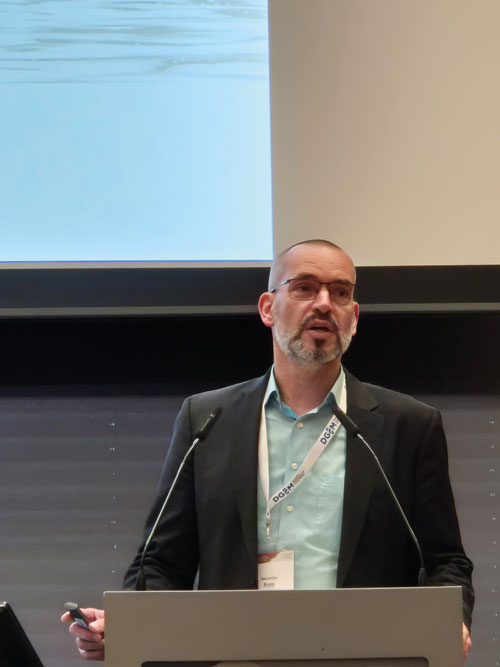
Focusing on Alpha-1: Our advisory board members Prof. Dr. Trudzinski (Heidelberg, Figure 1, left), Prof. Dr. Koczulla (Schönau, Figure 1, right) and Dr. Rupp (Stuttgart, picture right).
Personal stories: "Focus on what you can influence."„
A particularly moving contribution was made by Franziska Liebhardt, three-time organ transplant recipient and Paralympic champion, and chairwoman of the association KiO e. V. (Children's Aid for Organ Transplantation – Athletes for Organ Donation). She spoke openly about setbacks, new beginnings, and the courage to develop new perspectives. Her message: Resilience doesn't mean invulnerability – but rather the ability to get back up and keep going. Her most compelling statement: "Focus on what you can influence."„
Dr. Christian Becker, spokesperson for the Young German Society for Internal Medicine (DGIM) and cardiologist at the University Medical Center Göttingen, drew a connection to digitalization. In his view, dealing with new technologies such as artificial intelligence (AI) also requires resilience. The worst solution, he said, is to avoid engaging with digitalization altogether. Ideally, physicians should use the strengths of AI to further develop their own skills in patient care.
Fact check
Developments in Internal Medicine
- 42 % of the internists are women
- 18 of the internists are under 40 years old.
- 30 % work part-time
- 30 of the general practitioners come from internal medicine.
The number of employed internists increased from 2,807 (2016) to 4,027 (2020).
Regional differences continue to shape the supply situation.
Pulmonology and rare diseases in focus
Pulmonology was also represented at the DGIM Congress. A particularly informative lecture on Saturday was given by Dr. Sommerwerck, Prof. Dettmer, and Prof. Vogelmeier. Unfortunately, there was little interest in the topic of bronchiectasis – a cause for concern. If this condition receives so little attention, how difficult must it be to gain recognition for rare diseases like alpha-1 antitrypsin deficiency?
Ethics and AI: Challenges for the future
The third day of the congress began with a press conference on a highly topical issue: artificial intelligence in medicine. Professor Hirsch emphasized that AI not only supports diagnostics and documentation but also fundamentally changes the doctor-patient relationship. In the future, physicians will also need to be able to explain the assessments of AI systems in an understandable way – a new dimension of trust in treatment. Alpha1 Germany supports the demand that the use of AI in the sensitive field of medicine must follow clear ethical guidelines.
Strong finish with Alpha-1 in focus
A highlight at the close of the congress was the industry symposium hosted by CSL Behring, dedicated to the topic of alpha-1 antitrypsin deficiency – and, to our delight, very well attended. Led by our advisory board members Prof. Dr. Trudzinski (Heidelberg) and Prof. Dr. Koczulla (Schönau), as well as Dr. Rupp (Stuttgart), also an advisory board member of Alpha1 Germany, who contributed the practical perspective of a practicing pulmonologist, the symposium focused on raising awareness of alpha-1. A successful conclusion to our congress visit. Whether physician, patient, or family member – resilience is a topic that affects us all. The 2025 DGIM Congress impressively demonstrated how we, in our daily medical practice and as a society, can learn to cope with crises, strengthen one another, and find new paths forward. Alpha1 Germany was right in the thick of it – and we are taking away many important insights.


