

Author
Prof. Sabina Janciauskiene
Human alpha-1 antitrypsin has at least two distinct functions: inhibition of proteases and regulation of immune cell responses. Therefore, AAT therapy can be beneficial in various acute inflammatory conditions, including COVID-19.
The positive effects of AAT therapy have also been suspected in lung transplantation. Scientists have reported that AAT therapy improves lung function in transplanted animals. In a rat model, for example, post-transplantation damage was significantly less when the donor lung was treated with AAT and the recipient animal was also treated with AAT. In a pig model, treating the recipient pig's lung with AAT before transplantation significantly improved the survival rate. Furthermore, lungs that were perfused and stored in an AAT-enriched organ preservation solution (Perfadex) showed significantly less damage after transplantation than lungs stored in Perfadex without AAT. In a mouse model, we were also able to demonstrate that AAT therapy inhibits apoptosis* and influences lymphocyte subsets, thereby promoting recipient survival.
We know that lung transplantation in patients with AAT deficiency does not correct the inherited AAT deficiency that originally led to the development of this condition. Therefore, patients remain at risk of developing emphysema and its associated clinical consequences after transplantation. We believe that AAT therapy after transplantation may be beneficial. AAT therapy may even be more important for those lung transplant recipients who received AAT treatment before transplantation. We have previously reported that AAT-deficient patients who received AAT therapy before, but not after, lung transplantation have worse survival rates than AAT-deficient patients without prior augmentation or COPD patients with a normal genetic variant of AAT. AAT therapy administered after lung transplantation may prove to be anti-inflammatory and immunomodulatory (modifying the immune system). We are continuing our studies on the effects and mechanisms of AAT not only during acute, but also during chronic lung rejection.
The functions of AAT are controlled by different structural segments of the AAT protein. Several fragments of AAT exhibit impressive anti-inflammatory effects. We hope that some AAT peptides could serve as a basis for the development of novel anti-inflammatory drugs and as a research tool for a better understanding of AAT functions.
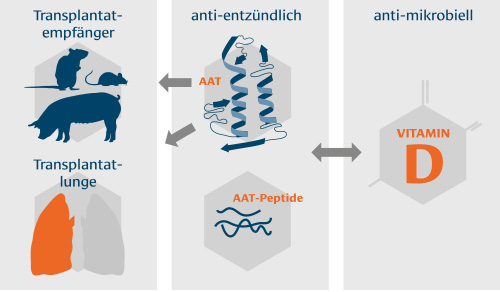
Vitamin D enhances anti-inflammatory and antimicrobial processes that promote respiratory health. Vitamin D synthesis is initiated after skin exposure (sunlight), but supplementation may be necessary to correct a deficiency, for example, during the winter months. Research has shown that vitamin D increases AAT production in human lymphocytes, and this response is impaired in individuals with ZZ AAT deficiency. Vitamin D-generated AAT contributes to local immune stimulation and respiratory health effects previously attributed to vitamin D. Further research is underway to understand the relationship between vitamin D, lung AAT levels, and lymphocytes.
Apoptosis is a form of programmed cell death. It is a 'suicide program' of individual biological cells. This can be triggered externally or by internal cellular processes. (Wikipedia)
** Translated from the English by Marion Wilkens. Original version on our website.
References
- Nakagiri T, Wrenger S, Sivaraman K, Ius F, Goecke T, Zardo P, Grau V, Welte T, Haverich A, Knöfel AK, Janciauskiene S. Alpha-1-antitrypsin attenuates acute rejection of orthotopic murine lung allografts. Respir Res. 2021
- Conrad A, Janciauskiene S, Kohnlein T, Fuge J, Ivanyi P, Tudorache I, Gottlieb J, Welte T, Fuehner T. Impact of alpha 1-antitrypsin deficiency and prior augmentation therapy on patients' survival after lung transplantation. Eur Respir J. 2017.
- Lior Y, Shtriker E, Kahremany S, Lewis EC, Gruzman A. Development of anti-inflammatory peptidomimetics based on the structure of human alpha1-antitrypsin. Eur J Med Chem. 2021
- Chen YH, Cheadle CE, Rice LV, et al. The Induction of Alpha-1 Antitrypsin by Vitamin D in Human T Cells Is TGF-Beta Dependent: A Proposed Anti-inflammatory Role in Airway Disease. Front Nutr. 2021


