
Alpha-1 antitrypsin deficiency: Rare mutations
Author
Dipl.-Biologist Martina Veith, PD Dr. med. Timm Greulich
The cause of alpha-1 antitrypsin deficiency (AAT deficiency) is mutations (alterations) in the SERPINA1 gene (serine protease inhibitor A1 gene), which is located on chromosome 14. The AAT gene exhibits considerable genetic variability. Currently, over 100 different mutations of the SERPINA1 gene are known, including many rare mutations that can lead to structural changes in AAT and thus to clinical presentations of varying severity. Mutations in this gene can, but do not necessarily, lead to AAT deficiency. Depending on the type and location of the mutation on the SERPINA1 gene, the function of the AAT protein is more or less impaired, ranging from mild to complete absence. In some mutations, e.g., In the case of the frequently occurring Z mutation, the molecule accumulates in the liver, leading to a deficiency of AAT throughout the body. This results in the protective function (enzymatic breakdown of lung tissue) being impaired or completely lost. This can lead to dysfunction of various organs, particularly the liver and lungs. AAT allele variants are classified into groups: Normal (Pi*M allele) = normal serum AAT level, Deficiency = significant reduction in serum AAT level, Null (Q0) = no detectable AAT. The different mutations are designated with letters from AZ and Null (Q0) and correspond to the migration rate during pH-dependent electrophoretic separation of the alpha-1 protein. The normal (healthy) allele is designated M. (Fig. 1). Since the human genome consists of a double set of chromosomes, the formula Pi*MM denotes a healthy person without the mutation (Pi stands for protease inhibitor, and the two following capital letters indicate the state of the two alleles). A distinction is made between homozygous, heterozygous, and compound heterozygous forms. Homozygous means that both alleles are identical; in the case of a disease, both alleles carry the same disease-causing mutation (e.g., Pi*ZZ). In the heterozygous form, only one gene copy (allele) is affected by the mutation, while the other remains unchanged (e.g., Pi*MZ). In the compound heterozygous mutation, two different mutations are present on both alleles (e.g., Pi*SZ). Most rare mutations have a name in addition to the letter, which is based on the patient's place of birth or the location or institution where the mutation was first discovered, e.g., Pi*MWürzburg, Pi*LOffenbach, Pi*YBarcelona, Pi*Q0Matthew. There are some very rare mutations that have only been detected once so far. For some of these mutations, no name has been assigned; only the exact location of the mutation on the gene is given, e.g., c221T > A.
Little is still known about the epidemiology of rare AAT variants. The results from the Marburg Alpha-1 laboratory show rare variants in only 1 of the % samples submitted, suggesting a very rare occurrence in the population (Fig. 2Accurate diagnostics are crucial for detecting rare and previously undescribed mutations. Various analyses are available for this purpose, including determining serum AAT levels, genotyping (at the DNA level, screening for the 14 most common and rare AAT mutations), phenotyping (at the protein level), and, if necessary, sequencing (at the DNA level, complete coding region). Serum AAT levels are essential for detecting rare mutations and are also very important for the clinical evaluation of the detected mutations. In most cases, rare mutations can only be discovered by evaluating these various methods. Due to the very small number of patients, the clinical course of rare AAT mutations is difficult to assess. Questionnaire surveys are currently being conducted to gain a better understanding of this. For many rare mutations, no definitive statement can be made regarding the clinical presentation due to a lack of comparability. In the case of a rare disease like alpha-1 antirypsin deficiency, it is crucial to pool expert knowledge to facilitate comparison and exchange. One of the most important goals of current research is therefore to identify commonalities in order to understand the different disease courses despite identical mutations and to develop more targeted treatments.
By participating in the questionnaire, patients can actively contribute to research and a better understanding of the disease, which in turn benefits those affected.

Figure 1: pH-dependent electrophoretic separation of the differently mutated alpha-1 proteins (AZ). The normal (healthy) allele is designated M (M1-M4) (Ignacio Blanco. Blanco's Overview of Alpha-1 Antitrypsin Deficiency. 2017, p. 108).
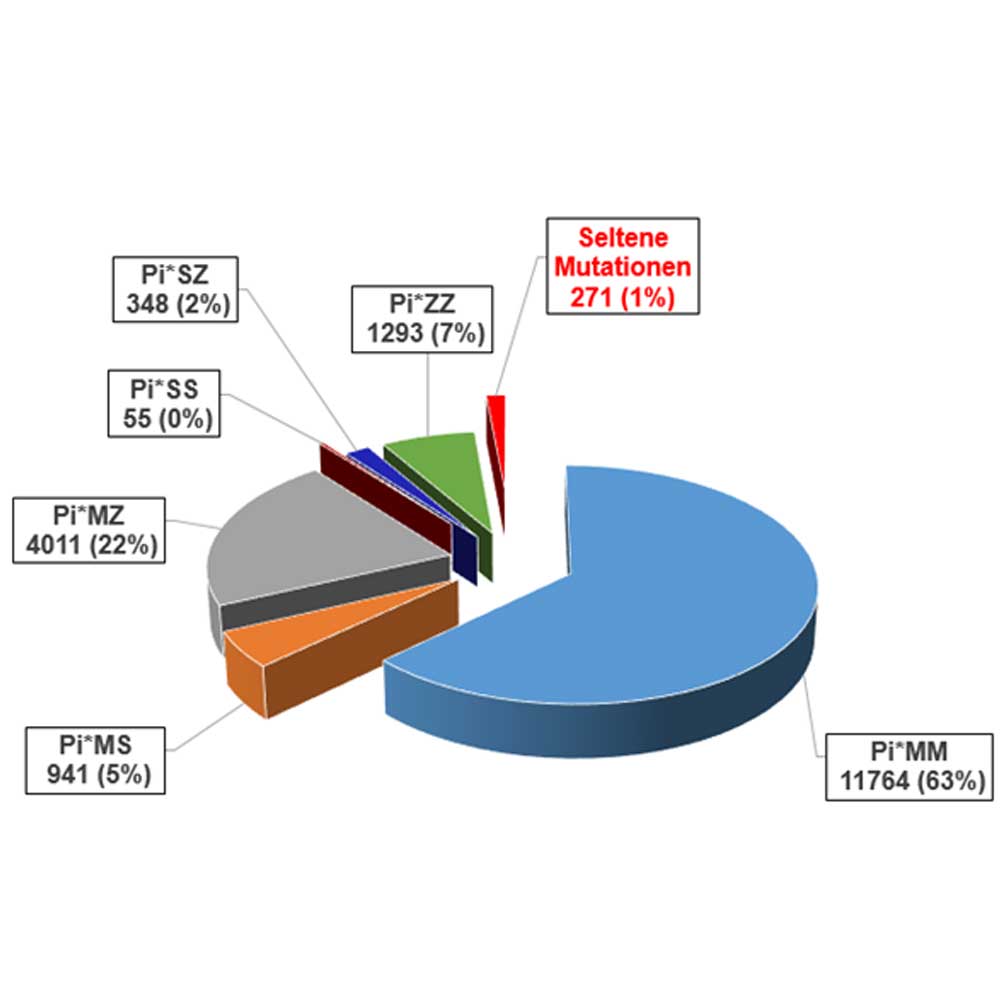
Figure 2: Distribution of mutations in a total of 18683 patients (Pi*MM=Healthy) (Greulich et al. Results from a large targeted screening program for alpha-1-antitrypsin deficiency: 2003 – 2015. Orphanet Journal of Rare Diseases 2016; 11:75).
Get rid of spring fatigue and get started with spring cleaning!
Actually, spring cleaning fits well with our 2019 motto "get off the sofa and into life," but did you know that we lung patients have a good excuse not to overdo it with the cleaning?
Many cleaning products not only tackle dirt but also release fumes that end up in our lungs and damage them. Besides shortness of breath, allergies and skin irritation are also common problems associated with cleaning.
According to a study by the Norwegian University of Bergen, women who regularly clean or clean professionally are more likely to experience a significant decline in lung function in the long term. The data were published in the American Journal of Respiratory and Critical Care Medicine.
For further reading, we have found the following links for you:
Did you know:
There were 797 organ donors in Germany in 2017, almost 500 fewer than seven years earlier. Although 84 percent of Germans declare their willingness to donate organs, only 36 carry an organ donor card. (Source: Apotheken Umschau 01/2019)

Introduction to an ABC of the liver
Author: Alexander Niepel, Group Leader of the Munich Self-Help Group
When the liver is healthy, you don't notice anything, just like with many other organs. The insidious thing about liver disease is that you often only notice it quite late. If the liver is affected, for example by an AAT deficiency, you're quickly confronted with a mountain of terminology that is essentially incomprehensible to laypeople. As someone affected by this, I'll try to explain a few of these technical terms as I've encountered them.
>>> Read the full article on our website.


