
Author
Heinz Stutzenberger, as appeared in Alpha1 Journal 1/2025.
Three events from the Alpha-1 Europe Alliance appear newsworthy since the last issue of the Alpha1 Journal:
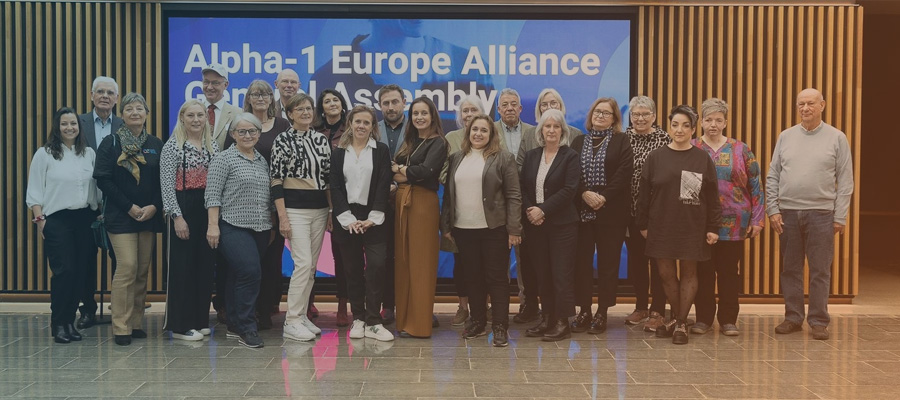
Firstly, there was the Alliance's introductory event for its partners, physicians, and sponsors, announced in Journal 02/2024. It took place in a Brussels hotel on November 15, 2024, under the title "Ensuring Equal Access to Treatment in Europe: Developing an Action Plan by 2030." Participants included representatives of the members and sponsors, as well as physicians with a long history of experience in the field of alpha-1 antitrypsin deficiency, such as Dr. Marc Miravitlles from Spain, Dr. Ilaria Ferrarotti from Italy, Prof. David Parr from England, Prof. Henedina Antunes from Portugal, and Dr. Stephanie Everearts from Belgium. The opening address, on the topic of "Ensuring Patient Participation in Policy Decision-Making Processes," was given by Valentina Botarelli, Head of Public Relations at EURORDIS, the European umbrella organization of patient organizations for rare diseases. The topics of "Barriers to Access to Treatment Options" and "Unmet Needs of Alpha-1 Patients" were then discussed in structured sessions and subsequently explored in greater depth in group discussions. The documented results are now being compiled and published in an Alliance action plan for the years 2025–2030, with support from the agency that organized and moderated the event.
Secondly, our involvement in applying for a research project within the framework of ERDERA, the European Research Alliance for Rare Diseases, which comprises national funding bodies for basic medical research, is worth mentioning. When we defined our priorities within the alliance before our official founding, including the item "Support for research projects on alpha-1 antitrypsin deficiency" seemed quite ambitious for a newly established organization. We were all the more surprised, therefore, when the initiators of such a project approached us with a request for our participation. Funding for research projects within the ERDERA framework has, among other things, two essential prerequisites: it must be a research consortium with participants from several European countries, and a patient organization must be involved—in this case, our alliance. The project involves university institutes in Italy, Belgium, the Netherlands, and Switzerland, and it focuses on basic research for a therapy that could one day be suitable for curing the lung tissue of alpha-1 patients, something long considered impossible. The project proposal was submitted on time, but unfortunately it was not selected over the other proposals. Now everyone involved is eagerly awaiting the reasons for the rejection so they can submit an improved proposal in the next round.
The final project to be reported on here is the campaign on the information channels of the Alliance and its members for Alpha-1 Awareness Day, which takes place annually on April 25th. The 2024 campaign, featuring eight different posts on various aspects of Alpha-1 antitrypsin deficiency and presented in the Alpha1 Journal 01/2024, was visually appealing and rather factual, in keeping with the tradition of the national Alpha-1 associations, and in retrospect, quite successful in terms of its reach. For the 2025 campaign, we benefited from the fact that our Italian colleague on the Alliance board works for a very large, international advertising agency, which, under a pro bono contract, agreed to develop a campaign for us free of charge (with a budget certainly in the five-figure euro range, which neither the Alliance nor the national associations could have afforded). Preliminary considerations regarding how to raise awareness for a rare disease amidst today's information overload led to a "disruptive" approach—one that involves profound changes to traditional methods. The presumed origin of Alpha-1 antitrypsin deficiency in the Viking Age was explored and spectacularly translated into short video sequences and striking images using AI. The aim is to generate enough interest in viewers to click through to a page where they can find further information about Alpha-1 antitrypsin deficiency in their own language and ultimately be directed to their national Alpha-1 association. If you haven't seen the campaign yet, please check the relevant information channels on the Alliance website. I hope to be able to report on the success of this campaign in the next journal.


