
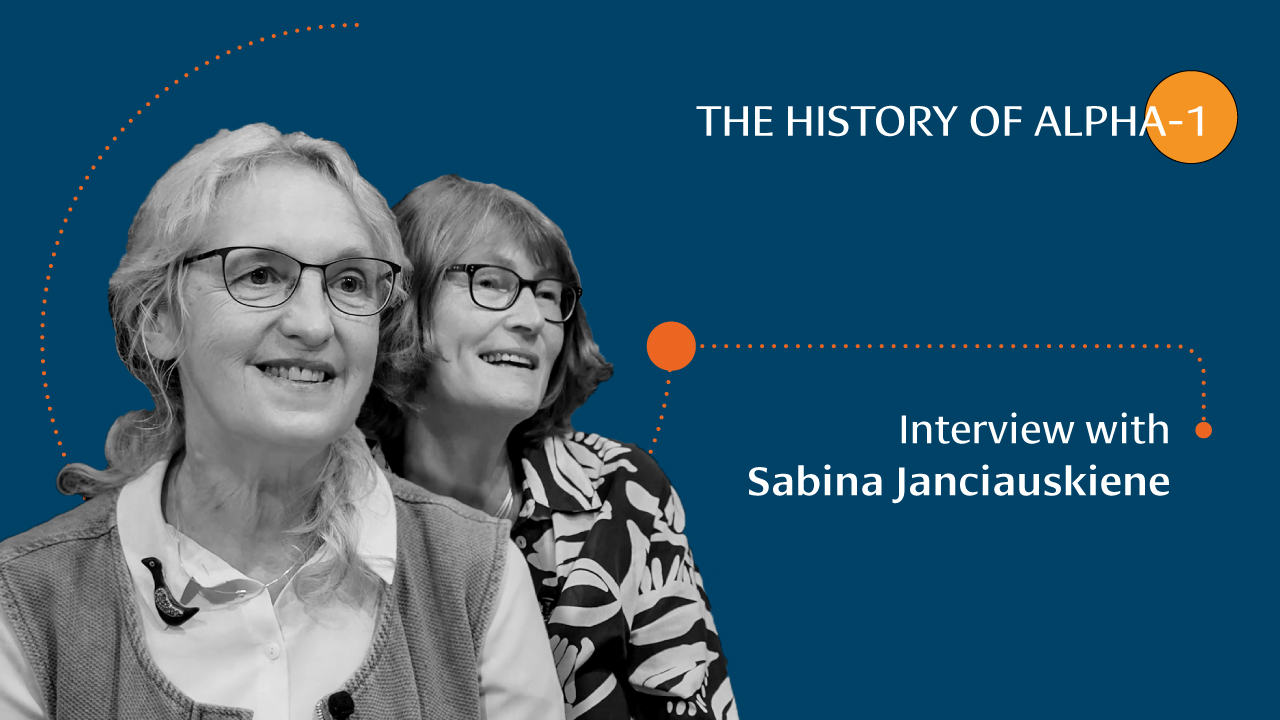
Alpha-1 History Video: When Medical History Comes Alive
A contribution by Leyla Gür.
There are projects in our agency work that feel special right from the initial discussions. The video about the history of alpha-1 antitrypsin deficiency was exactly that kind of project for me. It quickly became clear: this wasn't just going to be a nice piece of social media content. This was about a story that has moved people for more than 130 years and that still holds great significance for medicine in general today.
But let's start from the beginning. Last year, I had the opportunity to speak with Prof. Dr. Sabina Janciauskiene and Marion Wilkens about the history of Alpha-1 antitrypsin deficiency, on behalf of Alpha1 Germany e.V. Prof. Dr. Janciauskiene serves as a scientific advisor to Alpha1 Germany and has been conducting research on Alpha-1 for many years. Marion Wilkens, as you all probably know, is passionately and tirelessly committed to supporting those affected by Alpha-1, their families, and raising awareness of Alpha-1, both in Germany and internationally.
We were then able to turn this conversation into a video, which is now finally available for you to watch and listen to – on YouTube and also on Spotify. Feel free to take a look.
A discovery with consequences
One thing I learned during the preparation with Sabina and Marion, and which I'd like to share as a little spoiler: The story of Alpha-1 goes far beyond the disease itself. It also tells of how medicine evolves and how individual observations can gradually form a larger picture – and why it's worth taking a closer look when symptoms don't quite fit the usual explanations.
In the video, Sabina takes us back to the 19th century, to the first traces of Alpha-1. At that time, terms like DNA, genes, or protein variants, as we understand them today, didn't yet exist. Nevertheless, researchers at that time observed that substances apparently existed in the blood that could inhibit certain protein-degrading enzymes.
The decisive breakthrough came in the early 1960s when the two Swedish researchers Carl-Bertil Laurell and Sten Eriksson, using new laboratory methods, were able to demonstrate that some patients with early-stage pulmonary emphysema lacked a specific protein: alpha-1-antitrypsin. This proved to be a far-reaching discovery! It suddenly made it clear why even people without the classic risk factors such as smoking or occupational exposure to particulate matter can develop severe lung damage – and just how incredibly versatile and important proteins in our bodies truly are.
But I don't want to give too much away. In the video, you'll learn, among other things, which scientific breakthroughs made this discovery possible, why alpha-1 antitrypsin still plays such an important role in medicine today, and how closely research, education, and personal experiences are intertwined.
Camera and action – My impressions from the filming day
What I found particularly wonderful about filming this historical video was the location itself. Being able to film at the Thorax Clinic in Heidelberg was a perfect thematic fit. Many people actively involved in Alpha-1 research work and conduct research here today – including Prof. Dr. Franziska Trudzinski. At the same time, the clinic has stood for decades for pulmonary medicine and pioneering research. Special thanks go to Mr. Frank, Prof. Dr. Herth, Dr. Oswinde Bock-Hensley, and the entire Thorax Clinic team for their great openness and for even allowing us to use the Tuberculosis Museum located in the small castle as a filming location.
Everything went perfectly on location. Our cameraman, Martin Sauer from entermedia, brought everything needed for a professional shoot – from cameras and lights to sound equipment, tripods, and a whole lot of cables. Before the actual interview could begin, everything was carefully set up, wired, and tested. Microphones were attached, transmitters stowed away, and every detail checked multiple times. What looks so easy in the video actually requires a bit of planning and work.
The conversation went not only smoothly and with great professionalism, but was also very impressive to me both in terms of content and personality. Even though I was already familiar with the topics through my preparation, it was more than inspiring to see how much energy, knowledge, and passion Marion and Sabina radiate. It made me realize once again that with illnesses like Alpha-1, it's never just about medical facts, but always about people – people who are affected, but also people who are committed and full of enthusiasm to ensuring that the former are seen, understood, and supported in the best possible way.
Far from being from yesterday: Why history can give hope
But why did we actually make a video about the history of Alpha-1? Isn't there much more exciting stuff to tell about from the here and now?
Of course, first of all, one must say: A video is only a Video. And we very much hope to be able to implement many more videos and formats in the future, which deal, for example, with current research approaches, new developments or personal stories.
At the same time, the story of Alpha-1 is much more than just a look back. It can still provide valuable insights today and perhaps even offer hope. Thanks to the special perspectives of Marion and Sabina, who have accompanied and, in some cases, actively shaped the development of Alpha-1 over many years, it becomes clear what has already been achieved. One realizes how many people have contributed to the fact that we know so much more about the disease today than we did just a few decades ago.
This also makes it clear that progress is rarely linear. Sometimes it's new technological possibilities, sometimes lucky coincidences, and often years of hard work that make the crucial difference. And sometimes it takes the courage to follow a path that doesn't seem particularly promising at first glance.
Perhaps that's precisely why history is so encouraging: it shows that developments take time and that progress is built on the knowledge and commitment of many different people. Nothing comes from nothing, and to sharpen the analogy even further: only when you look back do you see how far you've actually come – regardless of how much road still lies ahead.
So, if you ask me: Take a quiet minute – or better yet, 60 😉 – and watch the story of Alpha-1, as told by Marion and Sabina. Perhaps it will make it as clear to you as it did to me that looking back not only explains how we got here, but also shows what becomes possible when people work on something with curiosity, perseverance, and dedication for many years. I definitely recommend it!
Click here to watch the video:


