
Author
Annkatrin Siegl, as appeared in Alpha1 Journal 1/2026.
”„Master, I have fallen into the abyss,“ he said. „The water is dark and deep.“ „Don’t forget one thing,“ the master replied, „you don’t drown because you dive underwater, but because you stay underwater.“ And the warrior used all his strength to free himself from his predicament.
Paulo Coelho (The Manual of the Warrior of Light)
Until early 2024, no one in my family had ever heard of alpha-1 antitrypsin deficiency: neither its symptoms, nor its treatment, nor whether it could be fatal. However, I vividly remember the day my parents called to tell me my mother's diagnosis. I was sitting at my desk in my room in London, the city I had moved to in January 2016 to pursue my master's degree, when my father mentioned that I, too, needed to be tested, as it was a genetic condition.
Although the focus remained on my mother and the significance of this diagnosis, after we hung up, I, like so many who hear about AATM for the first time, googled it. Initially, I didn't understand a word of what I read, mainly because emotions were still running high and, having spent over half my life watching "Grey's Anatomy" for years, I had apparently acquired no competence in understanding medical terminology.
One of the first pieces of information I came across concerned the life expectancy of people diagnosed with AATD, and I had to hold my breath when I read: "40 years for smokers and 65 years for non-smokers." Smoking was never an issue for my mother, as evidenced by the fact that her lungs were in excellent condition. It was her liver that became a problem for her, and unfortunately, the life expectancy estimate was spot on, as she was only 64 when she passed away in March 2025 after several AATD-related complications. In retrospect, this also means that we only had about a year to learn as much as possible about AATD. While there's no reason to point fingers or assign blame, it's quite clear that an earlier diagnosis could have made all the difference.
While my own AATM test in London was quick, easy, and free—unlike the bureaucratic hurdles my brother faced in Germany—it brought home to me once again how technology can be both a blessing and a curse. In London, the doctors didn't even call; they sent me the result via a health app. Looking back on the months between her diagnosis and her death, I'm grateful that they were filled with love, laughter, and community as much as possible. Although I spent most of my time in London, the distance allowed me to cherish the time I spent with family and friends when I did see them. We didn't know that our trip to Italy in August 2024 for one of my friends' weddings would be our last holiday together, but I couldn't be more grateful to have brought my parents along. And for that same friend to eventually travel to our hometown a few months later to attend my mother's funeral was the epitome of true friendship.
The thing is, when your mother is diagnosed with a rare genetic disorder and dies 15 months later, it doesn't just change your perspective on life and how fragile it can be, but also your perspective on the people around you—making you reconsider who deserves to be a part of your life and who doesn't. Sadly, we seem to live in societies, whether in the UK or Germany, where grief is still taboo for many because it's seen as the ultimate proof that life has and will end. Of course, we spend a lot of time thinking about the future: what will happen, what do we want to happen, what do we want it to look like? In doing so, we project our wildest hopes and greatest fears onto tomorrow. No matter what plans we make, reality will certainly turn out differently. But just like the warrior in the dark water, we learn that the danger isn't in falling into the abyss, but in being pulled down by it.
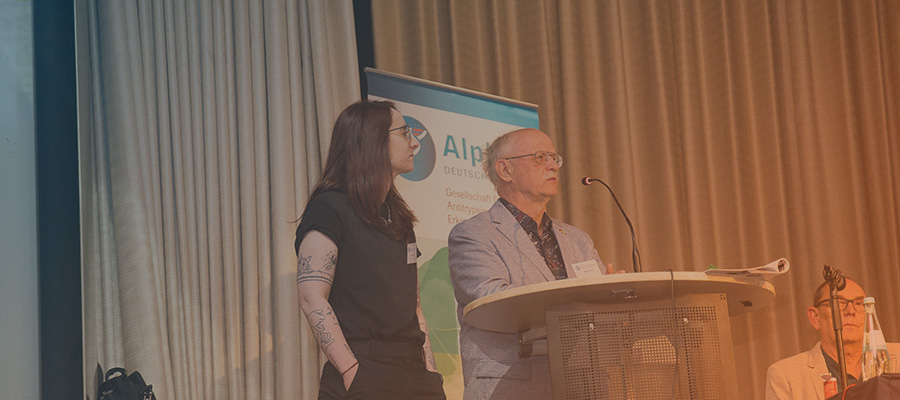
Annkatrin and her father shared this moving story at the Alpha1 information day. The association sincerely thanks them both for their openness and courage in sharing their personal experiences.


