

A pulse oximeter belongs in every Alpha-1 home medicine cabinet.
Author
Dr.-Ing. Heinz Stutzenberger, revised by Dr. Alexander Rupp
It is unlikely that anyone diagnosed with Alpha1 antitrypsin deficiency has ever had a pulse oximeter applied, whether as a handheld device barely the size of a baby's fist at the doctor's office or as a simple sensor wired to other monitoring devices in the clinic.
In both cases, the device is clipped onto a finger and then measures – as its name suggests – heart rate (pulse) and oxygen, more precisely: the degree of oxygen saturation of the blood, i.e., how many of the red blood cells are carrying oxygen. The initially quite simple-looking device uses a rather complex measurement method, namely spectral oximetry (i.e., oxygen measurement using light):
- On one side of the clip is a light source that emits light in 2 different wavelengths.
- On the opposite side is an optical receiver that measures how much light is absorbed by the blood in the finger and calculates the oxygen saturation value, expressed in %SpO₂.2, from the English „saturation peripheral O2“taken over”.
100 % SpO2 This would mean that the blood is saturated with oxygen to the highest possible degree. However, even perfectly healthy people usually don't reach this level in everyday life; their values typically range between 96 and 99.1, Other sources specify 92–97 % as the normal range.2.
These values apply to resting states. During physical exertion, oxygen saturation remains high in healthy individuals; only under extreme stress might a slight decrease occur. In contrast, individuals with significant impairments in lung function, particularly gas exchange (e.g., due to pulmonary emphysema), even moderate exertion leads to a measurable decrease in saturation.
Oxygen saturation can also drop during sleep, especially when lying on your back, which is sometimes not conducive to deep breathing.3, This is because it can intensify snoring, which, in particularly severe cases, can lead to actual pauses in breathing ("obstructive sleep apnea"). In some cases, for example in heart patients, the breathing commands from the respiratory center are also absent ("central sleep apnea"), so that oxygen saturation also drops. As a result of these effects, among others, the oxygen saturation of those affected is usually particularly low in the early morning, but then soon rises again to the usual level.
For people with healthy lungs, a resting saturation level of 92 mg/dL (%) is often considered the lowest acceptable value, and a rapid drop to values below 90 mg/dL (%) is even considered potentially life-threatening. However, in individuals with progressive lung function impairment, adaptation processes occur, which is why a modified perspective may be appropriate: the body can adapt to a lower saturation level to a certain extent.4, It is less the absolute value of oxygen saturation that is important, but rather a noticeable drop. However, due to many individual factors, there can be no universally applicable limit value for people with impaired lung function. Generally speaking, one can assume that an oxygen saturation of below 90 % requires treatment and in the long term at a value of below 85 % critical is4.
In addition to all these factors that make it difficult to make general statements about the individually "correct" oxygen saturation, measurement errors can also occur due to improper use of pulse oximeters, which usually lead to a reading that is too low. The most common causes for this are:
- Failure to follow the instructions in the user manual
- A device that is too loose or crooked on the finger
- Nail polish, artificial fingernails or nail fungus
- Cold fingers
Despite all these uncertainties, it is advisable to obtain a pulse oximeter for home use, especially for detecting changes in oxygen saturation in people whose lung function is already impaired, such as many people with alphas.
The following advice can be derived from the experiences of our club members:
- Purchase a pulse oximeter for your home medicine cabinet, for example from your local pharmacy or medical supply store; you can also find suitable offers online. Prices range between €20 and €30 (of course, there are also more expensive versions, such as those that store measurement data over time or can even be paired with a smartphone, on which the time course of the measurements can then be displayed – however, users of such sophisticated versions should have a certain affinity for technology and be aware that the added benefit compared to a simpler model is limited).
- Measure your oxygen saturation regularly, e.g. once a week (perhaps together with regular blood pressure measurements), and enter the result along with the measured pulse rate in a table.
- Take measurements calmly and always at approximately the same time of day.
- It is best to start taking measurements after a visit to the doctor, who has confirmed that your current state of health corresponds to your personal normality; this way you can simply take note of the first measurements and do not have to worry immediately if they deviate from what is described as "normal" in relevant magazines or on the internet.
- If you then regularly record and track your oxygen saturation in the following weeks, you will see that the result is subject to certain fluctuations and can vary by +/- 2 %; this is due on the one hand to the measurement accuracy of the devices, but also on the other hand to the fact that oxygen saturation in the body is also subject to certain fluctuations.
- Regular measurements over a period of several weeks will then lay the foundation for your individual, medium- and long-term oxygen saturation.
- If you measure an unusually low value, first check whether the pulse oximeter is correctly positioned on your finger or if other factors could be causing an inaccurate reading; simply repeat the measurement after a rest period of 10 to 15 minutes.
- However, if a significant drop in oxygen saturation from the long-term average is confirmed, you should contact your doctor, especially if you notice other signs that indicate a deterioration in your breathing or general health, or if the measured pulse rate has increased significantly compared to the long-term average.
- If you experience signs of a decline in your well-being, particularly regarding your breathing, it is advisable to measure your oxygen saturation outside of your usual routine and compare it to your long-term average. If you notice a significant drop, you should contact your doctor.
- Monitoring oxygen saturation at shorter intervals is recommended for lung patients if, in addition to chronic symptoms, further acute attacks on the respiratory tract occur, e.g., as part of a cold, a flu-like infection, bronchitis, or a Covid-19 coronavirus infection.
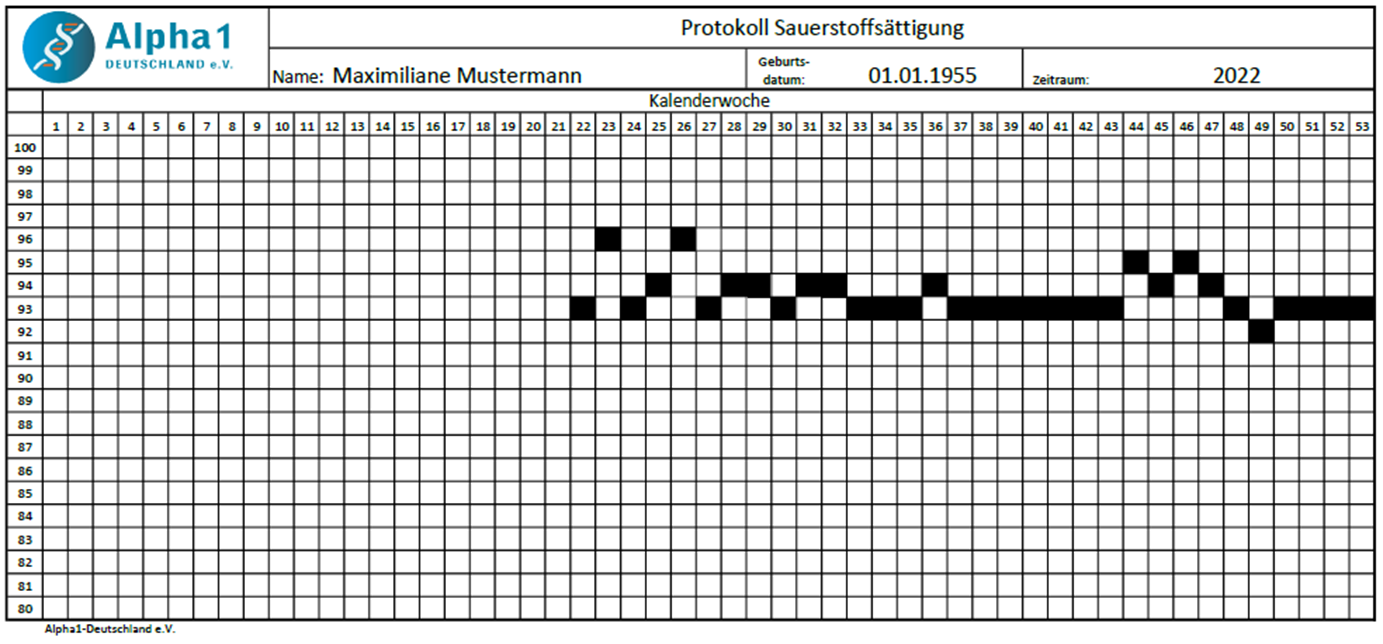
So much for the theory. Figure 1 now shows recordings of the oxygen saturation of a patient with the PI*ZZ profile, whose lungs are damaged by bronchiectasis and emphysema, but whose respiratory pump is still largely intact (for better readability, the manually recorded measurements were transferred to a computer table):
- The recordings were started a few days/weeks after a hospital stay, i.e., at a time of symptom-free „normality“.“
- The level of the measured values is
- Below what is to be expected for a person with healthy lungs.
- But significantly higher than what can be expected for those with already severely impaired lung function.
- The fluctuations in the measured values within the range specified above are clearly visible.
- Due to the frequency of measurements with 93 and 94%, these values can be assumed to be long-term averages in this case.
- During the period shown, there is no significant drop in oxygen saturation; this corresponds with the perceptions of the affected individuals, who also did not notice any change in their lung function during the specified period.

The details described are even more clearly visible in the graphical representation of the measured values in Figure 2 than in the table:
- Each blackened cell represents a measurement.
- It is now quite clear that individual measurements can deviate significantly from the mean value, but overall, during an uncomplicated period, the mean oxygen saturation value is stable and, in the present example, lies between 93 and 94%.
Unfortunately, from the perspective of a concise presentation, but fortunately for those affected, the recordings do not show a clear drop in oxygen saturation, but it is clear that – as already mentioned at the beginning – this would have to be significantly larger than 2% from the long-term average in order to be considered a warning sign.
In summary, it can be stated that:
- The pulse oximeter provides patients with lung function problems with an inexpensive device to detect and document a deterioration in lung function.
- Important for its application are measurements over a longer, symptom-free period in order to get a feel for its normal level and the usual fluctuations.
- A pulse oximeter should be in the home medicine cabinet of every Alpha patient with lung problems and should be used regularly.
- Significant drops in measured values should prompt contact with the treating physician, especially if they occur in conjunction with a deterioration of breathing, general well-being, or in the context of another respiratory infection.
For those of you who have now decided to carry out a weekly measurement of your oxygen saturation (and of course also for those who have been doing this for some time), we provide templates of the protocol shown above on our website. download Ready. If you are advised by a doctor to measure your oxygen saturation daily, you can also use this form by applying the scale to the calendar day instead of the calendar week as shown, and using a separate sheet for each month.
Please also note the following: This article contains only general information based on literature references and feedback from our members, and should not be used for self-diagnosis or self-treatment. It cannot replace a visit to a doctor.
Sources:
- https://flexikon.doccheck.com/de/Pulsoximeter
- https://www.cardiopraxis.de/pulsoximetrie-lunge-testen-bei-lungenentzuendung/#:~:text=Unter%20k%C3%B6rperlicher%20Belastung%20bleibt%20die,kein%20Messfehler%20vor%2C%20nicht%20normal.
- https://meinschlaf.de/gesunder-schlaf/sauerstoffsaettigung-im-schlaf-11273/
- https://www.dr-gumpert.de/html/erniedrigte_sauerstoffsaettigung.html
Photo credits: Pulse oximeter Kristini/shutterstock.com; Sleep Gorodenkoff/shutterstock.com


