
Author
Alpha1 Germany eV.
Anniversary celebration in Bad Wildungen: A weekend full of successes!
The first newsletter after the anniversary weekend in Bad Wildungen naturally starts with the highlights of the event. Both the General Meeting as well as the Information Day were a complete success. But see for yourself what it was like:
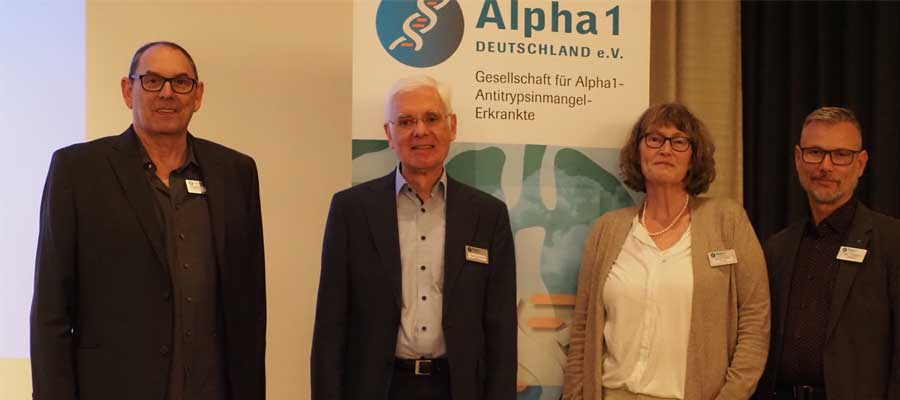
And in case you weren't there, here's a brief but important piece of information. The new board consists of (from left to right): Thomas Heimann (board member), Dr.-Ing. Heinz Stutzenberger (2nd chairman), Marion Wilkens (1st chairwoman), and Peter Hübner (treasurer). We are delighted that you elected us and will continue to dedicate ourselves fully to the Alphas, as always.

From research and science: The pulse oximeter belongs in every Alpha-1 home medicine cabinet.
An article by Dr.-Ing. Heinz Stutzenberger, revised by Dr. Alexander Rupp
It is unlikely that anyone diagnosed with alpha-1 antitrypsin deficiency has ever had a pulse oximeter applied: be it as a handheld device barely the size of a baby's fist at the doctor's office or as a simple sensor, wired to other devices for monitoring in the clinic.
In both cases, the device is clipped onto a finger and then measures – as its name suggests – heart rate (pulse) and oxygen, more precisely: the degree of oxygen saturation of the blood, i.e., what percentage of the red blood cells are carrying oxygen. The initially quite simple-looking device uses a rather complex measurement method, namely spectral oximetry (i.e., oxygen measurement using light):
- On one side of the clip is a light source that emits light in 2 different wavelengths.
- On the opposite side sits an optical receiver that measures how much light is absorbed by the blood in the finger and calculates the value for oxygen saturation, given in %SpO2, taken from the English "saturation periphery O2".
A SpO2 level of 100 (%) would mean that the blood is saturated with oxygen to the highest possible degree. However, even perfectly healthy people rarely reach this value in everyday life; their SpO2 levels typically range between 96 and 99 (%).1. Other sources specify 92–97 % as the normal range.2.
These values apply to the resting state. During physical exertion, oxygen saturation remains high in healthy individuals; only under extreme stress might a slight decrease occur. In contrast, in people with significant impairments in lung function and especially gas exchange (e.g., due to pulmonary emphysema), even moderate exertion leads to a measurable decrease in oxygen saturation…

Current status of drug trials
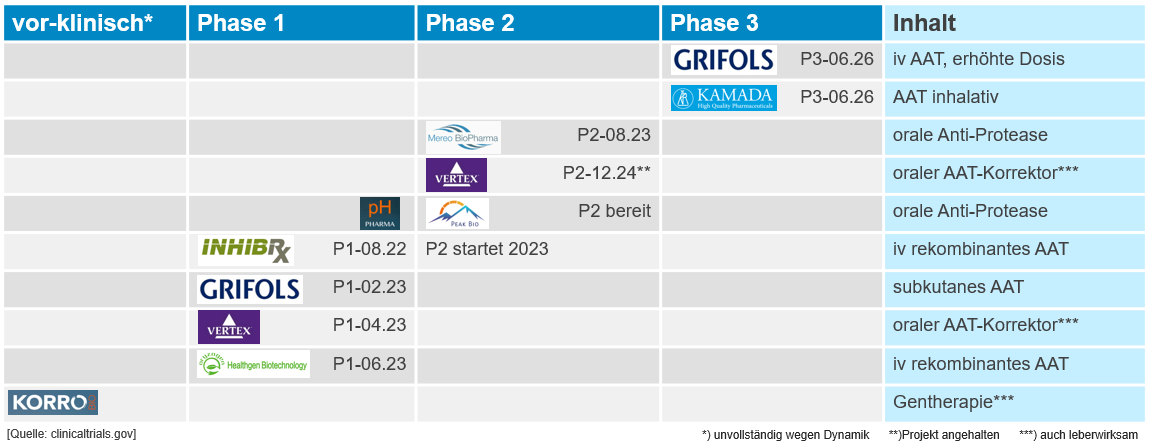
The diagrams below show a brief summary of the currently ongoing research projects (Based on information from the Alpha1 Foundation, updated by Dr.-Ing. Heinz Stutzenberger), which we will gladly explore in greater depth in the coming weeks and months. Some of these studies were also presented by Prof. Jansciauskiene at our information day and will therefore be documented in the next journal (which will be published shortly).
Drug studies on the lungs (as of February 2023)
Drug studies on the liver (as of February 2023)
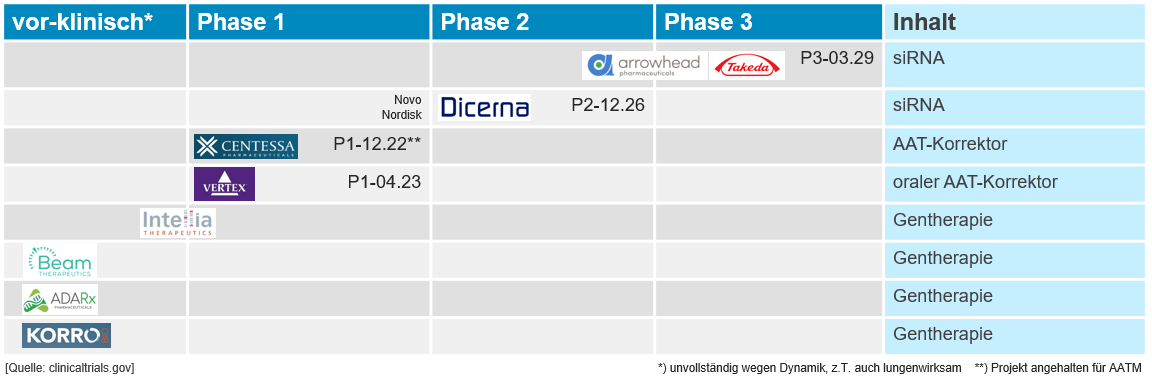
Overview compiled by Dr.-Ing. Heinz Stutzenberger, as of February 23rd.

Great results from a project for Alpha-1 children and young people, as well as their parents
Together with CSL Behring, we have created 12 animated films addressing frequently asked questions from relatives of young AATD patients. These films cover topics such as vaccinations, check-ups, and practical tips for daily life. The questions are posed by Gabi Niethammer, Dr. Eva Pfister provides the answers, and Marie Hübner illustrates the responses.

Digital in old age: Read the guide to digital helpers for everyday life now!
The Hessian State Chancellery has with the Hessian Minister for Digital Strategy and Development a wonderful brochure was published: „Digital tools for a better quality of life and participation“.
Whether you are older yourself or accompany older people in your environment, the guide is worth reading for everyone.

Shekitova – The exercise program for a successful start to the day
A 2020 study states that 7,000-8,000 steps per day have a health-promoting effect, regardless of intensity. However, this number of steps is often a real challenge for people with lung diseases.
Important for us: It's not about speed, but simply the number of steps. As is often the case, we want to emphasize the importance of movement and therefore offer you a program for a good start to the day. A helpful everyday tip! This program was devised by our pulmonary exercise trainer. Peddar (Peter Kukry).
Shekitova – The exercise program for a successful start to the day
What exactly is Shekitova? Peter explains:
„"Who doesn't remember Anna Shekitova, the famous athlete of the 70s? (laughing) Of course, that's just a joke! Shekitova isn't a person, but a short exercise routine for every day! I do it myself every morning for a great start to the day. It's helpful if you warm up beforehand (stairs or walking in place). You'll definitely notice how you feel afterwards..."“

Photo credits: Alpha1 eV / Pulse oximeter: Kristini / Shutterstock.com; Lung sports: Evgeny Atamanenko / Shutterstock.com;


