Author
Marion Wilkens, Chairwoman Alpha1 Germany eV.
Last year, together with other patient organizations and the German Association of Self-Help Groups (BAG Selbsthilfe), we advocated for a safe supply of plasma products. As previously reported, we sent a letter to the government, among other things. We have now received a reply from Prof. Dr. Claudia Schmidtke, who welcomes the strengthening of plasma donation and forwarded our letter to the Federal Ministry of Health (BMG) for review. On May 17th, we received the following response from Dr. Dagmar Dörmann of the BMG: While no decline in donations is anticipated in Germany, the dependence on other continents (especially America) could lead to a delayed impact (approximately one year) on the German market.
Much of what was mentioned in the reply was already familiar to us from a lecture, which we would now like to summarize in our own words: Transcript of a presentation on plasma given by Dr. Anneliese Hilger, Head of the Department of Hematology and Transfusion Medicine at the Paul Ehrlich Institute, Langen, as part of the InFusion event ‚Rare Diseases Forum‘. The event was moderated by Dr. Eckart von Hirschhausen, and representatives from, among others, the patient organization dsai (for congenital immunodeficiencies), which pointed out existing supply problems in its field, were also present. Dr. Hilger began her presentation with the question: What data is available on the supply situation?
All subsequent data can be found at the Paul Ehrlich Institute..
- The combined volume of blood and plasma donations has declined slightly over the past five years. Plasma donations alone have remained constant. The slight decrease has been in blood donations. This can be explained, among other things, by more economical use of blood products and the development of new guidelines for their use.
- Plasma is less frequently obtained from whole blood donations, but more often from apheresis (colloquially: blood purification).
- Approximately three million liters of plasma have been collected annually in Germany over the last ten years.
- Across Europe, almost seven million liters were produced in total => Germany therefore accounts for the majority share.
- Global: The USA has collected more than twice as much as Europe.
- The example of immunoglobulins shows that in recent years, a steadily increasing amount of plasma-derived product has been introduced to the German market (as was the case in 2020).
Since initial concerns about a shortage due to the pandemic were shared, the Paul Ehrlich Institute (PEI) convened a roundtable on plasma supply in December 2020 (PEI, industry, Federal Ministry of Health (BMG), patient representatives, state authorities, and many others). Dr. Hilger summarized the outcome as follows:
The industry's anticipated shortage of plasma products and its concern that reserves would be insufficient to compensate for fluctuations in supply could not be substantiated with reliable data (PEI). There was agreement that plasma collection in Europe needs to be strengthened. Three possible measures for improvement were also discussed: a public appeal for blood and plasma donations (Federal Centre for Health Education), compensation for expenses, and more collection sites.
Dr. Hilger summarizes: Despite a stable system for blood and plasma collection in Germany, and even though no data indicates a supply shortage, the system has weaknesses. For example, local and seasonal fluctuations are not captured, and complex factors (such as future industry planning) cannot currently be represented; therefore, it is impossible to predict the future.
No one can say for sure whether the supply of plasma in Germany will be sufficient in the future, but Dr. Hilger believes it will be.
Notice
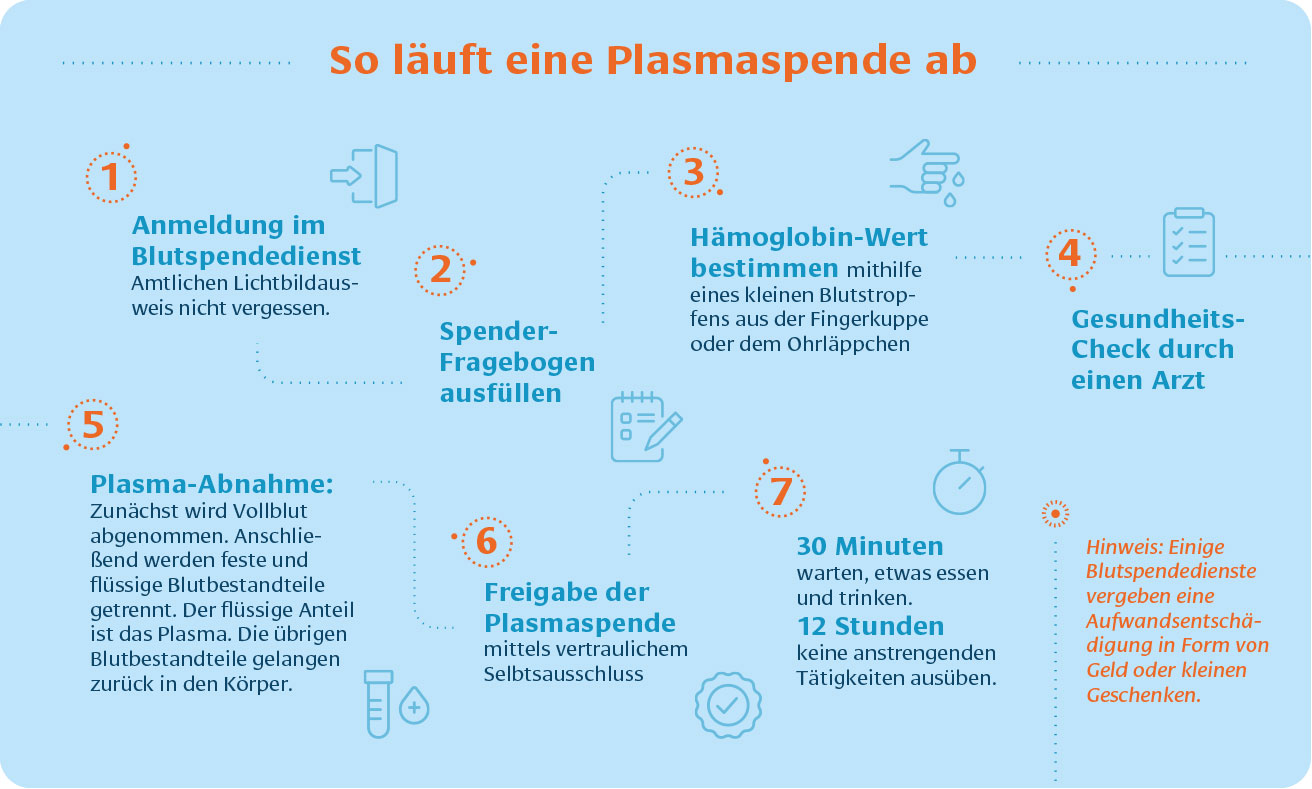
You can donate blood and plasma at university hospitals and many other hospitals, at the German Red Cross blood donation service, or at municipal and private blood donation centers. There are also mobile blood donation services with daily changing locations near you.
Find blood and plasma donation services near you.
Source: Federal Centre for Health Education (BZgA)
Comment Alpha1 Germany:
We have not experienced any supply problems due to insufficient plasma collection to date, and we do not anticipate any in the near future for the production of alpha-1 antitrypsin (unless plasma administration becomes a therapy for COVID-19). There have been occasional process-related difficulties in the supply chain, but these are not a political issue; rather, they concern ensuring the smooth operation of processes during manufacturing, packaging, and storage—in other words, the pharmaceutical industry's responsibility. The problem we see is a partial dependence on the American market, which needs to be addressed. Here, policymakers agree with us and recognize the need to strengthen production sites in Europe and Germany.