A visit to the blood center in New Zealand
Author
Bernd Dobbert, as published in Alpha1 Journal 1-2019
For many years I had dreamed of a stay in New Zealand. In 2019, it was finally going to happen. But there were many obstacles in my way that I first had to overcome.
Since I've been on hormone replacement therapy for several years, this was the biggest challenge, and I initially contacted Alpha1 New Zealand. Jim Clarke, one of the local managers, promptly sent me a link to the New Zealand blood bank, the Blood Service.
Jim also informed me that my medication was not approved in New Zealand, but that there was no obstacle to importing the medication as long as it was for personal use.
I immediately contacted the headquarters of the New Zealand Blood Centre and described the challenge. Just a few days later, I received a positive response. Dr. Richard Charlewood explained in a lengthy email that the Blood Centre was responsible for all infusions related to blood products and organized these throughout New Zealand.
He sent me a link to all the hospitals on both islands authorized to administer infusions. I compared this list with my travel dates and sent Dr. Charlewood my suggested appointment times and locations. A few days later, I received a detailed overview with confirmed appointments and the relevant contact persons.
In the time before my departure, a lively exchange of emails developed with several people who wanted to learn more about the disease and the substitution therapy.
At the same time, I also had frequent follow-up questions with Dr. Charlewood. As my enthusiasm for the project grew, so did my interest in visiting the blood center, and I inquired whether a visit to the center in Auckland would be possible. Naturally, I also wanted to meet Dr. Charlewood in person.
Once again, the answer came quickly and was positive: "We look forward to meeting you in person at our premises.".
On a rainy autumn day in New Zealand in March 2019, we got into a taxi that took us to Epsom, a suburb of Auckland.
Dr. Charlewood gave us a very warm welcome. He is a hematologist (blood specialist) and comes from South Africa. First, we went to the blood donation room. Here, all blood donors have their blood drawn. There are donors who give pure blood and others who give only plasma. In this process, the plasma is separated from the blood in a separator. The red blood cells then flow back into the body. The patients are cared for by trained nurses.
There were still a few blood donors in the room, and Richard introduced me to one of them. It was a special moment, because it made me very aware that we patients depend on people who donate their blood for us. We often don't think about that enough.
Then it got really cold. Richard led us to the cryochamber where the blood donations are temporarily stored. Deep-frozen at minus 30 degrees Celsius, the blood's shelf life is extended. Without freezing, the blood can only be stored for a maximum of one week. We couldn't stay in that room for long, so we moved on to the laboratory. There, the blood donations are tested for diseases such as HIV and hepatitis A to C. These tests are very complex and require meticulous work. The pathogens that cause hepatitis A and B are relatively common and not easy to detect.
Some of the blood is used as plasma, for example for accident victims; the larger portion is pre-separated in Auckland or subsequently sent to a large company in Australia equipped with very expensive blood separation machines. This Australian facility also processes blood from Singapore and other Asian countries.
This separation process results in different medications, e.g., for cancer patients or substitution medications for those suffering from Alpha-1 disease.
To meet the demand in New Zealand's hospitals, approximately 3,000 blood donations are needed each week: a major challenge for the blood center. Another difficulty is ensuring a sufficient supply of the required blood types, which is managed through a donor registry. This necessitates close contact between the blood center and donors to prevent both over- and under-capacities.
In New Zealand, there are approximately 700 transplants per year, all coordinated by the blood center. Appointments are arranged with the hospitals, blood is provided, and patients are informed about each step.
In addition, teams from sports, business, or hobby groups are encouraged to donate blood together. A ranking of these teams is maintained, indicating the number of people saved through their blood donations.
The more I learned about the logistics of the blood center that day, the more impressed I was. The blood center not only organizes all transplants in New Zealand, but also all infusions of blood products. Since I belong to this patient group, it was a given that everything was organized for me as well. At each hospital, there was a designated contact person who would get in touch with me about appointments or any questions. This allowed me to meet quite a few locals. In the various day clinics or outpatient departments, I was provided with tea, rolls, and fruit, spoke with many other patients, and had to answer numerous questions about alpha-1 antitrypsin deficiency.
Finally, Richard introduced me to a colleague who is responsible for international contacts. I was very surprised to learn that she had recently been in Cologne to pick up a stem cell donation from New Zealand that was a perfect match for a blood cancer patient.
Beyond the daily challenges, the blood center is also facing new ones. Globalization and climate change are causing increasing mixing of populations in different countries, with more and more people from Polynesia migrating to New Zealand due to flooding of their islands. This is resulting in ever-increasing blood mixing, and the search for donors is expanding to the entire South Pacific. Donors are being sought from Polynesia, Samoa, and various Maori tribes.
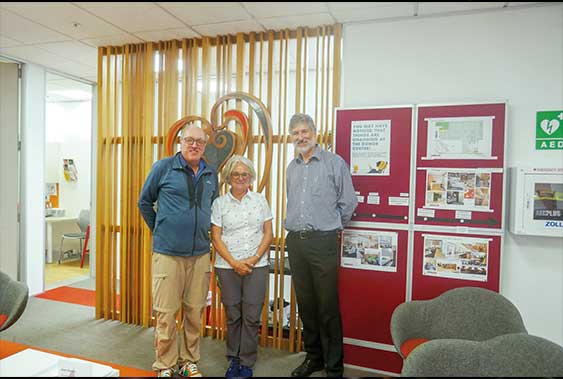
The afternoon ended far too quickly. As a parting gift, we took a commemorative photo and I promised a guided tour of Cologne for the next employee who picks up a stem cell donation in Cologne.
What remains is the memory of a fabulous organization, many human encounters in the hospitals, a professional handling of the substitution in a total of eight hospitals, and a deep insight into the supply of patients with blood products.
Bernd Dobbert, as published in Alpha1 Journal 1-2019.
PS Anyone who wants to learn more about the work of the blood center can find further information at www.nzblood.co.nz.