
An overview of treatment approaches for alpha-1 antitrypsin deficiency
Author
Alexander Niepel, checked by Mr. Dr. Pavel Strnad
This article was based on an online presentation by Willscott Naugler*. He originally gave a lecture on this topic at the annual meeting of the American Alpha-1 Foundation** in May 2019. Dr. Naugler was introduced as the leading expert on Alpha-1 liver on the US West Coast.
Alpha-1 antitrypsin deficiency (AATD) originates in the liver. The liver performs many functions, including the production of enzymes. Enzymes are catalysts that accelerate certain reactions in the body. The body needs alpha-1 in conjunction with the immune system to protect the lungs. In AATD, this enzyme is produced incorrectly and cannot leave the liver cells (hepatocytes). This leads to its accumulation within the cells, ultimately causing them to die. Interestingly, these accumulations of incorrect alpha-1 can be seen in tissue samples.
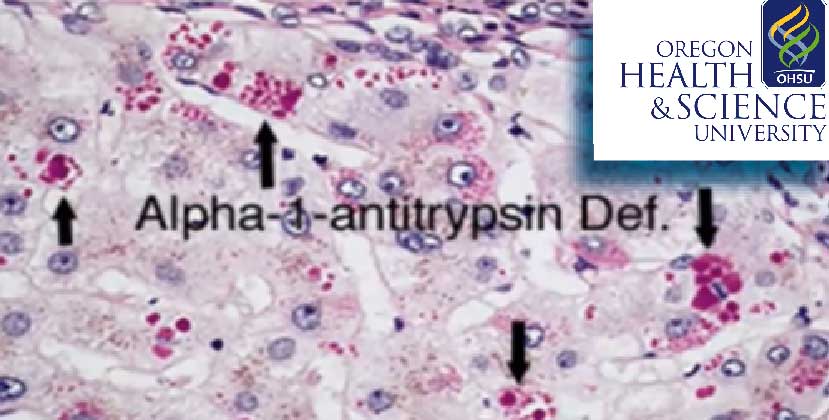
Image: Special staining of a liver tissue sample to show the accumulation of mutated alpha-1 antitrypsin - The aggregates appear pink (see arrows).
Is it actually a problem that liver cells die due to the accumulation of alpha-1 receptors? Not necessarily! Just because you have PiZZ (a specific antigen), you don't necessarily develop symptoms. Why this is the case is also a research topic. Professor Janciauskiene had requested blood samples for this purpose at the information day in Göttingen.
Alpha-1 deficiency in the body can be compensated for through replacement therapy, but it's unclear whether this helps liver cells. What could be done to protect liver cells? Is it possible to repair liver cells so they can produce alpha-1 properly again?
There are ideas for both, and it's very reassuring to hear that they exist, but it should be noted beforehand that all the approaches presented here are at various stages of research. Routine application in humans is still a long way off. Nevertheless, some of them work in mice.
Of course, everyone will now point out that there is a functioning procedure: liver transplantation. True, but it's a rather arduous path. Firstly, this is due to the considerable risks and consequences of the surgery, and secondly, the subsequent immunosuppression is also not without its problems. However, the decisive argument is the shortage of donor organs.
All other procedures fall under the umbrella of gene therapy. For gene therapy research, AATD is a particularly interesting case because it involves only a single, clearly identified gene that triggers the disease. Furthermore, AATD is the third most common inherited disease – note that inherited diseases are generally rare compared to acquired diseases, but Alpha-1 is common among them.
One approach is being pursued in the siRNA (small interfering RNA) study, which Dr. Strnad in Göttingen briefly mentioned. This study is now entering phase 2. The goal is to prevent the production of incorrect alpha-1. Here, the processes within the liver cell are being interfered with, but the faulty genetic material (DNA) remains unchanged. These processes are very well explained in YouTube videos as preparation for the Abitur (university entrance exam) in biology (keyword: translation & transcription at www.thesimpleclub.de/go), so they should be very easy to understand. However, I dropped biology and won't be catching up on it for this article. Nevertheless, the idea is roughly this: The genome stores the information about what the alpha-1 enzyme should look like. In the first step, a mirror image of the relevant DNA strand is created, the mRNA (messenger RNA). But before the RNA is used in the production of alpha-1, the administered drug arrives and blocks this RNA. Got it? Good! Unfortunately, that's still only enough for zero points in the biology A-levels. Ultimately, it would prevent liver damage, but not yet protect the lungs, because no proper alpha-1 receptor agonist is produced. This would still need to be supplied via substitution therapy.
To protect both the liver and the lungs, it's necessary to intervene in the genome and specifically repair the defective parts. This is already possible in the laboratory; the exciting question is how to get this repaired genome into the human body.
Viruses can be used for this purpose. They can already introduce substances into human cells and make them sick. In the DNA vector method, the virus's own genetic information is removed in the laboratory, rendering it harmless. Then, genetic information produced in the laboratory is inserted, and this virus is injected into the patient. The viruses then deliver this information into the human cells. The difference is that they no longer cause illness but instead deliver the "repair kit" directly to the cells. The problems here are that the effects are either not permanent or not targeted enough, and, for example, the risk of cancer increases.
Well, if the viruses can't manage it, then we'll just do the exchange in the lab, like "If you don't do it yourself...". The approach here is to take liver cells via biopsy, repair their genetic material in the lab, and then inject these liver cells back into the liver. There, they multiply and eventually displace the defective liver cells. This has already worked in mice.
If this "repopulation" works, the liver produces healthy alpha-1 and protects the lungs. The liver is also not further damaged by new, incorrect alpha-1. However, the already present incorrect alpha-1 remains and does not disappear. This is where the "autophagy" approach comes in: All human cells die, are recycled by the body, and regenerated. As reported in Focus magazine, no cell in the body of a 50-year-old is older than 10 years. Remarkable. And, yes, unfortunately, one is still 50, not younger… The liver is completely renewed 18 times over the course of a lifetime. However, if the genetic material is defective, as in AATM, this recycling process fails, and the cells with the incorrect alpha-1 remain, as shown in the image above. Here, it is possible to give the body a boost and adapt the recycling mechanism. This has already been achieved in mice, but not yet in humans.
In summary, what can be said? First of all, it's good that we have substitution therapy and can protect the lungs. There are exciting ideas on how to tackle Alpha-1 at its root, and there are many brilliant people working on it. It just takes time. Dr. Naugler said that it will definitely happen before he retires. The fact that he's 50 years old gives us Alphas hope.
Alexander Niepel, reviewed by Dr. Pavel Strnad
* “A1ATD and liver disease”, May 5, 2019, Alpha-1 Foundation
Willscott Naugler, MD
Associate Professor of Medicine
Medical Director of Liver Transplantation
Division of Gastroenterology and Hepatology
Oregon Health and Sciences University
** The Alpha-1 Foundation (https://www.alpha1.org/), like Alpha-1 Germany, is a patient organization in the USA dedicated to helping people with Alpha-1 and finding a cure for the disease. Founded in 1995, the Alpha-1 Foundation is connected to institutions, patient groups, and the pharmaceutical industry worldwide. It is an exceptionally large organization, due in part to its remarkably high level of support through donations.


