
Shortness of breath and inactivity in COPD
Author
Dr. Inga Jarosch, Schön Clinic Berchtesgadener Land, Schönau
The primary symptom of COPD is shortness of breath. This is not only very unpleasant, but also sets off a downward spiral: because of the shortness of breath, people avoid physical exertion, which impairs endurance and muscle strength, leading to a decrease in fitness, which in turn exacerbates the shortness of breath during the next physical activity. The shortness of breath itself also triggers feelings of anxiety. On a psychosocial level, shortness of breath has an impact, for example, by limiting one's ability to participate in activities with family and friends.
COPD is now considered a disease that is not limited to the lungs. Rather, other areas of the body are also affected, especially the cardiovascular system, but also metabolism and bones. And not least, the muscles, as current research shows. In COPD, the skeletal muscles themselves are altered by chronic inflammatory processes, oxygen deficiency, a negative energy balance, or even adverse effects of medications.
Pulmonary rehabilitation as a comprehensive treatment
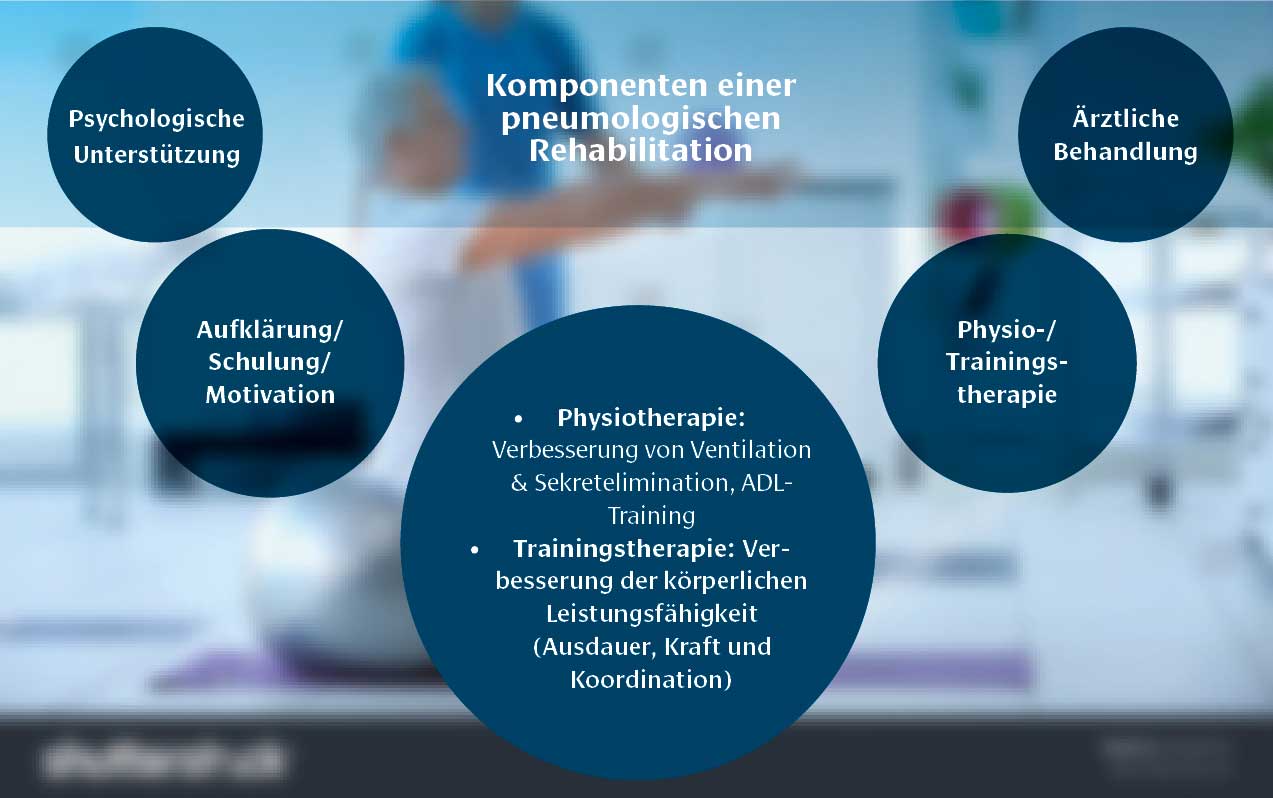
The downward spiral can be broken with pulmonary rehabilitation. Today's stays in specialized lung clinics, lasting at least three weeks, have nothing in common with the spa treatments of the past. Rather, rehabilitation is based on modern scientific findings published in treatment guidelines by international experts. During rehabilitation, therapists from various professional groups work together to design the optimal rehabilitation program for each individual patient. The essential components are physical training, education, and motivation for behavioral change.
Medical diagnostics include comprehensive lung function tests and blood work. Physicians inquire about current medications and ensure that inhaled medications are being used correctly. Long-term oxygen therapy and non-invasive ventilation are also checked for optimal effectiveness. Information and education on medical facts are crucial to empowering patients to become experts in managing their own condition. Rehabilitation encourages patients to make positive lifestyle changes. Psychological support is available to address and treat anxieties.
Physiotherapy and exercise therapy aim to improve the patient's endurance, strength, and coordination. The focus is on activities the patient can participate in daily life, such as climbing stairs at home.
Effectiveness of pulmonary rehabilitation in COPD
Rehabilitation is the most effective treatment for alleviating shortness of breath, improving physical performance, and enhancing the patient's quality of life. COPD patients of all severity levels benefit from this. The greatest effects are achieved in moderate to severe COPD. Scientists have summarized and evaluated research findings on rehabilitation from numerous studies. Regarding quality of life, patients experienced noticeable improvements in fatigue, mood, coping with the illness, and shortness of breath. Physical performance is frequently measured using the 6-minute walk test. After rehabilitation, the average walking distance improved by 44 meters, which is a very good and important result for the patient. These figures refer to a comparison between rehabilitation and a control group that did not receive rehabilitation.
When patients received pulmonary rehabilitation immediately after a COPD exacerbation, their 6-minute walk distance increased by an average of 62 meters more than in the control group. Quality of life after an exacerbation also improved significantly following rehabilitation. An equally important finding was that fewer patients required readmission to the hospital during the follow-up period if they had participated in a rehabilitation program. When comprehensive rehabilitation was implemented, in addition to physical training, mortality was also lower than in the control group.
Differences between COPD and AATM
Although AATD is classified as a chronic obstructive pulmonary disease, there are crucial differences: AATD patients are usually younger, can develop severe lung disease despite not smoking, and are much more likely to suffer from bronchiectasis than COPD patients. AATD, unlike COPD, is caused by genetic alterations. And only AATD benefits from alpha-1 antitrypsin replacement therapy.
Since 2013, international guidelines for pulmonary rehabilitation have specifically recommended pulmonary rehabilitation for patients with AATD who also have COPD. However, until then, there were only a few studies specifically on the effects of training in AATD patients. A research group from the Schön Clinic Berchtesgadener Land is attempting to fill this gap. An analysis of medical records showed that COPD patients improved their 6-minute walk distance by an average of 62 meters after rehabilitation, while the improvement for AATD patients was only 48 meters. This suggests that the adaptation processes after training may differ between AATD patients and COPD patients without AATD.
Effects of physical training in COPD and AATM
For a comprehensive training study, participants agreed to have a small piece of muscle tissue taken from their thigh at the beginning and end of their rehabilitation. Strength and endurance were also documented using stress tests, and the patient's maximum performance was recorded. This was followed by a 21-day inpatient training program with five training sessions per week using the interval method. This method alternates short, very intense bursts of exertion with rest periods. During each 30-second burst, the patient exerts themselves at their maximum capacity, followed by a 30-second rest. This cycle is repeated 10-20 times. Such interval training can be very effectively adapted to the individual capabilities of the patient, even in the case of seriously ill patients. The patient records their shortness of breath and leg fatigue in a training log.
This training study was evaluated in nine individuals with AATD-related COPD and 10 COPD patients without AATD. They already had significantly reduced lung function values, with an average FEV1 around 301 Tp3T of predicted. Their daily physical activity was comparable to that of truck drivers. Through training and rehabilitation, physical performance increased by an average of nine watts in the AATD patients, representing a relevant improvement. However, the increase in COPD patients was even more pronounced, reaching 18 watts. The analysis of the muscle biopsies was particularly interesting. Muscle tissue contains different types of muscle fibers, such as type 1 fibers, which are crucial for endurance, and type 2a fibers, which enable short bursts of high-intensity exercise. In healthy individuals, it is expected that type 1 fibers would increase after a training program. Surprisingly, the study patients with AATD showed no increase in type 1 muscle fibers after the three-week training period, but only in the more strength-oriented type 2a fibers. Researchers found a different picture in COPD patients. Their muscle samples more closely resembled those of healthy individuals, as they had more type 1 fibers after training than at the beginning. The reasons for these differences between the patient groups are not yet clear. However, it could be that people with AATD benefit more from a different type of training.
The research group at Schön Klinik Berchtesgadener Land is starting a new study on this topic and is still recruiting AATM patients! They should have a PiZZ type, their FEV1 must be below 50% of predicted, and they must not have diabetes mellitus. The study procedure will be similar to the previous training study, meaning muscle tissue will also be examined.
Active lifestyle at home
A weakness of rehabilitation arises during the transition to the home environment. If one has benefited from rehabilitation, how can this effect be maintained in everyday life at home? Ideally, the patient would continue to participate in an outpatient exercise program, such as pulmonary rehabilitation or medical training therapy. However, doctors cannot simply prescribe exercise and training as easily as medication.
It's important for everyone to become more active in their daily lives. This means sitting less, not being afraid to climb stairs, even if slowly, and going for frequent walks or staying mobile in other ways. For COPD, it's well-established that an active lifestyle significantly extends lifespan, and a similar effect can be expected for patients with AATD – although, as is unfortunately so often the case, there are still no AATD-specific studies on this.
Summary: Prof. Dr. med. Gratiana Steinkamp, as published in Alpha1 Journal 1-2019.


