

Alpha-1 antitrypsin deficiency, COPD and a lung transplant – ten years full of suffering, fear and hope
Author
Hauke Frischmann
Jürgen Frischmann was 48 years old when, in the spring of 2010, he embarked on the long journey from Wiesbaden to the North Sea island of Föhr to begin a pulmonary rehabilitation program in Utersum. He had no idea yet of what the next ten years would bring and how drastically his life would soon change.
A year earlier, he had still participated in sports competitions, regularly went to the swimming pool, cycled, and jogged through the woods. He noticed that he often had difficulty breathing and quickly became winded when climbing stairs, but he dismissed it, just like his pulmonologist, as a consequence of his years of smoking and tried to cope as best he could. Even the COPD diagnosis didn't change anything initially.
His condition deteriorated drastically during the car ride to the rehabilitation clinic, and his initially mild infection increasingly troubled him. He had just arrived in Utersum when he collapsed with severe shortness of breath and had to spend the next four days in the hospital in Wyk. After his return to the rehabilitation clinic, the doctors there decided to take a blood sample and shortly thereafter diagnosed him with alpha-1 antitrypsin deficiency, which was confirmed a short time later by the Alpha-1 Center at the Mainz University Hospital.
To slow the progression of his COPD – which had already reached stage IV – he began participating in the pulmonary exercise program of the German Patient League for Respiratory Diseases in Wiesbaden, consistently followed his medication plan, and kept himself informed about new developments and possible treatment options through informational events and support groups. Although this allowed him to maintain some of his quality of life, his condition predictably continued to deteriorate until, in 2016, he decided to put himself on the waiting list for a lung transplant.
The initial examinations took place at the Mainz University Hospital and were evaluated in Giessen. There, Jürgen Frischmann learned about the possibility of bronchoscopic lung volume reduction using valves, which can help reduce lung overinflation in cases of severe emphysema and COPD. After further examinations necessary for this treatment and a detailed consultation, he considered this option and shortly thereafter had three valves implanted at the Thorax Clinic in Heidelberg. However, since no positive effect occurred even after a six-month waiting period, the treatment was discontinued.
In 2018, he presented himself again at the University Hospital in Giessen and underwent all the extensive examinations necessary for lung transplantation for the second time. A few months later, he finally received the long-awaited letter, in which he read with relief: „…we have registered you with Eurotransplant for organ transplantation via the Giessen Transplant Center…“.
The following two years were by far the most difficult he had endured since his diagnosis. Although he continued to actively participate in all the self-help group activities and events and was very involved as vice-chairman of the DPLA (German Association for People with Lived Experiences), his severe health limitations forced him to withdraw more and more from social life. Now reliant on a walker and increasingly on an electric wheelchair, he could no longer move around as freely as before and depended more and more on assistance. He spent days and weeks in the hospital more and more frequently due to acute respiratory distress, which ultimately forced him to give up his job. His radius of movement became smaller and his activities more and more restricted. With each hospital stay and each setback, his zest for life diminished a little more, but he didn't give up. Although he was aware of the hopelessness of his situation and increasingly felt the helplessness of this illness, he seized every opportunity to improve his circumstances and never stopped hoping for that one, life-changing phone call.
On the evening of June 10, 2020, the moment finally arrived! His phone rang, and shortly afterward, he was on his way to Giessen, where preparations for the surgery began immediately. Fear and excitement accompanied him until the early hours of the morning, before the long-awaited operation finally commenced. Over the next seven hours, the doctors removed his lung, which was now 58 years old, and transplanted a functioning one into it. He will always remember this night! As will the moment he awoke from the anesthesia and consciously breathed with his new lung for the first time.
He did relatively well for the first two days after surgery, but on the third day, the first complications appeared: fluid retention in his feet, diabetes, and a pulmonary embolism. A week later, he overcame these challenges and was discharged from the intensive care unit. Over the next eight weeks, he began a slow mobilization and initial rehabilitation program, which, however, progressed very cautiously due to his significant loss of muscle mass and weight. After a total of 53 days, he was finally able to leave the hospital and go home.
Although he is still not fully mobile and will continue to face some challenges, he draws a rather positive conclusion:
„"So, I've now had a transplant and am fortunate enough to have a precious new lung. Now it's up to me how quickly I recover and regain my strength. I have to take care of the new organ and recognize any warning signs. Adherence to the prescribed therapy is extremely important, which requires a lot of discipline. All in all, it was a long but ultimately worthwhile journey." (Jürgen Frischmann, October 2020)
Hauke Frischmann, together with Jürgen Frischmann, compiled this moving account from various articles that appeared in the "Luftpost" (Airmail).
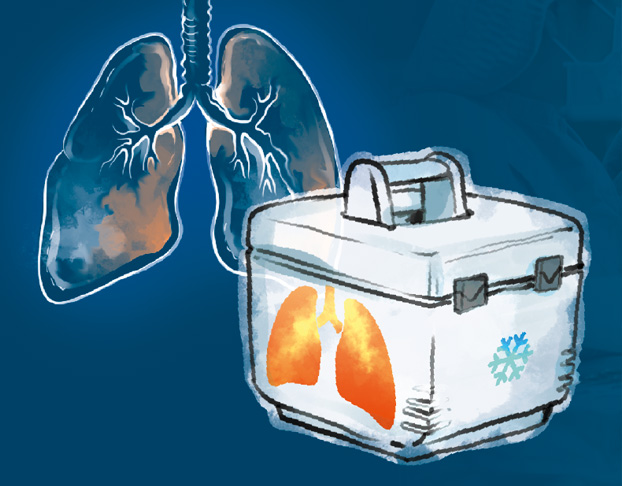
Organ and tissue donation is solidarity in action. Even though confronting topics like illness and death requires overcoming obstacles for most people, answering the question of whether one wants to donate organs is crucial. For many people waiting for an organ transplant, it's a matter of life or death. And you yourself could find yourself in a situation where you need an organ or tissue donation at any time due to an accident or illness. Therefore, it's important that as many people as possible consider this issue.


