

Thoughts on communication
Author
Monika Tempel, scientific advisory board Alpha1 Germany e. V.
The second online seminar, "Alpha-1 and the Psyche," concludes with this witticism from George Bernard Shaw. In the video, which is primarily aimed at the families of Alpha-1s, the topic of communication plays a central role. And for good reason! For those with Alpha-1 personality disorder, so much depends on successful communication.
Communication: a challenging task for people with Alpha-1 disorder
It is by no means a given that communication between people will succeed. Communication is often so difficult because what is said, what is meant, and what is perceived do not match up.
In many cases, misunderstandings and their consequences can be avoided by observing some basic communication rules. The principles of active listening are generally well-known in this context.
- perceive what is said
- Reflect on, evaluate, and classify what was meant through feedback.
- only then react to what has been perceived (in words or deeds)
That sounds simple – but it's challenging!
For individuals with Alpha-1 dementia, the exchange of information is often stressful due to the burdens and needs associated with their illness. This experience of stress has two aspects:
- Communication takes place under stress.
- Communicating about stress (the experience of stress) is particularly sensitive.
Communication under stress
Alpha-1 caregivers primarily report on: acute stress situations and chronic stress situations.
Acute stress situations include episodes of shortness of breath and exacerbations (sudden worsening of symptoms in a chronic illness). These situations put the body and mind on high alert, creating uncertainty and anxiety. In these situations, decisive and clear communication is especially important.
Chronic stress situations include overload and excessive demands, as well as anxieties about the future and loss. These persistent stress experiences can also lead to physical and psychological symptoms, such as sleep disturbances, tension, exhaustion, and depression. Self-awareness and self-care are crucial in these situations.
The family member version of the online seminar „Alpha-1 and the Psyche“ uses several examples to show what appropriate reactions to acute and chronic stress can look like in detail.
Communication of stress
As already mentioned in the section on chronic stress, self-awareness is an important aspect of communicating stress (the experience of stress). Furthermore, the following communication principles are important:
- Pay attention to when and where the conversation takes place (i.e., catch the "right" moment, e.g., talk while walking).
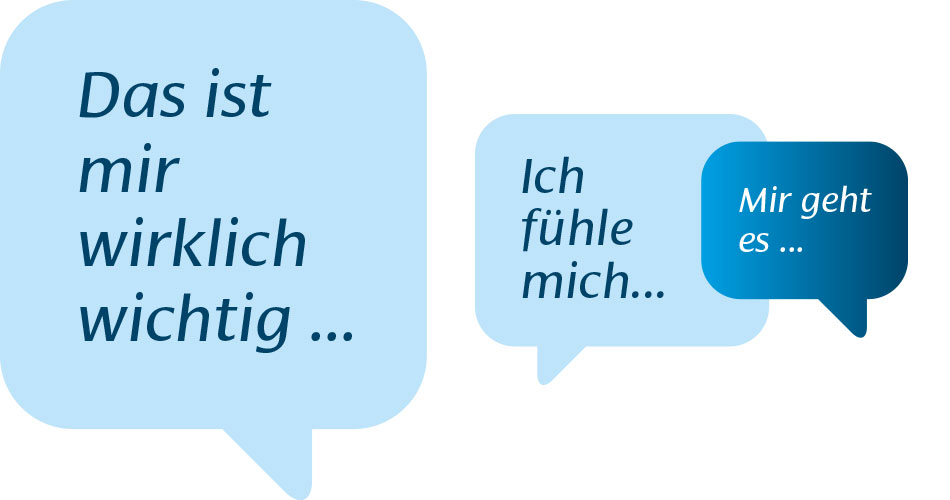
- Sending "I" messages ("This is really important to me...")
- Actively ask for comprehensibility ("If it's still unclear to you: Should I explain again in a different way what's important to me?")
So far, it's clear: Communication within the patient-caregiver relationship is a central and challenging task. But it gets even more demanding.
The communication partners of Alpha-1 caregivers
In addition to the communication within the relationship between patient and caregiver, numerous other conversation partners are involved:
- Relatives nearby
- Relatives far away
- therapist
The majority of Alpha-1 support workers must find appropriate ways to communicate with all these people – in a wide variety of roles and situations. The following list of topics illustrates how complex this communication network is and which "nodes" hold it together.
Communication with the patient
- How do I care for someone with alpha-1 antitrypsin deficiency?
- What information am I allowed to give the patient/relatives?
- What points should I consider when sharing information?
- Why do I want to share this information?
- Why am I afraid to share this information?
- What if we (i.e., the patient and I as their caregiver) don't agree?
- How can we decide together what we want to share with others?
- How can we find hope in the decisions we make together?
Communicating with relatives
- Who are the relatives?
- How (i.e., in what way, with what words) do I talk about Alpha-1 disease myself?
- Why can conversations about Alpha-1 hurt?
- How can I start a conversation about hurt feelings?
- „"I know that we are all dealing with new things right now..."“
- „"I can best take care of the patient and myself when I..."“
- How can my family help me?
- How can I tell others specifically what I need?
Communicating with relatives far away
- What does it mean to be a loved one living far away?
- What options do relatives living far away have to help with caregiving?
- What information (about the Alpha-1 progress, about other matters) can I, as a caregiver, share with relatives living far away?
- What coping mechanisms and communication options are available for relatives living far away?
- Planning a video chat?
- Should we arrange for relatives living far away to be included in appointments by telephone?
Communication with therapists
- What do therapists need from me as a caregiver?
- What things can I ask about, and how can I ask them?
- How can I ask my therapist for help?
- How can I say that something is not possible?
- „"I will not be able to take over this part of her care."“
- „"What other options are there?"“
To ensure that Alpha-1 support staff do not get tangled up in the many threads, but can use the communication network as a helpful tool for support, a few exemplary recommendations follow.
How do I talk about it, …
… when I feel alone with my burdens?
- Explain the problem you have.
- Tell the other person what specific help you need.
- Describe exactly how she can help.
- Explain how this will help you.
However, if this withdrawal persists despite important issues needing clarification, caregivers may need to cautiously reopen communication. This could be done, for example, as follows:
- „"I've noticed you're withdrawing. Would you mind telling me what's on your mind? ... When would be a good time for you to talk about it?"“
- „"There's something on my mind that I'd like to discuss with you... But I don't know when the best time for it is."“
- „"I sense that we are finding it difficult to talk to each other here and now. My suggestion: Let's choose a time and a specific place. Perhaps the conversation will then be easier for us..."“
… if I have a „bad conscience“?
Caregivers sometimes develop feelings of guilt when they cannot provide the level of care they expect of themselves. They may then secretly accuse themselves of being selfish or doing something wrong.
The following reflection questions are suitable for dealing with doubts and feelings of guilt:
- Do my self-reproaches change anything about the situation? Does the patient experience relief from my feelings of shame and guilt?
- Do my pangs of conscience bring any benefits to the patient – or do they burden me (e.g., through tension and restlessness) or our relationship (e.g., through suppressed anger)?
- Can I examine my own perceptions? Can I let go of my image as the "ideal caregiver" and choose a more palatable approach for everyone?
… when I feel ashamed because of certain thoughts and feelings?
This question also revolves around the ideal image of a "good" caregiver. For many, this includes the expectation of only showing positive feelings, always being balanced and strong, being considerate, and reacting in an exemplary manner. They believe that caregivers shouldn't even think, feel, or do anything unpleasant – so as not to worry or burden the patient, or because they fear harming them.
But what happens when this ideal image clashes with the caregiver's actual feelings, desires, and needs? Where do they put their fears, anger, longings, aversions, and other taboo subjects? A few suggestions offer examples of how caregivers can deal with these often unspoken experiences.
I am afraid (of the future).
The following "I" messages are possible:
- „"I'm worried about how things will proceed on this particular point. It would put my mind at ease if we could talk about...."“
- „"If we could discuss a joint solution for this particular point, I would feel more secure."“
- „"It's not easy, but I would like to resolve this particular issue together as far as possible."“
I'm angry.
The following approach is recommended here:
- In an escalating situation, distance helps (leaving the room, taking a deep breath, letting off steam physically).
- Once things have calmed down and clear thinking is possible again, seek a conversation: "I didn't mean to frighten you with my emotional outburst. But perhaps it's good that you now know how I feel in such a situation."„
- If the emotionally charged issue needs to be resolved permanently, schedule a meeting at a convenient time and use it.
I long for tenderness.
Talking about intimacy and sexuality can be difficult when a couple is burdened by one partner's chronic illness. In such situations, patience, empathy, and consideration are needed to avoid hurting or offending each other.
The most effective approach is to consistently send "I" messages:
- „"I feel …"“
- „"I'm fine …"“
- „"I wish …"“
I can't do that.
A caregiver doesn't always have to be ready to do everything that's asked of them. They may feel insecure or uncomfortable with demands from the patient or therapist. Even if it's difficult, a caregiver must clearly state when they can't do something, for example, like this:
- „"I am not capable of doing that."“
- „"We need to find a different solution for this task."“
- „"That's something I can't do."“
These are just a few example communication recommendations. More information can be found in the communication guide for Alpha-1 caregivers..

A communication guide to try out!
The communication guide for Alpha-1 mentors is an experiment. The success of this experiment depends on the commitment of the Alpha-1 mentors. Alpha-1 mentors are known for their keen interest and their determined and reliable dedication. This is demonstrated not only by their participation in the Alpha-1 information days.
Therefore, a request to Alpha-1 caretakers:
- Become communication researchers for your own benefit!
- Read the communication guide for Alpha-1 caregivers and try out the recommendations described therein!
- Please report back,
- which will be helpful for you
- which you find less helpful
- what's missing from the guide
- what you absolutely want to add
Your feedback will be incorporated into a workshop on "Communication for Alpha-1 Support Workers" at the Alpha-1 Information Day 2021. A heartfelt thank you in advance to all communication researchers!


