

„"Let's talk about Alpha-1" – When life gets in the way…
Author
Monika Tempel, Scientific Advisory Board (area of illness management, psyche, relatives)
What began at the 2018 information day with 27 dedicated family members was intended to continue at the 2019 information day with two offerings for all interested caregivers. But then life intervened… and the „DIY workshop“ and the „Alpha 1 family consultation“ unfortunately had to be cancelled this year in Göttingen.
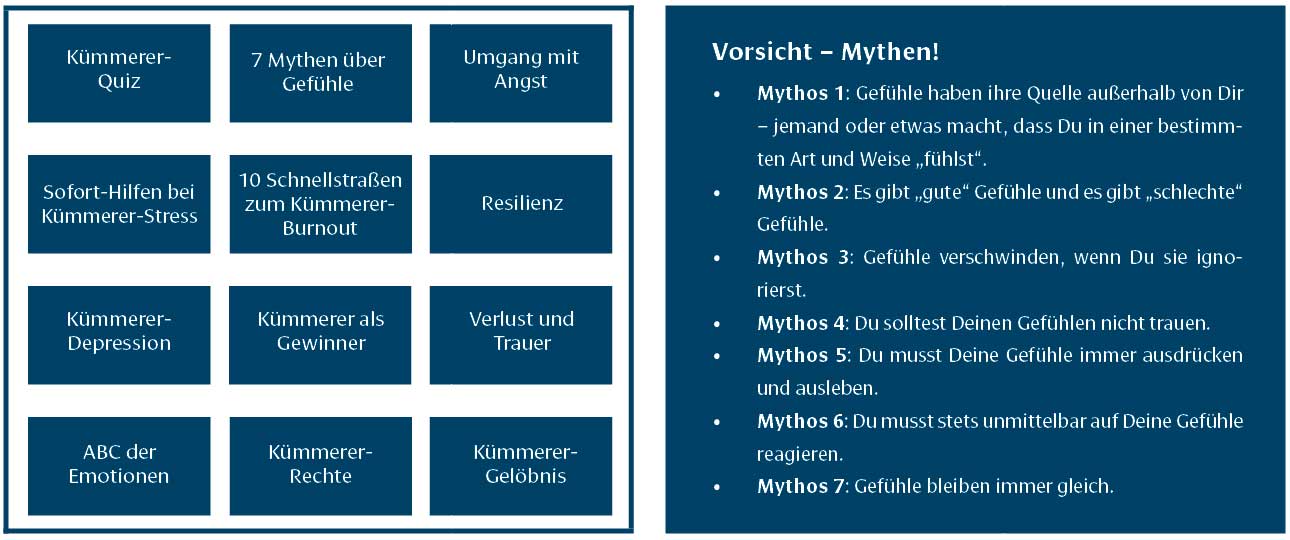
What a shame! The toolbox for the workshop "You Can Learn How to Help Properly!" was already well-stocked. Here's a look at the planned contents: Hopefully, we can unpack and try out these tools together at the next information day. Unfortunately, that's still quite a while away... So, what do you think about at least taking a theoretical look at one or two of the tools right now?
7 Myths (Misconceptions) about Feelings
Dealing with emotions is important for the joint stress management of patients and relatives, because the "caregiver journey" is sometimes a rollercoaster of emotions.
These feelings depend on many factors – and they in turn influence these very factors, for example: How do I feel in light of the many demands that come with living with Alpha-1? What feelings do I have towards "my" Alpha-1 patient? How competent do I feel in the caregiver role?
It's not easy to cope with all these feelings. Myths about emotions are a particular obstacle to dealing with them appropriately. Here you can find out if you, too, might be influenced by common misconceptions about emotions.
Do any of these myths sound familiar? Then try formulating counter-arguments to the seven myths. Here's an example for myth 2:
Feelings are neither good nor bad – feelings simply exist. Do you see how this works?
Immediate help with caregiving stress
Life with Alpha-1 is rarely easy – but sometimes an additional, acute burden arises. In such cases, caregivers need immediate relief from stress. The "STOP" exercise is a key that quickly and effectively unlocks the door to a stress-free space at any time. However, it requires that you practice the "STOP" exercise daily in relaxed situations so that it can be accessed automatically when needed.
„STOP“ is an acronym for:
Stop
T – take a deep breath
O – watch out… for thoughts,
Feelings, bodily sensations
P – to be present
Stop:
Stop what you are doing for one minute.
Take a deep breath:
Take a few slow, conscious breaths. Follow your breath as it flows – without trying to change it. Your breath is an anchor that brings you into the present moment.
Pay attention... to thoughts, feelings, bodily sensations:
Observe what is going on inside you – without trying to change it. Ask yourself the following questions:
- What am I thinking right now?
- What am I saying to myself in this situation?
- What feelings am I experiencing right now? (excited? sad? confused?…)
- What bodily sensations do I experience? (Anxiety? Paralysis? Lightness?…)
You will find that simply observing and naming the sensations is already calming.
Be present:
You have now shifted from a reactive, habitual stance to a mindful one. From now on, you can consciously decide how to proceed.
The "STOP" exercise can become a routine for you – like brushing your teeth. Do you think about brushing your teeth every day – or do you just do it? Do the same with the "STOP" exercise – just do it!
You've now been introduced to two tools from the workshop "How to Help Effectively Can Be Learned!" This can potentially be quite helpful in certain situations. Of course, it becomes even more effective when you explore and try out the tools together and then integrate them into your daily life as a caregiver. We hope to work through all of this together at the next information day, exploring the underlying technology, how to apply them in practice, and the best tips and tricks for using them effectively.
Yours sincerely, Monika Tempel
Scientific Advisory Board (area of illness management, psyche, relatives), as published in Alpha1 Journal 1-2019.


