

Author
Monika Tempel, as appeared in Alpha1 Journal 2/2025.
„Winter anxiety“ and „winter blues“ are common phenomena in people with chronic lung diseases such as COPD or asthma. This article explains the underlying mechanisms, describes the impact on the lives of those affected, and provides evidence-based tips for coping in everyday life.
What does the term "winter effect" mean in the context of chronic lung diseases?
From a psychopneumological perspective, the "winter effect" in chronic lung diseases is primarily due to "winter anxiety" and "winter blues".
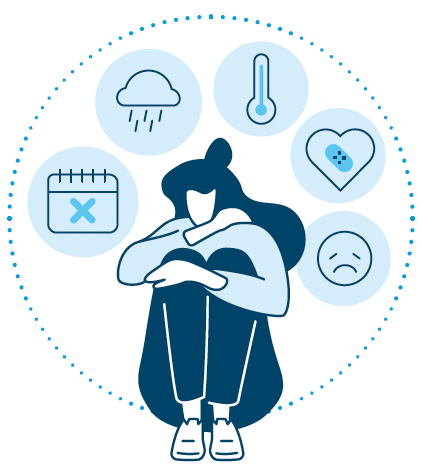
„"Winter anxiety" is the heightened fear of infections and acute exacerbations of illness during the cold season. "Winter blues" refers to the seasonal low mood that can manifest during the darker months as lack of energy, low spirits, sadness, and inner restlessness. Both conditions can occur together and reinforce each other. The following discussion focuses particularly on the tendency to withdraw and become withdrawn during the winter, which can be influenced by both "winter anxiety" and "winter blues.".
What results do scientific studies provide on the "winter effect"?„
Studies that explicitly mention winter-related anxiety, its causes and effects show that this anxiety reduces quality of life and can promote exacerbations, as those affected are less active and neglect their self-care.
These include:
1. PERCEIVE study (2007)
This international telephone survey of 1,100 COPD patients examined their perception of exacerbations. Approximately 30% of those affected reported significant anxiety about the onset of winter, anticipating more infections and symptoms. The study highlights that exacerbations cause considerable psychological distress: 17% of those affected fear a significant reduction in their functional capacity or even death. Coughing and shortness of breath are perceived as particularly anxiety-inducing, leading to isolation. The consequences include increased doctor visits and a reduced quality of life, as more than half of those affected restrict their activities.
2. Hidden Depths of COPD Survey (2013)
A global survey of 2,000 COPD patients (from 14 countries) examined anxieties and exacerbations. Frequent lung infections or exacerbations, particularly in winter, are reported as a symptom by 41–57 participants (depending on severity), exacerbating seasonal anxiety. 77 participants worry about their long-term health, and 38–59 fear premature death due to COPD. Exacerbations lead to significantly increased hospitalizations and longer recovery times. As a result, patients experience high levels of anxiety and depression, despite feeling in control of their condition. Many sufferers underestimate the severity of the infection or exacerbation, leading to delayed access to care. The study emphasizes the need for better education to reduce anxiety.
3. Seasonality study on COPD exacerbations (2014)
This analysis (of studies with large patient numbers) showed a winter increase in exacerbations of 56–116 %. Causes include viral infections (e.g., rhinovirus, influenza) and cold exposure, which weaken the immune system. Winter exacerbations are more severe, accompanied by longer recovery times and higher levels of anxiety and depression. Consequences include increased isolation, hospitalizations, and mortality. Those with lower socioeconomic status are more severely affected. The study links this to higher levels of psychological distress and discusses the influence of media coverage of pandemics.
4. TANDEM study and meta-analysis on anxiety in respiratory diseases (2020–2023)
A meta-analysis of 33 studies (1996–2019) and the TANDEM study investigated anxiety in chronic respiratory diseases and found a prevalence of 10–55 (depending on the study design). An interesting clinical example from the TANDEM study describes a COPD patient with "winter anxiety": she has a great fear of cold and germs, leading to house arrest. Typical catastrophizing thoughts and inappropriate behaviors (e.g., "I can't breathe outside") exacerbate the cycle. The consequences include deconditioning through avoidance, more exacerbations, and a reduced quality of life.
Conclusion:
- Studies on the winter effect (mostly cross-sectional or cohort studies) are based on patient reports and clinical data.
- They emphasize that „winter anxiety“ has a scientifically demonstrable real basis (real anxiety).
- On the other hand, „winter anxiety“ usually does not occur in isolation, but is (in 40–50 % of COPD patients) linked with general anxiety and depression, which increases exacerbations by 20–30 %.
- The effects on those affected include social isolation ("housing up"), sleep disorders, reduced fitness (deconditioning) and higher costs due to increased doctor visits in winter.
How do vicious cycles and avoidance behavior intensify the "winter effect"?
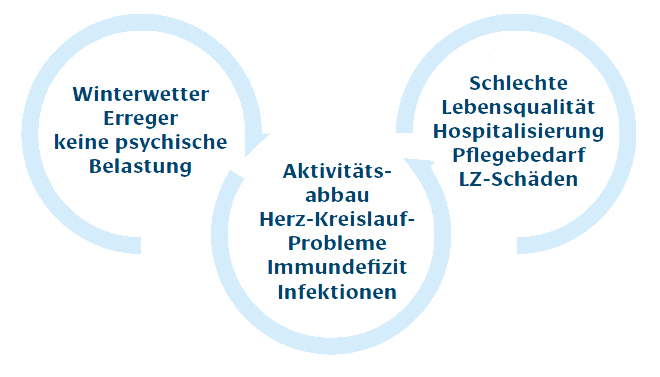
Chronic lung diseases often create vicious cycles in which physical symptoms and psychological stress reinforce each other. Shortness of breath (dyspnea) triggers anxiety in many sufferers, as it is associated with a threat—for example, in winter, the fear of infection or a severe exacerbation. This anxiety leads to avoidance behavior: those affected avoid activities that could trigger shortness of breath, such as walks or social gatherings. This leads to a decrease in physical fitness (deconditioning), which further impairs lung function and intensifies the anxiety.
A key factor is the fear of infection. Studies show that patients with COPD or asthma develop heightened sensitivity to bodily signals such as rapid breathing, which triggers panic and can lead to hyperventilation – which in turn worsens shortness of breath. This cycle is particularly intensified in winter: cold weather, dry air, and viral infections (e.g., influenza) increase the risk of exacerbations by up to 30–50%. The fear of this leads to "hogging oneself in" – a retreat into one's own home to avoid infection. This is based on learning theory models: avoidance reduces anxiety in the short term, but increases it in the long term, as the body does not learn to cope with stress.
In addition, comorbidities play a role: anxiety and depression occur in up to 40–50% of COPD patients and increase the risk of exacerbations through immunological effects and reduced self-care. Factors such as smoking, low living standards, or previous hospitalizations (especially due to exacerbations) reinforce this cycle.
A diagram clearly illustrates the negative feedback loops of these vicious cycles:
Practical tips for dealing with "winter anxiety" and "winter blues"?
Fortunately, there are proven strategies to break these vicious cycles. The focus is on a combination of psychological and physical approaches that have demonstrated their effectiveness in studies.
1. Prevention and social support
Vaccinations against flu and pneumococcus reduce the risk of infection, which lessens anxiety. If you haven't already, build a support network – phone calls or online groups can help combat isolation. Studies emphasize that non-drug approaches are often just as effective as antidepressants.
A specific set of instructions might look like this:
- Get vaccinated against flu and pneumococcus.
- Wear a scarf in cold weather (if you can tolerate it, pull it over your mouth).
- Wash your hands regularly (e.g., always after activities outside the home) and avoid mass events.
- If possible, join a local or online support group. Regularly share your experiences with other affected individuals.
- Create a winter plan for your self-management, including doctor contacts, (emergency) medications, and regular activities.
- Adapt your daily enjoyable activities to an indoor setting (e.g., a cozy chat on the phone instead of visitors). This improves your quality of life.
2. Exercise and Rehabilitation (PR) – adapted to winter
A structured program including (psycho)education, exercise, and breathing techniques improves physical fitness, reduces anxiety, and prevents depressive moods. PneumoFactory, for example, offers such an outpatient program (specifically for people with alpha-1 antitrypsin deficiency). Visit the PneumoFactory website
If you are unable to participate in the PneumoFactory program, you should take the initiative yourself: Start with light exercises at home, such as daily walking, Tai Chi or Qi Gong, resistance band exercises, and lung exercise (adapted for winter, e.g., indoors), to prevent the deconditioning spiral. You can find instructions online, for example here: For the video tutorial on YouTube
3. Breathing and relaxation techniques
Easy-to-learn techniques such as resistance breathing (pursed-lip breathing, straw breathing) or progressive muscle relaxation break the anxiety cycle and are evidence-based for asthma and COPD. In winter, you can access mindfulness and guided imagery apps to promote relaxation, for example, here: Visit the 7mind website
4. Cognitive Behavioral Therapy (CBT)
This approach helps to identify and change anxiety-provoking thoughts. This reduces panic symptoms and avoidance behavior, often combined with exposure (consciously confronting fears). In everyday life (also for dealing with the "winter effect"), it's helpful to keep an "anxiety diary," note triggers, identify irrational thoughts, and seek rational counterarguments.
A concrete guide to cognitive restructuring looks like this, for example:
- Keep a diary: If you feel anxious (e.g., before a winter walk), write down your thoughts about it (e.g., "I can't breathe in cold air").
- Check evidence for/against and consider a balanced view (e.g., "I have emergency medication and can turn back").
- Plan short outings in winter with a scarf over your mouth (e.g. 10 minutes daily).
You can learn exercises from cognitive behavioral therapy (combined with mindfulness-based and body-oriented therapy exercises) in the LungCouch program. It offers various modules for a wide range of emotional burdens, including anxiety and depressive moods in general, or fear of disease progression. Behind "winter anxiety" and "winter blues" often lies the fear of the disease worsening and progressing (fear of progression).
Here you will find detailed information. Information about the LungCouch program
A typical exercise from the "Progression Anxiety" module (as an alternative to the cognitive restructuring mentioned above) looks like this:
Metaphor exercise: The ball in the swimming pool
When anxiety rises from the depths of your consciousness (and, for example, your fear of infection threatens to keep you from your planned winter walk), imagine the following scene: On a beautiful summer day, you visit the outdoor swimming pool and look forward to swimming laps in the large pool. You start swimming, but after only a short time, you are disturbed by a large plastic ball bobbing on the waves in front of you. So you try to push the ball underwater, away from your sight and your awareness. But such a ball cannot be so easily "suppressed"—it will immediately resurface.
What now?
You have no choice but to either repeatedly push the ball below the surface or keep it constantly submerged with your hand or body. Both are as pointless as they are tiring – you're just wasting your energy. Moreover – and this is interesting – your efforts only bring you closer to the ball: you're holding it, touching it repeatedly, coming into closer contact with it than you would without the struggle. If you let go, it bounces back to the surface like a jack-in-the-box – right next to you.
The alternative?
What happens if you do nothing? In the best-case scenario, the ball will drift away from you on its own, encouraged by the waves from other bathers. In the worst-case scenario, it will brazenly stay put. But at least then you won't have to fight it anymore – instead, you can perhaps simply swim off and enjoy the bath (or, in this specific case: slip on your lined boots, put on your coat and scarf, and head out for a short winter walk).
”""Dear readers, if you have any comments or questions about this article, please feel free to contact me. Yours sincerely, Monika Tempel.""
Monika Tempel | Physician, Speaker, Author | Focus on Psychopneumology | www.psychopneumologie.de
List of sources (alphabetical)
Barnes, N., Calverley, PM, Kaplan, A., & Rabe, KF (2013). Chronic obstructive pulmonary disease and exacerbations: patient insights from the global Hidden Depths of COPD survey. BMC pulmonary medicine, 13(1), 54.
Donaldson, G.C., & Wedzicha, J.A. (2014). The causes and consequences of seasonal variation in COPD exacerbations. International journal of chronic obstructive pulmonary disease, 1101-1110.
Jepsen, M. (2014). Ball in a pool. The big book of ACT metaphors: A practitioner's guide to experiential exercises & metaphors in Acceptance & Commitment Therapy, 39.
Miravitlles, M., Anzueto, A., Legnani, D., Forstmeier, L., & Fargel, M. (2007). Patient's perception of exacerbations of COPD—the PERCEIVE study. Respiratory medicine, 101(3), 453-460.
Sohanpal, R., Pinnock, H., Steed, L., Heslop-Marshall, K., Kelly, MJ, Chan, C., … & Taylor, SJ (2024). A tailored psychological intervention for anxiety and depression management in people with chronic obstructive pulmonary disease: TANDEM RCT and process evaluation. Health Technology Assessment (Winchester, England), 28(1).


