
Author
Alpha1 Germany eV.
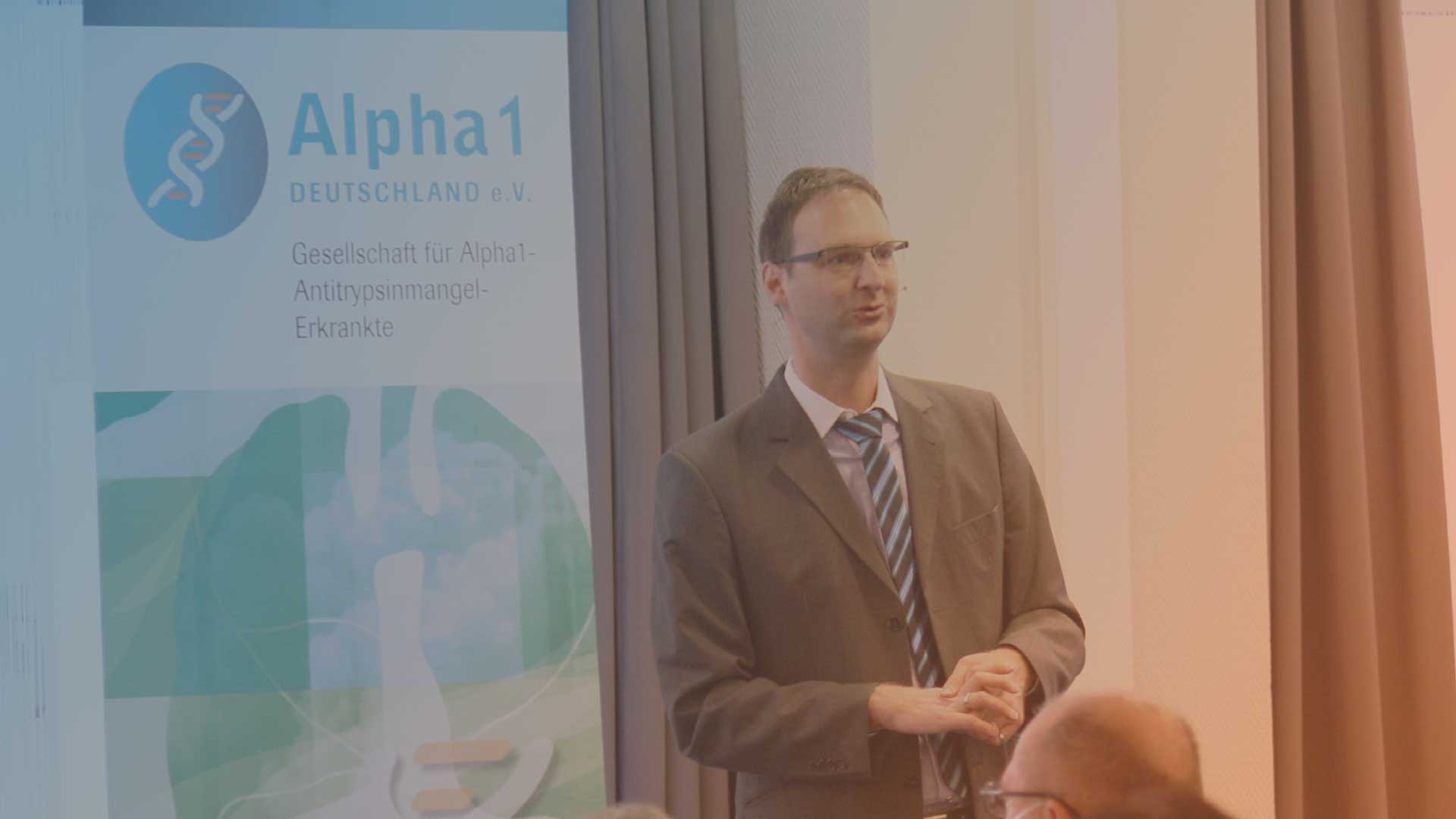
For the past few months, we have been pleased to welcome another scientific expert to our advisory board, and we would like to take this opportunity to introduce Dr. Greulich to our members. He is a senior physician and head of department at the Alpha-1 Antitrypsin Center of the University Hospital of Marburg and a practicing pulmonologist at the PneumoPraxis Marburg. Linda Tietz contacted him with a few questions:
Linda Tietz: Hello, Dr. Greulich! Welcome to the scientific advisory board of Alpha1 Germany and thank you for taking the time to introduce yourself to our members and readers of the journal.
Dr. Timm Greulich: Good afternoon to you as well! I've had some contact with Alpha1 Germany in the past and greatly appreciate your work. That's why I'm delighted to be able to participate.
Linda: Looking at my notes, I urgently need your help to sort through the many activities and commitments you have regarding the Alpha-1 gene defect. First of all, as I see, you are a senior physician and head of department at the Alpha-1 Center at the University Hospital in Marburg and you also work at the PneumoPraxis Marburg, correct? What exactly is a PneumoPraxis?
Dr. Greulich: Thank you for your question. I'd be happy to explain in a bit more detail: As a senior physician at the University Hospital of Marburg, I'm responsible for the laboratory that diagnoses alpha-1 antitrypsin deficiency. We are certainly the largest laboratory in Germany specializing in alpha-1 antitrypsin deficiency and one of the larger ones in Europe. We have over 15 years of experience, during which we recently examined approximately two thousand samples annually for the presence of mutations that can cause alpha-1 antitrypsin deficiency. However, I'm not actually a laboratory physician by training, but a clinician. Therefore, I hold a consultation every two weeks at the University Hospital of Marburg for patients with alpha-1 antitrypsin deficiency. Here, I often address the broader questions, such as whether replacement therapy should be started, whether it's beneficial for certain genotypes, and what the general progression of the condition is like for affected individuals over two, three, or five years. Yes, and then there's the PneumoPraxis-Marburg. That's the pulmonology practice where I currently work as an employed physician, completing three days of my weekly workload there. I enjoy it, and I can easily imagine gradually increasing my involvement at the practice. Nevertheless, it's my firm intention to continue the consultation for alpha-1 antitrypsin deficiency at the university hospital for as long as possible. I'm very curious to see how that goes.
Linda: As a specialist for rare mutations in Germany, you are also active for the Alpha-1 Centers in Germany. What exactly does your work in this area entail?
Dr. Greulich: This is probably like carrying coals to Newcastle, but I'll say it again anyway: Patients with alpha-1 antitrypsin deficiency need doctors who are experts in the diagnosis and treatment of these patients. Such doctors aren't available everywhere, and sometimes they're hard to find. In Germany, however, we are fortunate that they are networked within the framework of the Alpha-1 Centers. Here, they can help each other in difficult cases, refer patients seeking help to a suitable doctor, and thus be of assistance. Fortunately, a year and a half ago, we were able to join the German Respiratory Society and are legally organized as a section of the Respiratory Society. You can find us online at www.alpha-1-center.org/. Together with Professors Koczulla and Bals, I form the board of the section, and I enjoy doing so very much. – Let me say a word here about the rare mutations you also mentioned: Through the Alpha-1 laboratory in Marburg, we have already diagnosed quite a few patients with rare mutations; currently, we have just over 400 patients. However, we lack information about the clinical course of most of these patients. For this reason, we applied to the ethics committee for a study, which was approved, allowing us to collect clinical data and lung function test results from all patients diagnosed with a rare mutation. So, if any of our readers belong to this patient group and have been diagnosed with a rare mutation (that is, all except "M," "S," and "Z"), they are welcome to contact us via our email address (alpha1@med.uni-marburg.de). My esteemed medical colleague, Dr. Peychev, is overseeing this study at our center and will then get in touch.
Linda: Your commitment to researching and testing Alpha-1 extends far beyond Germany. What is EARCO all about?
Dr. Greulich: Even though we've known about alpha-1 antitrypsin deficiency for quite some time now, several important questions remain unanswered. This is particularly true regarding the natural course of the disease. We are repeatedly surprised to see elderly patients who, despite having a homozygous genotype, exhibit only minimal changes in lung function. Conversely, we see patients with the same or a similar genotype whose lung function is already significantly impaired. We believe that larger registries will allow us to collect enough patients to gain a better long-term understanding of which patients experience particularly rapid disease progression and would therefore likely benefit most from replacement therapy, and in which patients the disease remains stable over a very long period. Together with my co-chair, Marc Miravitlles from Barcelona, I am currently leading the European registry through the first three years of its funding period, and we are eager to see what the future holds. At this point, it is very important for me to emphasize that the German registry (under the direction of Prof. Bals) and the European registry are not in competition with each other, but rather complement each other. While the German registry is based on patient-entered data, we in the European registry have opted to accept only data sets entered by physicians. We hope and believe that this dual structure in Germany will even provide us with valuable insights into how the data differ from each other and, if applicable, how they can complement one another.
Linda: What path led you to the scientific advisory board of Alpha1 Germany?
Dr. Greulich: I've had the pleasure of collaborating with Marion Wilkens on and off for several years now. We see each other at the Center meetings and conferences, and we also talk on the phone from time to time. She asked me, and I immediately said yes. I haven't regretted it for a moment.
Linda: Finally, allow me one more personal question. What does Dr. Greulich like to do in his undoubtedly limited free time, and does he share it with his family?
Dr. Greulich: What a wonderful question to end with, thank you so much! I have three daughters aged 12, 15, and 17. With a total of four women at home, there's always a lot going on, and I'm a real family man. I also have a number of hobbies; I enjoy kitesurfing, diving, and I play a little guitar. I don't really know what boredom is.
Linda: Thank you so much, Dr. Greulich, for giving us such a detailed and open insight into your work and achievements. We look forward to your expertise enriching our advisory board and to our future collaboration!


