
Rare Disease Day, updates on the Corona vaccination, meaningful lockdown activities & much more
Author
Alpha1 Germany eV.
On February 28th, the Rare Disease Day, also called Rare Disease Day, this time under the motto „Let there be light„"During this international campaign, buildings of special significance were illuminated in the colors of Rare Disease Day. Several of us also participated in activities for this day; for example, Gudrun Plett called for more plasma donations. And some members of the self-help group in Saxony/Saxony-Anhalt..." Candles in the window posed, while group leader Udo Held explained Alpha1 at an online event in Dessau.
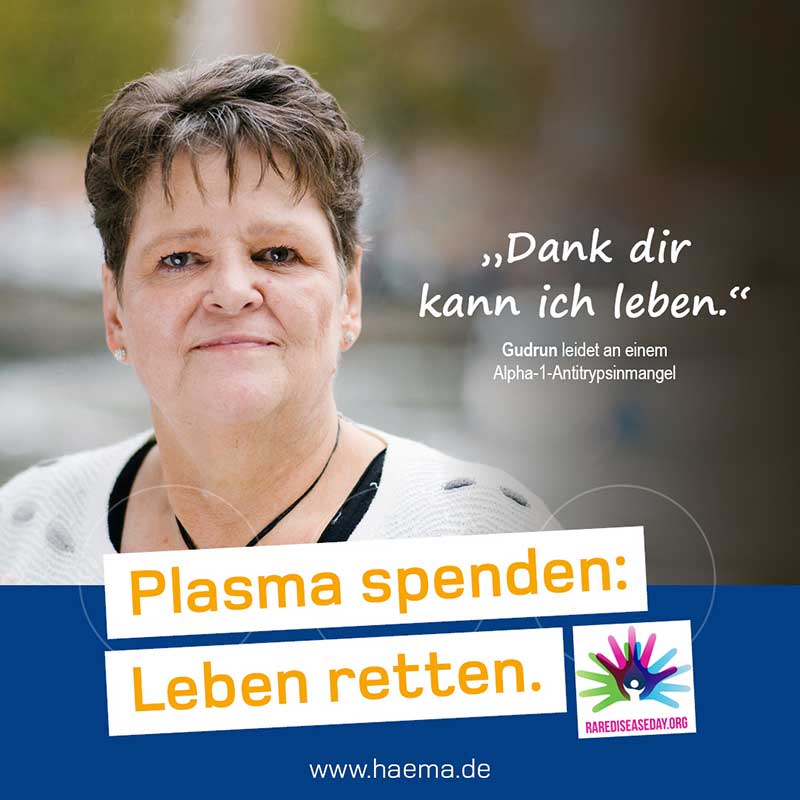
Gudrun Plett with her appeal for plasma donations.
More information on the Corona vaccination
Coronavirus is and remains a topic of discussion; uncertainty is palpable, and we have received many inquiries. Therefore, we would like to address the topic of vaccination again:
Prioritizing the Alphas
To do this, we Alphas need to be divided into four groups:
- Patients with emphysema (or COPD) are currently classified as being in Group 2 according to the Robert Koch Institute (RKI). A confirmation letter from their treating physician is sufficient (as reported in the last newsletter). Although there is no data on an increased susceptibility to COVID-19 in patients with emphysema, caution is still advised to avoid further stressing their already vulnerable lungs.
- Alphas with severe liver or kidney damage are also found in Group 2. The Liver Aid organization offers comprehensive Corona recommendations for people with liver disease.
- Alphas with significant comorbidities (accompanying diseases), since we Alphas belong to the group of rare diseases, can obtain an individual case decision through the doctor and thus be prioritized.
- What remains are the "alphas," those who have no symptoms and are otherwise healthy. Of course, they should also protect themselves from lung damage throughout their lives (hence the recommendations for pneumococcal and influenza vaccinations, quitting smoking, reduced alcohol consumption, and careful planning when choosing a career), but according to current data, they are not at risk of experiencing a severe course of Covid-19. The recommendation to get vaccinated when called upon also applies, but no prioritization is planned.
Naturally, we also discussed this with the Alpha1 specialists (lungs and liver), who also believe that prioritization should depend on the symptoms and not on the deficiency itself.
Reaction to the vaccinations
Based on current knowledge and limited experience, we Alphas do not react to vaccinations any differently than others. Many experience minor reactions (redness at the injection site, mild fever, and fatigue with muscle aches). It should be noted that with mRNA vaccines (such as BioNTech/Pfizer or Moderna), the body often only reacts after the second dose, while with adenovirus-based vaccines (such as AstraZeneca), the body more frequently reacts after the first dose.
The good thing is: if you react, you can see for yourself that your body is dealing with the virus and starting to build up protection.
Which vaccine should we get, Alphas?
All vaccines approved to date are suitable for us according to current knowledge; this applies in cases of severe shortage as well as to people with PiMZ (the only exception being transplant recipients).
Special features for transplanted Alphas
Please discuss the vaccination with the transplant center and your treating physician. Uwe Deter offers a tip: the online seminar on "Vaccination after Organ Transplantation" from the Survival Foundation has been recorded. Here is the link to the event from February 2nd, 2021., where all important questions about vaccination and transplantation are answered.
In fact, we like to use the saying: The main thing is to be vaccinated! Because according to current knowledge, all vaccines provide significant protection against severe cases!
Prof. Tobias Welte (MHH) has clearly and explicitly stated many of these points. in a video brought up.
Are we more susceptible to Covid-19 infection?
An article from America has caused considerable concern, but this cannot be confirmed by data from Germany. As yet unpublished data from a study by Dr. Pavel Strnad show no increased risk, at least for carriers (PiMZ, PiMS), and also that the initially suspected risk does not exist for the PiZZ and PiSZ variants.
Nevertheless: Take care of yourself, continue to be cautious and live according to the AHA rules; as already mentioned, you should not subject an already damaged lung to any further strain.
How does the registration process for a COVID-19 vaccination work?
A report from an Alpha1 member: Friday evening. I'm entering my working hours from my home office when three emails arrive in quick succession. I glance over at my computer and see that my group leader, Heike Isensee, has written. In the preview pane, I read the subject: Vaccination. Find out here what happens next.
Further useful information
- Should you still have any unanswered questions despite the extensive information provided regarding the FFP2 masks If you have questions, you're guaranteed to find the answers on the following pages (tip from Marion Deter): Possibilities and limitations of independently reusing FFP2 masks for private use: To the article.
- Here we show you where you are most likely to become infected: Covid-19 infection via aerosol particles – comparative assessment of indoor spaces with regard to the situation-specific R-value: To the article.
- and where you are less likely to get infected: "Nothing will happen while walking": To the article.
So get out into the fresh air and move around! Our tipArrange to go for a walk together.
Symbolic image
A note from us:
Following joint eHealth workshops organized by the German Respiratory League and several successful online meetings, the initiative "Shaping the Digital Future Together" is now underway. Published in Pneumology 2021; 75: 14–17.
We, Alpha1 Deutschland eV, together with representatives of the German Respiratory League eV, the Association of Pneumological Clinics eV (VPK) and the eHealth working group of the sponsoring association of the German Respiratory League eV, discussed and commented on the health policy framework and application possibilities of telemedicine and digital health applications (DiGA) in the field of pulmonology in an online workshop.
We are breaking new ground: We must not miss out on digitalization!
Our group leader Bernd Dobbert (SHG Cologne) writes to you personally about how he is using his time during the lockdown:
Eventually, the basement was cleaned, all the documents were organized, and all the vacation photos were gathered. What should I do now? I remembered that I'd been toying with the idea of a children's book for a long time. So I sat down at my desk and considered whether I should actually start this project. I wanted to push the daily monotony of the news—lockdowns, vaccination issues, and infection rates—into the background anyway. So, I got right to work. It did take a while before the first lines were written. But then, suddenly, it went very quickly. After six weeks, the text was finished. The first children who read it thought it was okay, but they said it was very boring without pictures. Of course, they were right, but how was I supposed to find an illustrator?.
I made phone calls here and there, and after two weeks, I suddenly had three candidates (two female illustrators and one male illustrator) on the shortlist. It quickly became clear that Theresa and I had the best chemistry. I explained the plot to her and a lot about the background of the story; she researched and delivered initial drafts, all of which I liked very much.
Now, almost six months later, after many discussions, clarifying details, designing a cover, and countless revisions, we were finally able to send the finished work to print. We defied the pandemic, completed a fantastic project, and didn't have a single dull moment. We're currently waiting for the printer's results and are very excited to see the final product. The book, titled "A Chance for Timmy," tells the story of the dog Timmy and the twins Ben and Lara.
It seems we'll have to be patient a little longer, as the numbers are rising and the vaccines... well, no comment. So I've started my next project: a novel about two girls in the Spanish Civil War in 1936 and 1937. The months until the vaccinations will certainly be anything but boring.
Bernd Dobbert, Alpha1 Cologne
If you are interested in his book, please write to Mr. Dobbert at bernd.dobbert@alpha1-deutschland.org to.
Our note: a great project and the result is a wonderful children's book (more information to follow).
News from research
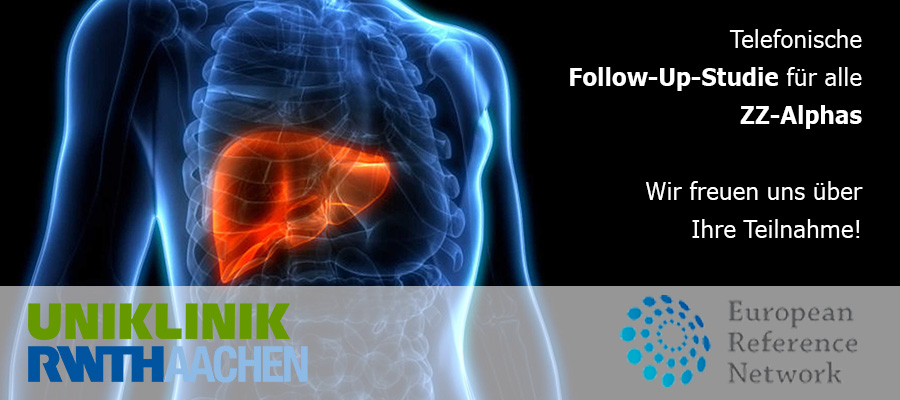
We at the Aachen Alpha-1 Liver Study want to understand how liver involvement progresses in AATD so that we can provide you with clear prognoses. However, this is only possible if we find out what has become of all the participants we have examined over the past six years. Therefore, we want to inform all people with pizza You will be asked in a roughly 15-minute telephone interview how you have been doing in the meantime. The study started in mid-February.
Hotline Tel.: 0241 80-36606. Give us a call! We would greatly appreciate your support!
Your Alpha-1 Liver Team Aachen
Another call to participate:
To learn more about liver disease associated with alpha-1 antitrypsin deficiency, volunteers are currently being sought to participate in approximately 75-minute interviews conducted by a consulting firm. Participants will be compensated for their time and expenses.
If you are interested in participating and meet at least one of the following criteria, please contact us (info@alpha1-deutschland.org) for further information:
- You or your child has been diagnosed with liver disease by a doctor.
- You are a so-called F2/F3 or F4 patient (fibrosis grade)
- They received liver transplants due to Alpha1 deficiency.
Today we would like to say goodbye with the words of Ms. Lichte-Steeger (employee at the AlphaCare patient service), who likes to end her phone calls with:
Think positive and stay negative!


