

Author
Heike Georg, Editorial Team Health Platform leichter-atmen.de. Thus appeared in Alpha1 Journal 1/2022.
If we – as everyone does these days – do a quick Google search, we find a multitude of entries for "breathing therapy," "breathing training," or the frequently used term "lung training." Right at the top of "Doc Google" are phrases like:
- „"Singing is a great breathing exercise" or "Breathing therapy acts like a massage and oxygen shower from within.".
- That's not entirely wrong, but it's not very helpful when it comes to chronic respiratory diseases.
The lungs cannot be trained.
Unlike our heart, the lungs themselves have no muscles. Therefore, we can't really train our lungs. They don't control our inhalation and exhalation; that's done by the respiratory muscles. Approximately 90 percent of the active force during inhalation is generated by our diaphragm. The lungs expand during inhalation, and the diaphragm moves downwards. Exhalation occurs passively in our daily lives without any effort – it can be intensified by contracting the accessory respiratory muscles and the abdominal muscles.
Respiratory muscles: The central respiratory muscle is the diaphragm, supplemented by the intercostal muscles (which raise and lower the ribs, thus causing inspiration and expiration). The internal intercostal muscles are used for expiration during forced breathing, while the external intercostal muscles are used for inspiration.
Accessory respiratory muscles: This includes some muscles of the neck and chest, as well as the abdominal muscles. They can assist with inspiration or expiration as needed.
Air needs pressure differences to move.
During inhalation, the diaphragm contracts. This increases the space in the chest cavity, expanding the lungs. This allows oxygen-rich air (O2) to penetrate even the smallest airways and the alveoli (air sacs). The contraction of the muscles creates negative pressure in the chest cavity, extending all the way to the alveoli.
During exhalation, the diaphragm relaxes; the space for the lungs becomes smaller. A positive pressure is created, which forces the air enriched with carbon dioxide (CO2) out of the alveoli.
Respiratory muscle training and respiratory physiotherapy with aids:
The term "respiratory therapy measures" encompasses both respiratory muscle training, where forced breathing is used to increase strength and endurance, and respiratory physiotherapy, where prolonged breathing is used to reduce respiratory rate and lengthen breaths.
The training specifically targets the muscles and takes place via inhalation, while the physiotherapy specifically targets the airways and is performed via exhalation.
Exhalation needs just as much attention as inhalation.
The O2-CO2 exchange, also known as gas exchange, is vital for us. However, not only is oxygen intake extremely important, but so is the exhalation of CO2. Therefore, the "correct"„
Breathing is so important. Patients with respiratory illnesses, in particular, are often caught in a negative respiratory spiral these days. The fear of shortness of breath or pain leads them to inhale and exhale too quickly. In this case, it helps to lengthen the breathing cycle and/or reduce the respiratory rate. Ideally, exhalation should last twice as long as inhalation; this ensures sufficient CO2 is exhaled.
Overview of breathing maneuvers
Expiratory: Via exhalation
- PEP: Positive Expiratory Pressure
- Function: Prolonged/extended exhalation against resistance
- Effect: Keeps the airways open
- OPEP: Oscillatory Positive Expiratory Pressure
- Function: Prolonged exhalation against changing resistances and resulting vibrations
- Effect: Loosens trapped mucus
- EMT/EMP: Expiratory Muscle Training
- Function: Forced/powerful, rapid exhalation against resistance
- Effect: Strengthens the accessory respiratory muscles (up to the point of abdominal muscle tension)
Inspiratory: Via inhalation
- IMT: Inspiratory Muscle Training (inhalation muscle training)
- Function: Forced/powerful, rapid inhalation against resistance
- Effect: Improves strength and endurance
- OIMT: Oscillatory Inspiratory Muscle Training
- Function: Forced/powerful, rapid inhalation against changing resistances, thereby creating vibrations.
- Effect: Improves strength and loosens trapped secretions.
- ONIP: Oscillatory Negative Inspiratory Pressure
- Function: Prolonged inhalation against changing resistances, resulting in vibrations
- Effect: Improves stamina and loosens stubborn mucus.
A healthy adult breathing at rest often takes only 10-15 breaths per minute. With a respiratory illness, it's common to inhale and exhale 30 to even 50 times per minute. Therefore, prolonged breathing exercises are helpful. Since this type of breathing doesn't involve muscle training, it's also considered a form of therapy. It's important to consider not only the duration of the O2-CO2 exchange but also the lung volume. If the diaphragm's contractile force is reduced, only a fraction of the necessary oxygen can be absorbed during inhalation. Accordingly, the diaphragm's contractile force plays another crucial role. This force can be trained through a forced breathing exercise with appropriate resistance, just like with other muscle groups. This is called respiratory training. This breathing exercise is the opposite of the prolonged maneuver.
Use of aids in respiratory therapy and breathing training
In addition to medication, it is beneficial for patients to support their bodies. Non-pharmacological measures include various options that can make breathing easier overall. These include, among others...
In addition to a healthy diet and pulmonary exercise, targeted breathing exercises are also beneficial – especially when using aids.1 Handheld devices (VRP1-Flutter, RC-Cornet® and RC-Cornet® PLUS, acapella, Choice, Pari-PEP-System, PEP mask), which generate positive expiratory pressure (PEP), are potentially able, on the one hand, to prevent or at least reduce bronchial obstructions caused by instability of the bronchial walls, and on the other hand, to loosen secretions from the bronchial walls through the overpressure and subsequent dilation of the bronchi, which can then be removed from the bronchial tree by huffing.
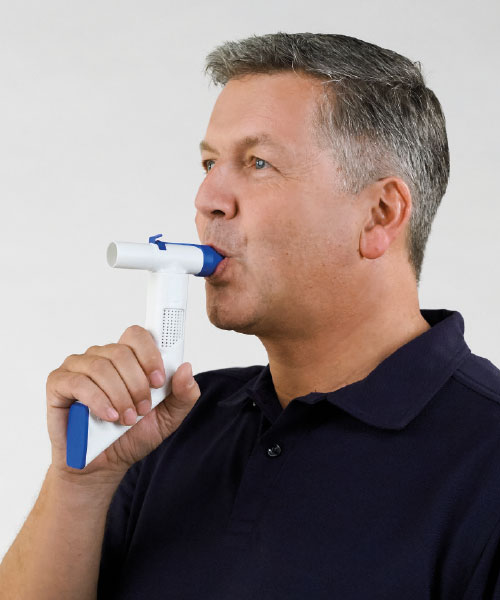
Important: Before you start training on your own, you should definitely discuss your basic suitability and the general conditions with your pulmonologist.
Oscillating therapy devices have proven effective in respiratory physiotherapy, which also aims to loosen secretions. Their vibrations help to loosen mucus, making it easier to cough up, and to open the airways, thus facilitating breathing.<sup>1</sup> The RC-Cornet®/RC-Cornet® PLUS is one such oscillating device, with the advantage of being usable regardless of the patient's position. These therapy devices are reimbursable with a corresponding diagnosis (and can be represcribed annually).
Likewise, there are a variety of breathing trainers on the market.2 Specifically for respiratory patients, e.g., Powerbreath Medic or the RC-FIT® CLASSIC, which combines breathing therapy with training as well as oscillation and relaxation.
In principle, every patient can independently carry out a program of respiratory therapy and breathing exercises at home. With or without aids.
1 Page 279, 6.2.6 Aids for secretion elimination
2 www.leichter-atmen.de/atemtherapiegeraete


