

Author
Heinz Stutzenberger, Alpha1 Deutschland eV, as published in Alpha1 Journal 1/2022.
Under the "Research & Studies" section of our website, you will usually find several calls for participation in scientific studies. These are typically the third and final phase of a standardized procedure for the approval of new medications (a fourth phase after approval is also possible, see below). In this Phase 3, the safety and efficacy of new drugs are demonstrated. It builds on studies in earlier phases, and a Phase 3 study is only initiated if the results of the preceding study phases are positive.
The content of each study phase is as follows.1,2:
Phase 1: Compatibility and safety assessment
- first-time use of the drug in humans to study tolerability, safety and behavior of the active ingredient in the body
- Typically up to 100 study participants who are either healthy or for whom there is no other therapy option (anymore).
- This phase lasts weeks to months.
- Because of the risk associated with the first application in humans, participants are often paid considerable fees.
Phase 2: Verification of effectiveness, determination of appropriate dosages
- In a strictly defined group of up to 500 patients, it will be tested whether and at what dosage the drug is effective for treating the disease.
- This phase also lasts weeks to months.
- Typically, no fees are paid for participation in this phase.
Phase 3: Proof of efficacy and safety
- Investigation of the efficacy and tolerability of the preparation and the evaluation of its benefits, also with regard to the frequency and severity of side effects.
- A larger group of participants, often over 1,000 patients, makes it possible to better assess even less frequent side effects.
- This phase lasts months to years.
- It is often conducted as a randomized, double-blind study, in which
- The participants will be randomly divided into two groups.
- Only one group receives the drug, while the other receives a placebo.
- Neither the study participants nor the study assistants (the participating doctors) know who receives the medication or the placebo.
- Participants will not receive a fee; there will be no financial incentives for participation.
- After this phase, the subsequent steps look like this:
- an intensive evaluation of the present and further study results
- the review of the results by other expert bodies
- and finally the application for approval of the new drug to the competent authority.
- These phase 3 trials are the ones of interest to AATM patients.
Phase 4: Long-term observation to detect side effects
- This only occurs after approval and testing on a large number of patients (often over 1,000).
- It serves to identify rare side effects or interactions with other medications.
- It may also consider specific patient groups, e.g., a particular age group, people with specific medical conditions, and similar factors.
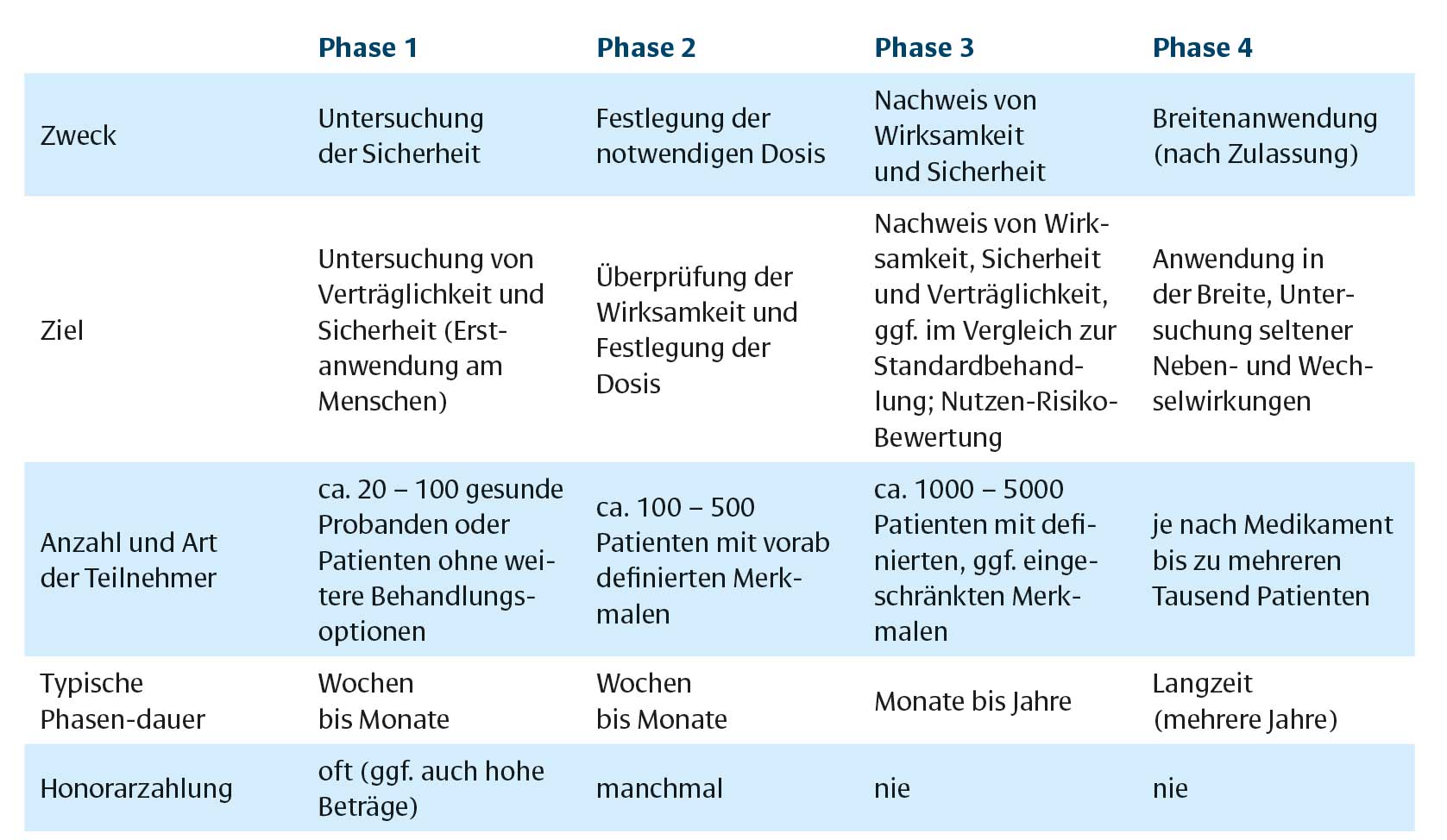
The most important points of each study phase are summarized again in the table below:
As mentioned previously, Phase 3 trials are of interest to AATM patients, usually conducted as randomized, double-blind studies. Anyone seriously interested in participating in a trial will first review the "Patient Information and Informed Consent Form" with their attending physician. This ensures that1
- The potential participant fully understands the clinical trial, including all procedures, possible side effects, and other risks that may be associated with participating in or conducting the study.
- he is aware of his responsibility as a participant in the clinical trial
- all his questions regarding the clinical trial will be answered
- He knows that he can leave the clinical trial at any time without giving a reason.
Relevant questions that should be clarified include:1:
- What is the specific goal of the clinical trial?
- How is the study planned to proceed?
- What accompanying examinations are planned?
- Who is funding the study?
- Will the participant incur any costs by taking part in the study?
- Is there any compensation for expenses?
- Has participant insurance been taken out?
- How much time is required for participation?
- What obligations are associated with participating in the study?
- Is longer follow-up required after the study is completed?
- What are the benefits and risks of participating in the study compared to existing treatment methods?
- What experience is already available for the new therapy method?
- What side effects can be expected?
- Who is responsible for student support?
- Who can be contacted in case of an emergency or if questions arise?
- What data is collected, processed, and stored?
- What restrictions should be expected at the beginning or during the clinical trial (e.g., no pregnancy, no alcohol)?
- What happens if the study is terminated prematurely?
- If necessary: how can the treatment be continued after the end of the study?
Participation in clinical trials: Flexibility and responsibility in the decision-making process
It is reassuring to know that participants can withdraw from the study at any time without giving a reason and without incurring further disadvantages. However, it is important to note that these studies incur very high costs for the initiating pharmaceutical company, and the withdrawal of participants can reduce the study's validity. Therefore, withdrawal should not be taken lightly or factored into the decision to participate. Typically, in the event of withdrawal, the organizers will ask for the reasons and, in particular, whether these are related to the (side) effects of the medication. The withdrawing participant can answer these questions, but is not obligated to do so.
Participants should also be aware that the pharmaceutical company conducting the study aims to generate revenue and profit through drug approval. However, this appears to be a legitimate approach, as it is the only way to ensure research into new drugs, especially those for rare diseases like AATD. Government agencies no longer conduct drug development themselves, but at most provide funding for basic research and Phase 1 and 2 clinical trials.3
Participation in Phase 3 trials: Recognizing opportunities and keeping an eye on risks
However, this aspect also provides an additional level of security for study participants, as pharmaceutical companies go to great lengths to avoid liability claims arising from the development and distribution of unsuitable medications. Despite the unavoidable residual risk associated with novel drugs, we believe that participation in Phase 3 trials offers more opportunities than risks, and we encourage you to seriously consider participating in trials for which you are eligible.
Should someone, after careful consideration, decide to participate in a Phase 3 double-blind study, especially hoping to finally receive an effective drug to control or prevent the progression of their disease, their chances of improved treatment are naturally only 50%, since they could also be assigned to the placebo group with exactly this probability.
But even then, participation still brings him significant advantages, e.g.
- an intensified monitoring of his health and disease progression through the study-accompanying examinations
- the awareness of having made a relevant contribution for those patients who will benefit from the improved treatment after approval.
- possibly also an intensification of the body's self-healing powers as a result of the conscious decision to actively do something for its recovery and to be supported by caring, empathetic companions.4
Sources
- janssenwithme.de, Last accessed January 24, 2024.
- csl.com, Last accessed January 24, 2024.
- bmbf.de, Last accessed January 24, 2024.
- Mende, Annette: Placebottle-medicine with real effects, Pharmaceutical Journal, Issue 51/52/2012.


