

Author
Heinz Stutzenberger, Alpha1 Deutschland eV, as published in Alpha1 Journal 1/2022.
Under the heading "Research & Studies" on our website, you will usually find several calls for participation in scientific studies. If you are considering participating in one of the listed studies, the following information may help you make your decision.
Fundamentals of evidence-based medicine
The foundations of "evidence-based medicine" were developed by the English physician Archibald Leman Cochrane (1909 – 1988), therefore the term "evidence" in this context should not be understood in the German sense of the word ("Evidenz" = obviousness), but in the Anglo-Saxon sense of the word ("evidence" = proof).
A key principle of evidence-based medicine is therefore that only those therapies and/or medications should be used whose effectiveness is so well documented that experts consider it to be clearly established and statistically proven.
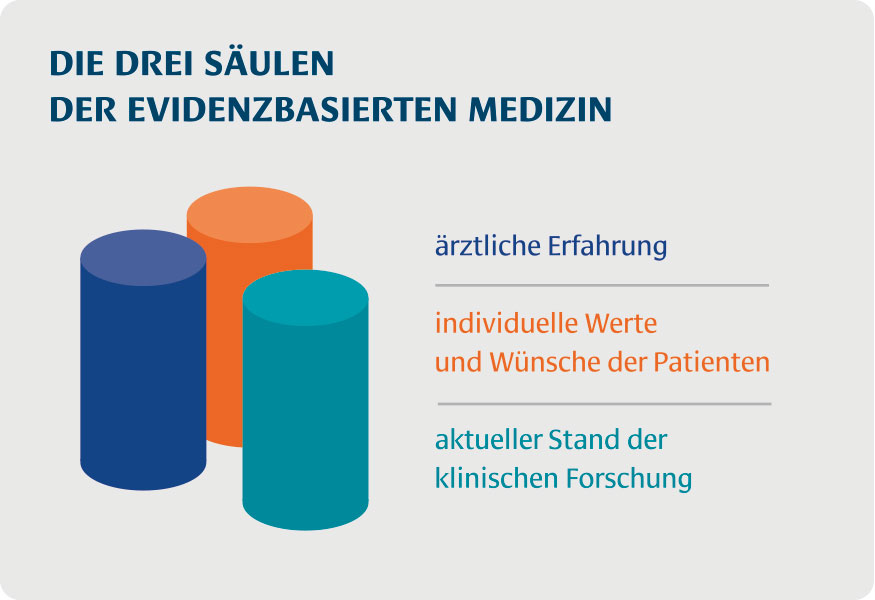
Evidence-based medicine rests on three pillars.1,2:
- medical experience (individual clinical expertise or internal evidence),
- the individual values and wishes of the patients (patient preference) and
- the current state of clinical research (best available external evidence).
Clinical trials often document the current state of scientific research. They are frequently conducted as blinded studies (see below), in which the participants are more or less well-informed about the nature of the administered medications, depending on the type of study.
The structure of such a study is typically as follows:
- First, there is a hypothesis that is to be proven within the framework of the study (e.g.: The vaccine XYZ prevents infection with ABC disease in healthy people aged between 50 and 70 years).
- Then, a suitable and statistically sufficiently large group of test subjects is assembled from individuals who meet the aforementioned criteria.
- This collective is then divided into two groups strictly according to the principle of randomization.
- a group that is treated with the drug under investigation
- and the second group, which is not treated or is treated with an ineffective substance (placebo).
- A study is described as "open" if the patients know whether they will receive the drug or the placebo.
In contrast, the study
-
- simply blind, if the patients do not know which substance they are receiving (test subject „blind“),
- double-blind, when the patients and the treating physician do not know who receives which substance (test subject and research assistant "blind"),
- A study is triple-blind when neither the patients, nor the treating physician, nor those conducting the analysis know who receives which substance (the study participant, research assistant, and evaluator are all "blind"). Only the study sponsor knows who received which substance.3
- At the end of the study, it will be evaluated whether and, if so, how significantly the results differ between the two groups and to what extent the initial hypothesis is supported; a drug (or the vaccination mentioned above as an example) is only effective if the group receiving medication differs significantly from the group receiving the placebo (in the example: there should be significantly fewer infections in the vaccinated group than in the unvaccinated or placebo group).
- Before deciding to participate in a clinical trial, potential participants should carefully weigh the associated opportunities and risks. It's important to note that the stated advantages and disadvantages usually only apply if you are assigned to the group that does not receive the placebo.
Opportunities of evidence-based medicine4
- Opportunities for new therapies: If you participate in a study as a patient, you will receive
- either the best currently known therapy
- or you receive a treatment that the study physicians believe, with good reason, to be more effective or better tolerated than the previous one.
- Intensive care: You will receive particularly intensive care and regular examinations. Doctors conducting a study follow a treatment plan developed by specialists and reviewed by government authorities. This "study protocol" describes what should be done, why, and when. All patients are monitored and accompanied with special care.
- Scientific progress: Last but not least, you personally contribute to the acquisition of further knowledge – perhaps this progress will benefit you during the study, perhaps it will help you and others in the future.
- Compensation – financial remuneration: Often, study participants can be reimbursed for travel expenses. However, you will not receive financial compensation for participating in a clinical trial – for ethical reasons. No patient should be 'persuaded' to participate in a study by paying a large sum of money. Exceptions exist for so-called Phase I trials ('first-in-human' studies), where healthy volunteers test medications that have not yet been clinically proven. In these cases, participants are sometimes paid substantial fees.
Risks of evidence-based medicine4
- New or improved drugs and treatment strategies always involve venturing into uncharted territory, and are therefore associated with uncertainties.
- Nevertheless, you can be sure that as a study participant you will not be exposed to any unnecessary risk.
- The World Medical Association enshrined the principles for the protection of study participants in its Declaration of Helsinki as early as 1964. This includes ensuring that the risks to you as a patient are carefully assessed and weighed against the potential benefits.
- A study must be carefully planned and described in a study plan (or study protocol) that is strictly adhered to.
- Only doctors with special experience are allowed to conduct clinical trials and must treat you with the best known therapy. An ethics committee reviews all of this before the study begins.
We hope this information has helped you feel more confident in your decision-making. The fact that we publish calls for participation in various studies on our website should lead you to conclude that we are generally in favor of participating in scientific studies, taking the aforementioned aspects into consideration.
Sources
- Sackett D. Evidence-based medicine. Lancet. 1995;346(8983):1171
- Sackett D. Evidence Based Medicine: How to Practice and Teach EBM. New York: Churchill Livingstone, 1997
- Wikipedia: "Blind study"„
- Website of the University of Leipzig, Last accessed January 24, 2024.


