

Author
Heinz Stutzenberger, 2nd Chairman of Alpha1 Germany eV, as appeared in Alpha1 Journal 2/2023.
The last two issues of the Alpha1 Journal described the steps towards establishing a European umbrella organization for Alpha1 associations from various countries up to spring 2023. Things progressed rapidly after that, at least until the summer break, when the pace of progress slowed slightly: firstly, because all the country representatives gradually went on holiday, and secondly, because our project coordinator went on maternity leave.
Nevertheless, further progress was made even during this somewhat quieter phase.
We already presented the logo, defined by Working Group 1, in the last issue. Its colorful design symbolizes the diversity and inclusivity of the participating organizations. Based on this, the layouts for the website, the standard slide set, and the office materials (letterhead and business cards) were then finalized.
A preliminary entry page for the website is already complete. It contains basic information about the new organization and will be continuously expanded in the future. Since the website is aimed at national associations, it will initially only be available in English. Individuals should continue to contact their national associations directly, and where none exist, an English-language page offers at least a way to obtain initial information and make contact.
The modified entry page, planned for a later date, will then be designed with strong shades of blue and other colored graphic elements.
Working Group 2 has meanwhile prepared an initial draft budget. Not entirely unexpectedly, the need for establishing and maintaining regular operations for the association, including engaging a service provider to handle routine business, has already proven quite substantial. Securing these funds is the next major task for those involved. Fortunately, the planning process has shown that our former project manager will be available to us again for at least a few months, until she returns to the university in the summer; naturally, this is contingent upon the availability of the necessary funding.
Following this, the communication concept for the initial phase was developed. From the abundance of information channels now available, those must be selected that will make the maximum contribution to achieving the club's goals with the least possible time investment. This process is not yet complete, but for the time being, after intensive discussion and with professional (free!) advice, the following channels were selected. X (formerly Twitter) and LinkedIn These have been designated as additional channels. Anyone subscribed to these channels should definitely check out their performances.
Working Group 3 submitted its draft statutes to a lawyer who is supporting us pro bono, meaning free of charge. Some large law firms agree to this and, within the scope of these mandates, advise not only individuals who cannot afford legal representation, but also, and preferably, charitable organizations like ours. The changes resulting from this consultation were manageable in scope, in contrast to the necessary and sensible additions that ballooned the statutes to over 20 A4 pages. They are written in English; however, for registration in Brussels, they still had to be translated into French.
Afterwards, Working Group 3 had to develop a procedure for establishing the association. The lawyer strongly advised against naming all participating associations as founding members, because the risk of disagreements that could complicate or delay registration increases significantly with the number of participants. We ultimately agreed that the six countries that had significantly contributed to the work in the working groups should also be the founding countries, and these are:
- Belgium
- Germany
- Italy
- Switzerland
- Spain
- United Kingdom
These companies first audited each other to ensure they met the admission requirements stipulated in the statutes; all audits were completed with positive results.
After that, the board positions had to be filled, starting with the chairperson. Besides the talents generally required for such a position, our preferred criteria were: personal experience of being affected (for reasons of credibility), female (like the vast majority of volunteers in our patient organizations), and young (and therefore able to perform the duties over a longer period). And indeed, we found a suitable candidate. The remaining five board positions were filled with active members from the preparatory phase, taking into account the skills they demonstrated during that time. The board now looks like this:
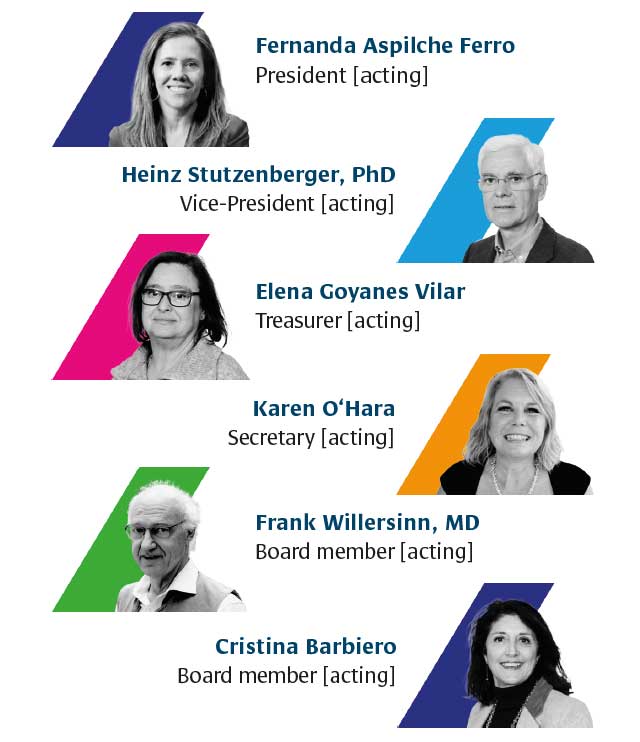
The representatives of the founding associations were then supposed to sign the statutes as a prerequisite for the registration process. It now became clear that the lawyer's advice to limit the number of founding members had been very wise: while five signature sheets arrived in Brussels within a short time, one was delayed in the mail for unknown reasons, so the planned registration date had to be postponed.
Then, on October 17, 2023, the time had finally come: our Belgian colleague, together with our lawyer, submitted the signed articles of association and received a registration number. Thus, the Alpha-1 Europe Alliance was founded.
Shortly afterwards, the next big step could already be taken: our preliminary website It could be activated and put online.
Parallel to the founding of the association, other members were able to apply for membership in the umbrella organization; this opportunity was taken up by associations from Denmark, Portugal, Austria, and Romania, and a foundation from Spain that is also active in South America. These organizations were also audited to ensure they met the admission criteria, and their admission, based on the recommendations of the board members derived from the audits, is scheduled for the first general assembly. Associations with boards elected from among their members can be admitted as full members; foundations whose boards are appointed by the foundation council and are therefore not democratically legitimized can become associate members without voting rights.
In our sister organization in Ireland, a change in management occurred concurrently with the activities described above, preventing the timely submission of the application documents. However, our Irish colleagues have made it very clear in writing that they wish to join the alliance and will submit the application documents as soon as the successor has been fully integrated into the management team.
It is somewhat disappointing that several countries that expressed interest in membership during the early stages of the project have not applied, namely France, Greece, the Netherlands, Poland, and Sweden. We can only speculate about the reasons, as our contacts are not responding to our inquiries; we fear that, at least in some cases, the silence is due to an escalation of the national representative's illness. Furthermore, we expect that through effective advocacy at the European level, we will be able to persuade one or two more of them to apply for membership.
All founding members and prospective members are now looking forward to the first general assembly, which will take place on Monday, November 27, 2023, in Barcelona. It will be part of a two-day program that includes presentations on topics related to the supply of alpha-1 antitrypsin from blood plasma, as well as visits to the Grifols Museum and a blood plasma product manufacturing facility. We will, of course, keep you informed about everything you need to know and our experiences at these events.


