Author
Marion Wilkens, Chairwoman Alpha1 Germany eV.
The Department of Internal Medicine V of Saarland University Hospital (UKS), headed by Prof. Dr. med. Dr. rer. nat. Robert Bals, has been running the Alpha1 Registry in Germany since 2010 for both adults and children and adolescents.
It is not easy for researchers to obtain enough study participants or even data for a rare disease, which is why registries are extremely important. Every person affected by alpha-1 antitrypsin deficiency should actively participate in improving treatment options by registering in a registry.
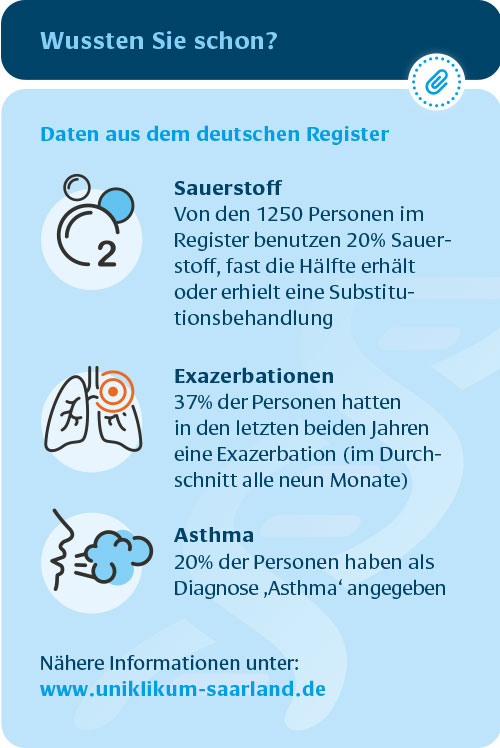
Professor Bals compiled some interesting data from the registry for us (see blue box on the right). What we learn here is that we need to look not only among COPD patients, but also among asthmatics – we've always suspected this, but now it's been confirmed by data.
We are fortunate to have an Alpha-1 registry in Germany, although we would like to see more active participation. To be honest, children and adolescents were only included incidentally – their data was hardly analyzed. This is understandable, as the pulmonology department at Saarland University Hospital (UKS) is primarily an adult center. This is now set to change by transferring the children's and adolescents' registry to Bonn, under the direction of Professor Dr. Rainer Ganschow. We welcome this transfer to a dedicated children's center, which will undoubtedly expand the dataset for children and adolescents. Identifying early on what can influence the course of a disease offers us all an opportunity for more individualized and effective treatment.
It is important to ensure that the exchange of data between registries continues in the future, because, as we know, children grow into adults. We face this issue generally, as we also have a registry/study at the University Hospital RWTH Aachen. This study focuses on the liver, but it also collects a great deal of other valuable data from outside the liver.
But that's not all; a European EARCO registry will also be established in the future. Several countries are already actively collecting data from Alpha-1 patients, with more than 250 patients already included. Germany is currently in the approval process; the ethics committee still needs to give its consent.
The aim of the EARCO registry is to collect standardized longitudinal data at an international level in many different centers, which are needed to evaluate the following findings:
- The natural course of the disease
- The influence of risk factors
- Other genetic factors
- The role of substitution therapy in the
- Prognosis of the diseases
The main inclusion criterion is: severe AATD, defined by an AAT serum level < 50 mg/dl and/or a proteinase inhibitor; genotype ZZ, SZ and compound heterozygotes or homozygotes of other rare deficient variants (non-M).
This means that not all alphas are registered here either; for example, 'normal' MZs are not eligible. The data can only be entered by the center; the patient does not have the option to register themselves. The advantage: the data is secure and, due to the annual follow-up, scientifically very meaningful.
There are other registries, not exclusively focused on Alpha-1, that we could use for our condition, such as the Population Registry. This international registry aims to record as many people as possible affected by rare lung or respiratory diseases. Prof. Dr. Thomas OF Wagner, Medical Director of the Frankfurt Reference Center for Rare Respiratory Diseases and Coordinator of the ERN-LUNG Consortium, sees great potential in the registry: „Patient registries are important tools for supporting clinical research in the field of rare diseases and thus improving healthcare in the long term. With the help of the Population Registry, we are taking an important step towards providing better care for patients in the future.“. The Population Registry is available here in German and English.
Registers are extremely important; a lot of data can have a significant impact. From our perspective, the focus should absolutely be on ensuring that the collected data/registers can be interconnected. Far too little importance is currently attached to these interfaces!