
Author
Gabi Niethammer, as appeared in Alpha1 Journal 2/2025.
What exactly is social media? Annkatrin Siegl in conversation with Gabi Niethammer
Social media – this term has been circulating in our ever-accelerating world for years. But what exactly is it? Alpha1 Germany is fortunate enough to have found someone who will support us with this complex topic. But have we really found them?
Here is their story:
Gabi: Hello Annkatrin, how lovely that we're talking on the phone and that you're introducing yourself. How did you come to join our club?
Annkatrin: My family lives in a small town in Baden-Württemberg. For the past ten years, my mother suffered from severe liver problems, the cause of which could not be diagnosed. What particularly affected me was that she was constantly blamed – even though she had lived a very healthy life and didn't drink or smoke. This spring, my mother passed away at only 64 years old. The homozygous alpha-1 antitrypsin deficiency had only been discovered 14 months earlier. So much struggle, pain, and sadness! So much wasted time – time that could have been used to pursue targeted therapy and fight the true cause, the genetic defect. I work in marketing and PR, so raising awareness and informing the public is part of my daily work. To cope with my mother's death, I began searching for organizations that deal with AATM and came across the Alpha1 Foundation in America and the Alpha1 Europe Alliance. They then referred me to Alpha1 Germany.
Gabi: Now, the special thing is that you live in London. Can you tell us a little bit about it?
Annkatrin: Ten years ago, I moved to London for my master's degree and stayed. Now I'm 35 and I love it here so much that I don't plan on moving back to Germany anytime soon. I mainly work in the music industry, which is very exciting and varied, but often means working late into the evening due to artists' performances.
Gabi: What do you do for Alpha1 Germany?
Annkatrin: About three months ago, I took on the topic of social media, in particular the development of Instagram and LinkedIn for the club.
Gabi: I'm going to admit I'm completely clueless. Can you shed some light on what these two platforms are all about, especially for the club?
Annkatrin: LinkedIn is a more professional platform where doctors, medical companies, and researchers can find information about Alpha-1 and link to it on their own sites. I would say that it's primarily used by adults; private exchanges are rare. Instagram offers the opportunity for direct exchange among patients and is also suitable for teenagers. Linking to private content is possible. Success on both platforms can be measured analytically, and I'm pleased that Alpha1 Germany already has 300 followers (regularly interested users) on Instagram, with each post receiving 15–30 likes. What's special is that we achieve this organically and authentically, without spending any money. The challenge on Instagram is to present the content in bite-sized pieces and simple language to maintain the readers' attention. We do this, for example, with our monthly post "Alpha-1 Knowledge," where we convey essential basic knowledge concisely and clearly.
Gabi: Thank you! Now I understand the purpose of the two platforms and their differences much better, and I'm excited to see how they develop. It's great that you regularly choose, write, and post content in your free time. Speaking of free time—what do you enjoy doing?
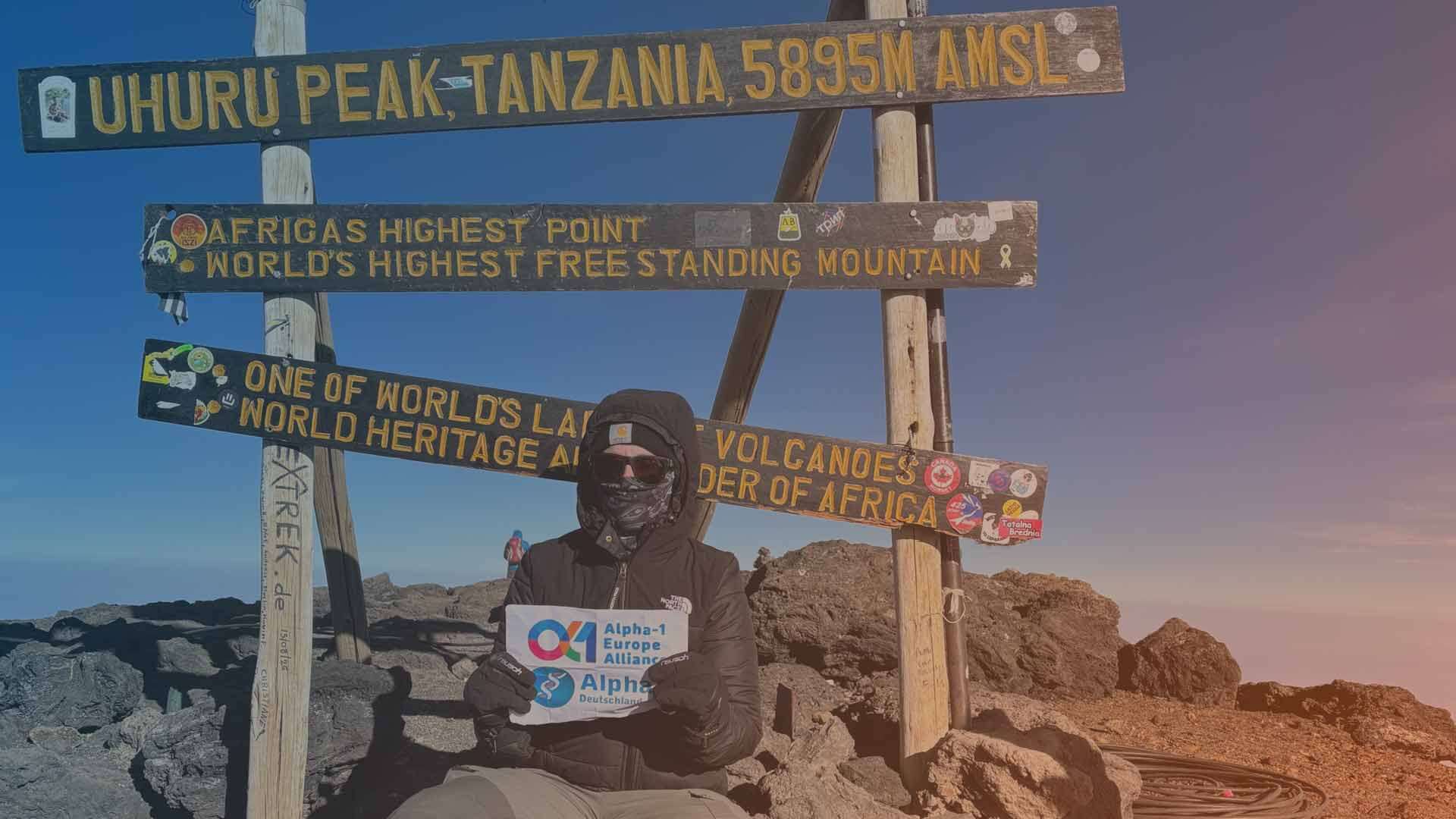
Annkatrin: I do a lot of hiking and boxing, I also enjoy reading and love video games. After my mother's death, I finally did something I had planned for three years but hadn't been able to do because of her illness: I climbed Kilimanjaro and had my picture taken at the summit with the logos of Alpha1 Germany and the Alpha1 Europe Alliance. As a carrier of the genetic defect, I wanted to show that it's possible to reach for the stars, which seem very close at 5,895 meters.
Gabi: Uaohh! Dear Annkatrin, what do you wish for in your voluntary work for Alpha1 Germany?
Annkatrin: Due to a lack of knowledge, my mother did not receive proper treatment. To prevent this from happening again and again, my greatest wish is to educate as many people as possible about this genetic defect – both those affected and medical professionals. To achieve this, my goal is to double our reach within a year, and to make this happen, I ask you all to support the association and me by sending me content, be it patient stories, personal accounts, or letters to the editor.
Gabi: I gladly join this appeal and thank you very much for your time and the very nice conversation.


