
Author
Heike Isensee, as published in Alpha1 Journal 1/2026.
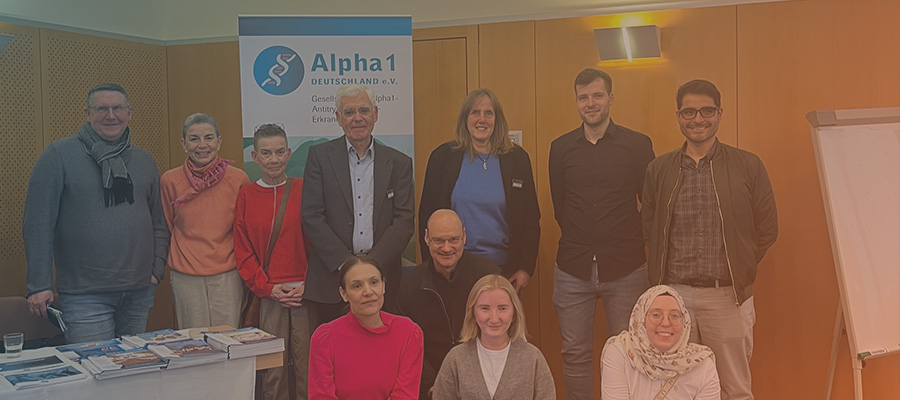
On March 7th, at the invitation of Professor Trudzinski and her team, the 4th Patient Information Day took place in Heidelberg. It was very well attended.
We participants were treated to a very informative program. The clinic's medical and scientific staff gave engaging and easily understandable presentations on various important topics related to Alpha1. Dr. Ersöz spoke about the current state of research and the fundamentals of Alpha1. This was important, as several newcomers were among the participants. Information on bronchiectasis, as well as its diagnosis and treatment, was also fascinating. Dr. Heinz Stutzenberger, second chairman of Alpha1 Germany and the European Alpha1 Alliance, reported on the association's tasks and services, information channels, study support, and much more that characterizes the patient organization. During this time, the two new group leaders of the regional self-help group Rhein-Neckar-Odenwald introduced themselves. Sisters Christine Stukkan and Luise Behrens shared their own moving experiences with the disease. They are passionately committed to supporting other affected individuals. The first regional meeting is already planned – on July 18, 2026, in Heppenheim.
To get some fresh air, a short break in the newly designed clinic garden followed, along with the opportunity to do some breathing exercises and stretching. After coffee, the session continued with renewed focus. Dr. Höger had much to report on new therapeutic approaches for Alpha-1. Substitution therapy is not, in fact, the ultimate perfect solution for our condition. Numerous research projects are underway to find a therapy or cure using various approaches. Dr. Höger also spoke about research approaches that had failed. There is certainly hope for the future.

Dr. Olivares, head of the Center for Clinical Studies, spoke about ongoing studies and new projects in which the Thorax Clinic collaborates closely with other institutes and clinics, such as the University Hospital in Hanover. He presented a new method for examining the airways: oscillometry. This new device also allows for the examination of lung function, for example, in children, people with weakened immune systems, or patients who are unable to perform the breathing exercises during standard body plethysmography.
Ms. Rahel Weber presented her master's thesis in the field of healthcare research – a very interesting perspective. Previously, no one had explored the question of how patients experience self-administered therapy at home. This begins with the decision-making process, examines the advantages and disadvantages, concerns, challenges, and also the pride of success. Even everyday problems are addressed, such as the question of obtaining supplies (if I can't get an IV stand, I'll just hang my IV bag in a tree...). We will certainly hear more about this topic.
Dr. Ersöz then gave another presentation on her award-winning doctoral thesis, which focused on gender-specific differences among individuals with Alpha-1 autoimmune disease. For this research, data from the EARCO study were analyzed, and numerous patients were interviewed on various topics. And indeed, significant differences were found. It was fascinating to learn about these facts.
At a concluding lunch, there was an opportunity to ask all the doctors any questions that hadn't been answered earlier. It was wonderful that the Thorax Clinic team dedicated so much time to the participants. They could also try out oscillometry measurements. Representatives from CSL Behring, to whom we extend our gratitude as a sponsor of this event, were present with a booth and a wealth of information. And, of course, there were many conversations among the patients themselves, leading to a helpful exchange of experiences. A truly successful event.


