
Disability ID card with Alpha1 – what you should know about it
Author
Heike Isensee
First of all: In 2020, 7.9 million people in Germany were severely disabled. It definitely makes sense to apply for a disability card as soon as possible if, for example, you are diagnosed with alpha-1 antitrypsin deficiency (with functional limitations!).
What is a severely disabled person's ID card?
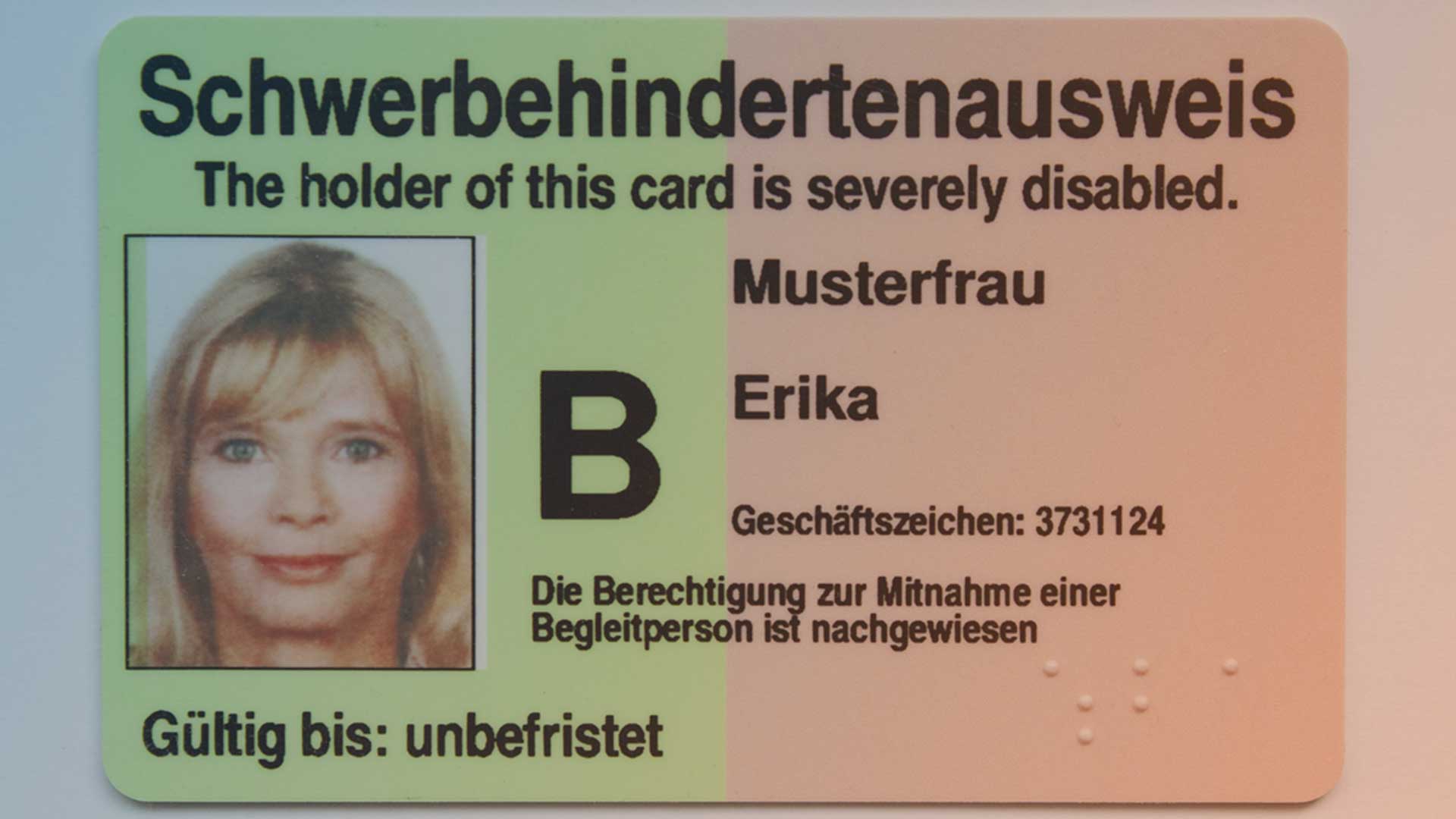
A severely disabled person's ID card is a credit card-sized document that indicates the degree of disability. This is referred to as the degree of disability (GdB). A severely disabled person's ID card is only issued with a GdB of 50 or higher!
Furthermore, the ID card can include certain so-called special markings. For us Alphas, this usually means the marking "G", which indicates that our mobility in road traffic is significantly restricted. This marking can be found on the back of the ID card along with the degree of disability (GdB).
There are other disability markers, such as "B", which indicates the right to be accompanied by an attendant, or "aG" for a severe walking disability. Further markers for blindness, deafness, etc., are hopefully not relevant for our purposes.
The certificate also indicates its validity period, which can be found below the holder's photo. For example, in cases of cancer, the certificate is usually issued with a validity period of 2-5 years. However, since alpha-1 antitrypsin deficiency is a disease with no expected cure, the certificate is normally valid indefinitely.
How do you obtain a severely disabled person's ID card?
You must submit an application for a determination of your degree of disability. The application is submitted to the relevant authority, which varies depending on your state. This could be, for example, a district office or a social welfare office. You can find the address either at your local citizens' registration office or online. Application forms are available directly from the office or online.
You also need a passport photo.
And here we go.
First, it's a good idea to read through the instructions and information sheet that accompany the application. It's helpful to have examination records or doctor's letters at home (or, for example, old medical bills if you're a private patient). Hospital reports, expert opinions from rehabilitation, lab results, X-ray reports, etc., are also useful. The information from your most recent lung function test is particularly important! It's essential to include copies of these with your application (the more documents, the better...).
Now, list all physical, mental, and/or psychological health conditions that have been present for more than six months and the resulting functional impairments. All of these are important for determining the degree of disability (GdB). This means that if there are any problems other than alpha-1 or lung function limitations, it is crucial to list them all. The respective treating physicians or hospitals must be named and released from confidentiality so that the authorities can obtain information from them. It is advisable to inform the respective physician beforehand that follow-up questions may arise to clarify the details. Processing time To shorten the form somewhat, if the space provided is insufficient for listing the treating physicians, clinics, etc., an additional sheet with this information can be attached. No doctor or therapist should be omitted.
Once everything is filled out, the "document" (with passport photo) is sent to, for example, the district office (preferably by registered mail), and then it's a matter of waiting patiently... Processing takes several weeks to months.
One more comment:
If you are unsure about how to fill out the application, you can get help from, for example, the VdK (social advice service) – or from our advisor Ursula Krütt-Bockemühl.
How is the degree of disability (GdB) determined?
The processing authority commissions a medical report. This report is based on the "Disability Assessment Ordinance with its Principles of Disability Assessment." This ordinance specifies percentage degrees of disability or impairment for every conceivable impairment.
When several health impairments occur simultaneously (e.g., impaired lung function, depression, and a damaged knee), the individual percentages are not simply added together. Instead, an assessment is conducted to determine the extent to which the individual functional impairments affect each other. The calculation always starts with the most severe impairment, i.e., the highest single degree of disability (GdB), and then considers the other problems in relation to the primary impairment.
Sometimes, however, the following don't happen. comprehensible Results are emerging. It should be noted here that an appeal should be filed immediately against a disability rating that feels too low. The VdK (Social Association of Germany) can again assist with this – or you can contact our advisor, Ursula Krütt-Bockemühl.
For us Alphas, Chapter 8 (Chest, lower airways and lungs) from the basic principles of healthcare is important, but Chapter 9 (Heart and circulatory system) can also be significant.
The regulation specifies the percentage of the degree of disability (GdB) depending on the impairment. This is then referred to as a GdS (degree of damage).
Under point 8.3, diseases of the respiratory organs with permanent impairment of lung function, the following is listed:
- Mild degree: shortness of breath exceeding the usual level during moderate exertion (e.g. brisk walking 5-6 km/h, moderate physical work), static and dynamic measurements of lung function tests up to 1/3 lower than the target values, blood gas values within the normal range => results in a degree of disability of 20-40.
- Moderate severity: shortness of breath exceeding the usual level even during light everyday exertion (e.g. walking at 3-4 km/h, climbing stairs up to one floor, light physical work); static and dynamic measurements of lung function tests up to 2/3 lower than the target values; respiratory partial insufficiency => results in a degree of disability of 50-70.
- Severe degree: Shortness of breath even with the slightest exertion or at rest, static and dynamic measurements of the lung function test more than 2/3 lower than the target values, global respiratory insufficiency => results in a degree of disability of 80-100.
After a lung transplant, the patient must wait for the healing process to complete. For two years, the degree of disability (GdB) is set at 100. After that, even with a favorable recovery, the GdB is set at a minimum of 70. This information can be found in section 8.4.
Sleep apnea syndrome, for example, can also be included in the calculation of the degree of disability (Chapter 8.7).
What advantages do I have with a severely disabled person's ID card?
The benefits received with a severely disabled person's ID card are referred to as compensation for disadvantages. The following apply from a disability rating of 50. (With a lower disability rating, no ID card is issued):
- Employees are entitled to an additional 5 vacation days (based on a 5-day work week).
- There is increased protection against dismissal; overtime is not permitted.
- It may be possible to retire two years earlier (this only applies if you have paid into the statutory pension insurance for at least 35 years). The situation regarding early retirement is complicated; you should seek advice from the pension insurance institution, the VdK (Social Association of Germany), or another social welfare advice center.
- One has the right to maintain or obtain a workplace suitable for people with disabilities (i.e., the workplace must be adapted to the respective health impairment).

- Severely disabled individuals with the disability markers G, Gl, Bl, aG, or H are entitled to free use of local public transport (excluding, for example, ICE trains). However, a pass must be purchased from the district office or the relevant authority. In Baden-Württemberg and Hamburg, for example, this pass costs approximately €80 for one year. Severely disabled individuals with the disability markers G or Gl can alternatively claim a reduction in motor vehicle tax. If the disability marker aG, Bl, or H is also present, motor vehicle tax exemption can be claimed in addition.
- Many places, such as museums, theaters, cinemas, swimming pools, parks, etc., offer discounted admission. Automobile clubs also offer discounts on membership fees (attention ADAC members). And a BahnCard (German Railcard) is cheaper if you ever want to travel by ICE train…
Above all, there are tax advantages. The tax-free allowance for income tax depends on the degree of disability (GdB). For 2020, the tax-free allowances are as follows:
- GdB 25/30 310 Euro
- Disability rating 35/40, 430 euros
- GdB 45/50 570 Euro
- GdB 55/60 720 Euro
- GdB 65/70 890 Euro
- GdB 75/80 1060 Euro
- GdB 85/90 1230 Euro
- GdB 95/100 1420 Euro
From the 2021 tax year onwards, these amounts will be doubled, and tax allowances will apply starting at a disability rating (GdB) of 20. It should be noted (also for the 2020 tax year) that for disability ratings of 20-45, the tax benefits only apply if one receives statutory pensions or other comparable regular payments, if it is a typical occupational disease, or if there is a severe restriction of physical mobility. Otherwise, the benefits only apply from a disability rating of 50.
ACHSE Information Sheet: Assessment Procedure for the Degree of Disability

I have a disability rating of 30-45 – what does that mean?
With a disability rating (GdB) of 30-45, you can apply for equal status with severely disabled individuals with a GdB of at least 50. You submit the application to the employment agency responsible for your place of residence. They will also provide you with the application forms. These forms, along with a copy of the assessment from the social welfare office/district office, should be completed and sent to the employment agency.
Equal status brings the following advantages: Employees have special protection against dismissal and the right to a workplace adapted to their disability. They may also benefit from support services such as integration services. Employers receive a wage subsidy.
However, equality does not result in additional vacation days, it does not allow for earlier retirement, and there is no possibility of free use of public transport.
What else should you consider?
With a severely disabled person's ID card bearing the letter G, you are not allowed to park in disabled person's parking spaces.
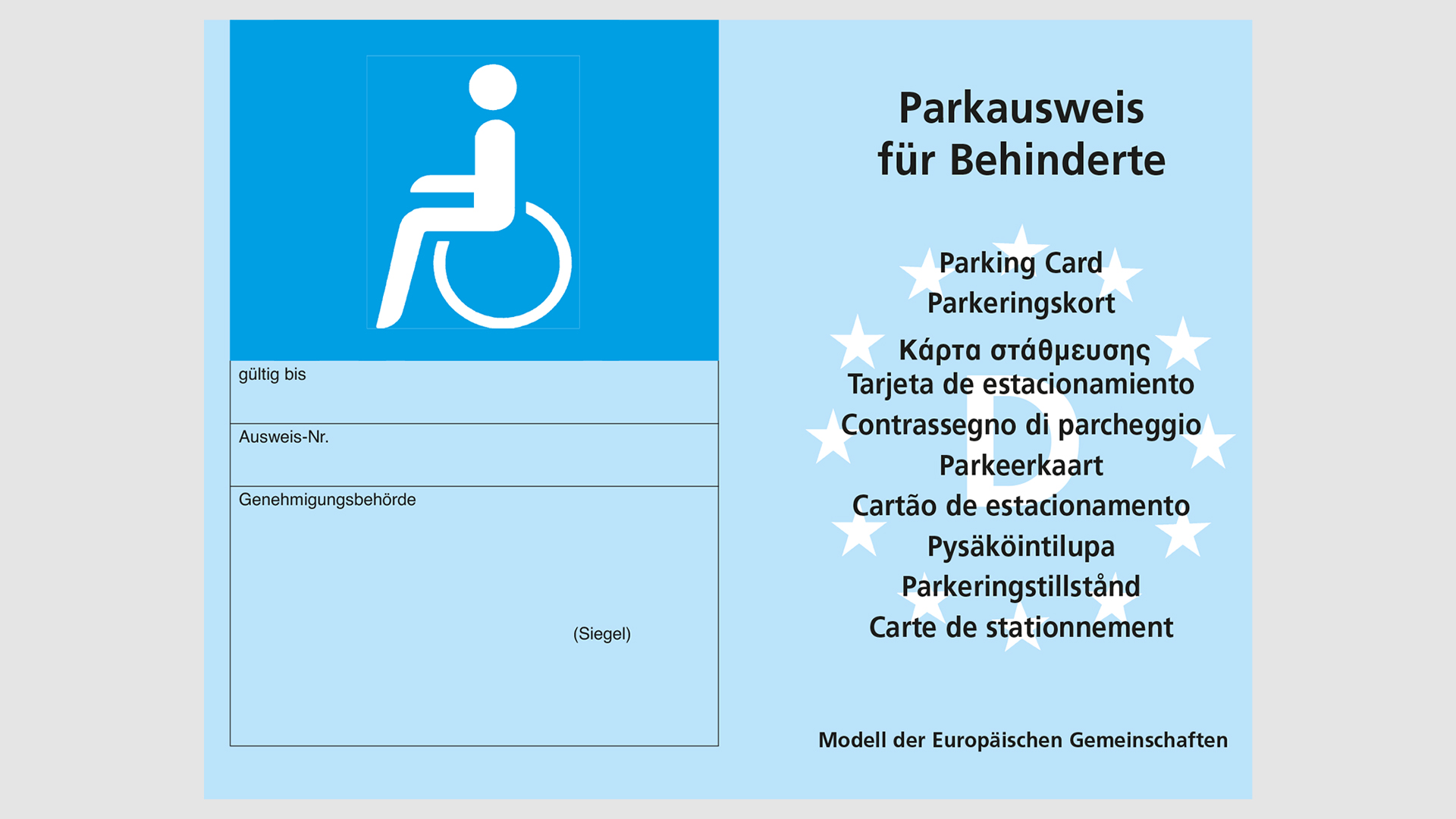
Addition by U. Krütt-Bockemühl: You need the blue parking permit for this:
To obtain the blue parking permit, which entitles the holder to park in disabled parking spaces, a disability rating of at least 80 (based solely on lung function) and the "aG" designation are required. The blue parking permit also entitles the holder to apply for a reserved parking space at their place of residence or work. The blue parking permit is valid internationally.
In some municipalities, there is also a regional orange parking permit. This requires a disability rating of at least 50 for functional impairments of the heart or respiratory organs, as well as the disability markers G and B. The permit authorizes parking for up to three hours in areas with restricted parking (parking disc required!). It also allows parking for up to three hours in residents' parking spaces (parking disc required!). Parking is permitted at parking meters and ticket machines without charge or time limit.
On public transport, the severely disabled person's ID card is only valid together with the supplementary ticket.
If the state of health deteriorates, an application for a reassessment of the degree of disability must be submitted.
I have tried to provide an understandable overview in this article of the topic of disability identification cards, which can seem daunting to some. I myself have a disability identification card and am glad I applied early. I am not a specialist lawyer in social law or anything similar, and I ask for your indulgence if some of the language is a bit informal. If a specialist in this field notices any errors, I would appreciate feedback and understanding. I have written this article to the best of my knowledge and after extensive research, and I hope it will be helpful to readers.


